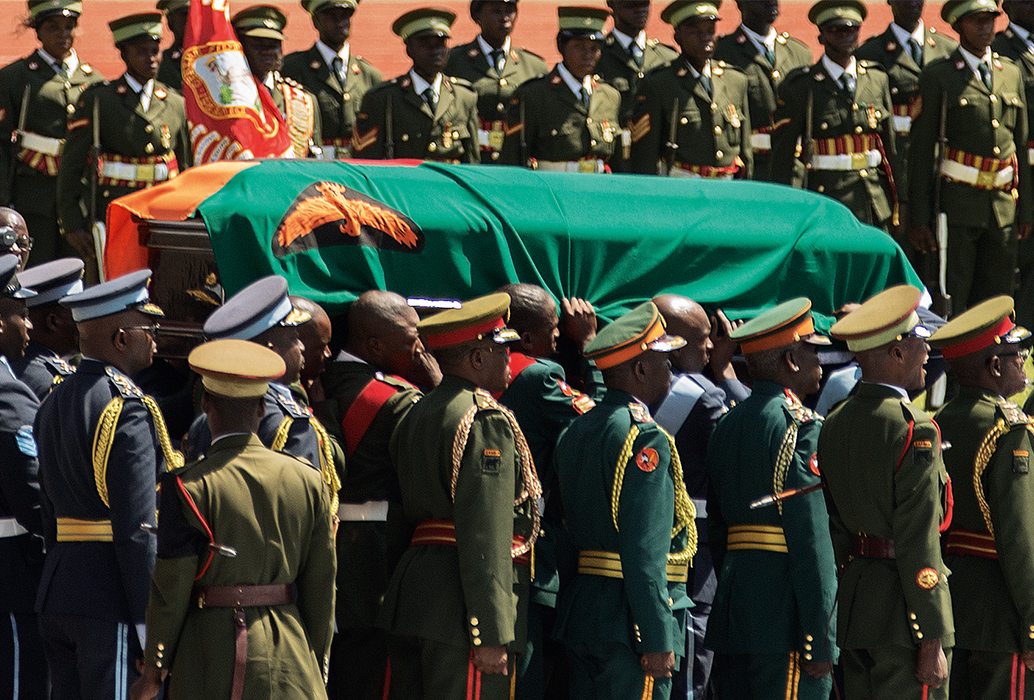
Zambia will hold presidential elections next month, following the death of President Michael Chilufya Sata a few days after the country’s 50th independence anniversary celebrations. But even as the country mourned his passing, battle lines were being drawn in the succession struggle within the ruling Patriotic Front. What next after the death of “King Cobra”? Reginald Ntomba reports from Lusaka.
The country’s Golden Jubilee celebrations had hardly subsided when Zambia went into mourning, just four days after independence day. On 28 October, news broke that the much loved, charismatic leader and Zambia’s fifth president, Michael Sata, had died in a London hospital of an undisclosed illness.
“King Cobra”, as he was popularly known due to his sharp tongue, is the second Zambian president to die in office. Levy Mwanawasa died in a French hospital in 2008.
President Sata’s death was not unexpected, as he had been ailing for some time. Despite public concern about his deteriorating health earlier in the year, the government insisted the president was fine and working. So when he died, their denials simply caught up with them.
The 77-year-old president was a giant figure who graced Zambia’s political landscape for over 30 years. A product of grassroots politics, he boasted of having traversed the entire terrain, as he rose through the ranks, serving as councillor, governor, member of parliament, and minister in several portfolios. He quit government in 2001 to form the Patriotic Front (PF) after failing to succeed Frederick Chiluba.
Sata did not win the presidency in 2001, 2006 or 2008. But being a tough and tireless campaigner he pressed on and destiny finally gave him what he wanted when he scooped it on the fourth attempt in 2011. This tenacity earned him praise from admirers and critics alike.
“If I were him, I would have given up but he didn’t,” remarked his priest, Fr. Charles Chilinda of St. Ignatius Catholic Church in Lusaka. Throughout his ten years in opposition, Sata highlighted the plight of the poor and built a strong bond with this segment of voters who saw him as their messiah. Many tributes noted his being at ease with ordinary people.
“I will remember him as a gallant son of Zambia who dedicated his entire life to uplifting the lives of the poor,” said Emmanuel Chenda, cabinet minister and a close associate who worked with him for 34 years.
“He always told us that we should leave this world better than we found it.”
Charismatic and abrasive, Sata commanded a cult-like following and had his own way with the masses. This was testified to by the outpouring of grief at the grassroots level.
A key figure in the national epic, he was a highly visible and skilled political operator who used the press effectively to assert himself as a “man of action”, a tag he acquired for his forthright and energetic approach to public affairs.
After two weeks of national mourning, Sata was buried on 11 November at Embassy Park, the presidential burial site in Lusaka. Presidents, vice presidents, former presidents, prime ministers, speakers of parliaments, the African Union, royals, and several other dignitaries from around the world attended his funeral.
His close friend, Zimbabwean President Robert Mugabe, who received a rousing welcome at the funeral, described Sata as “a man of the people of Africa”. African Union Commission Chairperson, Nkosazana Dlamini-Zuma, remembered Sata as a frank person. “Whether in Tokyo or Brussels, he spoke his mind.”
What next?
The strength, visibility and brand of the ruling party revolved around Sata. His death created a free-for-all atmosphere, as there had been no clear succession plan. The infighting that had characterised the party for over a year only provided a foretaste of what would happen when Sata – the glue that held the Patriotic Front together – was no longer there.
A few days after taking over the leadership of the party and country, Vice President Guy Scott fired the secretary general Edgar Lungu.
That instantly sparked protests from party members. Scott gave in and reinstated Lungu the next day. Scott’s move had the unintended consequence of testing Lungu’s popularity in the party.
Before he travelled to London for treatment, Sata had appointed Lungu acting president. But after Sata’s death, the cabinet swiftly handed power to Scott. This raised a legal debate, because in all the three years he was in power, Sata never appointed Scott acting president due to his constitutional ineligibility to run for president. The Attorney General and other legal experts insisted Scott was the right person to act as president on Sata’s death.
Some party members believe that by leaving Lungu in charge of the country, Sata had more or less endorsed him as successor, a view furiously rejected by the opposing faction. Lungu’s star has been rising in both party and government. Formerly Sata’s lawyer and a long-serving loyalist, he started off as a deputy minister and was later promoted to cabinet minister in charge of home affairs. He currently holds two senior portfolios, those of defence and justice. Following the dismissal of Wynter Kabimba as secretary general in August, Sata appointed Lungu to the position, making him a powerful figure in charge of the entire party machinery.
Some members of the influential northern clique who dominate the party and have a large say in its affairs are rooting for Lungu and that places him as frontrunner. However, others were waiting in the wings.
An animated chase for the slot was widely expected after Sata’s burial and indeed several figures have declared their intentions.
The other main faction, led by Kabimba, seems deflated, although their trump card is the control of the state machinery through Scott. This means that if Lungu is confirmed the candidate for January’s presidential elections, he will still need the other camp. As acting president, Scott is the only one allowed to use state facilities during the campaign. Thus the Kabimba/Scott faction may succeed in extracting some concessions.
As we went to press, the PF Central Committee adopted Lungu as both party president and presidential candidate for the January elections. But Scott had countered the committee’s actions, saying this decision went against the PF’s constitution.
He says that party president selection can only take place at a party convention.
Regardless of its flagbearer’s identity, the party is expected to trumpet “continuity”, and exploit the advantage of incumbency; it hopes to collect a sympathy vote. But the PF’s worst enemies are neither the opposition nor the voters, but themselves. How they handle their internal election will determine their showing at the national election.
The opposition
Hakainde Hichilema of the United Party for National Development (UPND) is the frontrunner. He has the advantage of having been on the ground longer than his other opposition colleagues and any candidate the PF will pick. Unlike the former ruling Movement for Multiparty Democracy (MMD), dogged by infighting, the UPND is a much more cohesive unit, structurally and logistically better organised to contest a snap election with a decent prospect of winning. Hichilema kicked off his campaign a day after Sata’s burial, while the other parties were still sorting themselves out.
The usually low political temperature during the Christmas and New Year holidays will be at fever pitch this time round as contenders criss-cross the country in search of public approval. It’s all systems go.
The Jubilee goes on
But as the mourning and the power struggle continues, the year-long Jubilee celebrations are also set to go on as planned. Zambia, one of the most peaceful and stable countries in Africa, achieved independence from British colonial rule on 24 October 1964. During the 50th independence day celebrations, excitement and national pride were palpable, despite Sata’s absence. The president was lying on his deathbed in the country which his people were celebrating freedom from.
The party went on in a carnival atmosphere throughout Zambia, with liberation songs of yesteryear and new versions reverberating in many households and public spaces.
Individuals and families celebrated and, of course, there were also government-sponsored activities taking place in all districts. The corporate world also smelt the coffee and weighed in with its own series of extravagant corporate-branded celebrations. For the Christian community, the Jubilee had spiritual significance and they too were at the forefront, rallying the nation, which hypes itself as a “Christian nation” – constitutionally so.
The event also attracted some high-profile visitors. Former South African President Thabo Mbeki was in attendance. This represented something of a homecoming for the anti-apartheid struggle hero, who spent many years in exile in the Zambian capital Lusaka, which for 30 years during apartheid, served as the headquarters of the African National Congress
“Zambia is home to us. My wife came to Zambia long before I did. She participated in the first independence celebration in 1964. Zambia was an important headquarters for the entire region. This is a great day for Zambia but a great day for us all,” Mbeki said.
As the celebrations hit high gear, thousands flocked to the spanking new National Heroes Stadium in the capital where the main event took place, while millions more followed the proceedings live on national television and radio. At exactly midnight, the Zambian flag was hoisted, a few metres away from the old Independence Stadium where a similar ceremony took place 50 years ago, when the Union Jack was lowered to pave way for the flag of the new nation.
For founding president Kenneth Kaunda, now aged 90, who performed a similar act when he was 40, it was an emotional experience. But two weeks later, KK, as he is fondly known, would lead Zambians (in the same stadium) in grief as they bade farewell to their popular president, before his burial.
Zambia’s post-independence history has not been without hurdles and a lot of economic challenges remain unresolved after five successive governments, including Sata’s.
But Finance Minister Alexander Chikwanda is optimistic, and told parliament a few days before the anniversary: “We have had an unbroken period of political stability and peaceful co-existence by putting into practice our motto of ‘One Zambia, One Nation’. We have advanced the cause of freedom and self-determination at home and abroad by fighting for the liberation of our neighbours. We have also advanced a generation of Zambians who are contributing to the growth of our nation at home and in the diaspora. These are achievements worth celebrating.”
But despite the current state of affairs many Zambians largely concur that the spirit of “One Zambia, One Nation” will prevail, and as the politicians jostle for power in the next few weeks, as has happened in the past 50 years of independence, peaceful Zambians will not allow themselves to be political cannon fodder. The national motto is what binds, rather than separates Zambians. And some politicians agree. “We politicians come and go but Zambia remains,” says Nevers Mumba, president of the opposition MMD.
Even with the passing of Michael Sata, Zambia is set to live up to its reputation as a haven of peace and stability and as one political commentator puts it: “Zambians demonstrate that regardless of whatever differences the people may have, the nation comes first.”
The world watches Zambia in this transition period with keen eyes.