
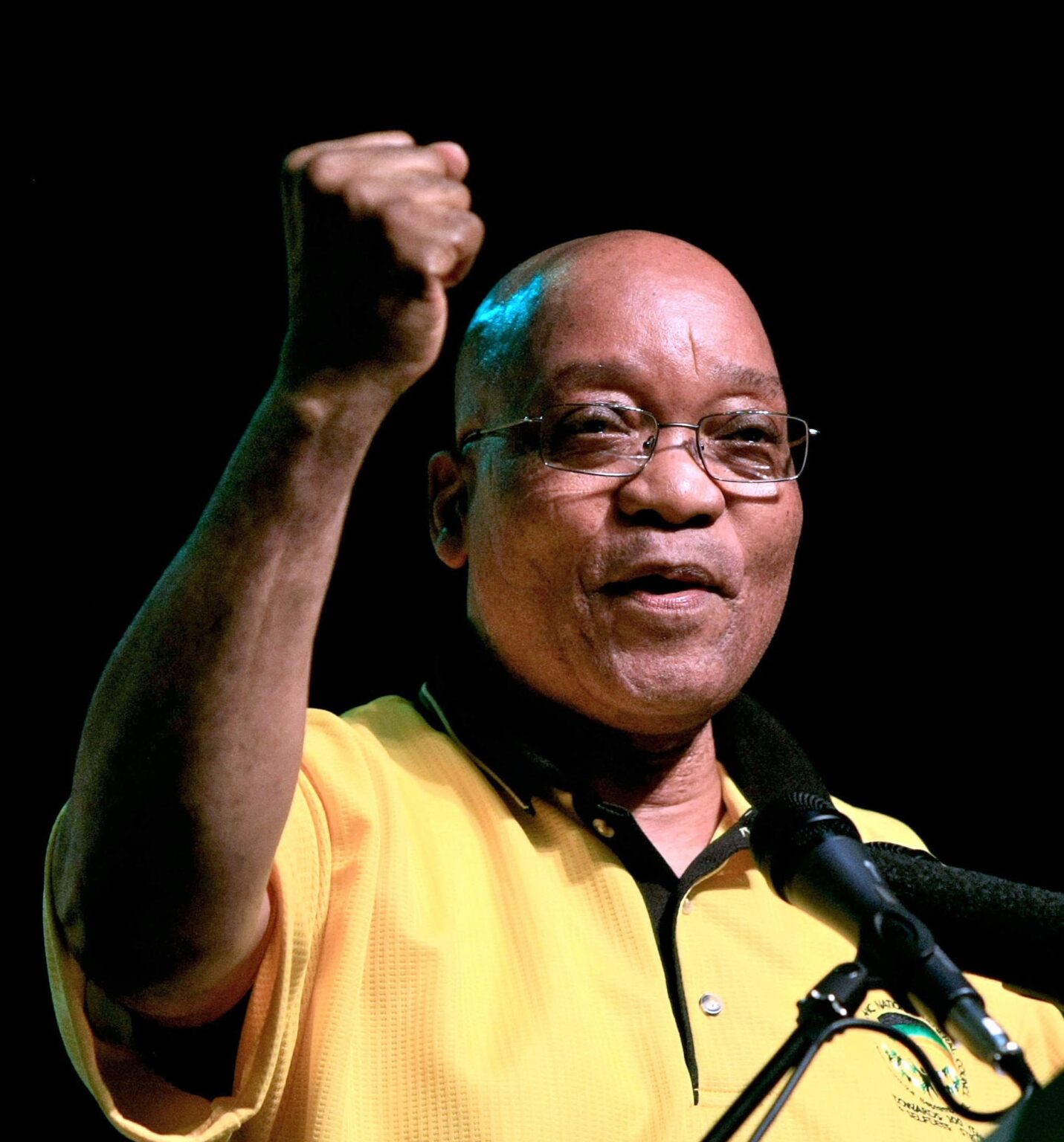
South Africa’s ruling party, the African National Congress (ANC), will in a few month’s time, hold its elective conference to decide who leads the party in the general election fixed for 2014. Already daggers are drawn for the incumbent, President Jacob Zuma, who is determined to have a second term. But with his enemies gathering for war in addition to a media backlash, will Zuma, the man who has shown himself to be a wily political survivor with help from friends, survive? In this report, our South African correspondent, Pusch Commey, looks at all the permutations and predicts that the world will witness a factional dogfight that will make Polokwane (the ANC’s last elective conference in 2007 that dethroned ex-President Thabo Mbeki) look like an afternoon walk in the park.
As the African National Congress (ANC) elective conference nears, the country is preparing for another round of political bloodletting. In December this year, representatives of the ANC branches across the country will gather in the city of Mangaung (formerly Bloemfontein) to elect the ANC president, and, concomittantly, the presidential candidate of the party for general elections in 2014. It is almost inevitable that the ANC, still dominant in South African politics, will win the election and consequently elect the president of the country in a majority parliamentary vote. In a proportional representation system, seats in the 400-member chamber are allocated in proportion to the percentage of votes garnered by a party at a general election.
The ANC, as a liberation party, has consistently polled over 63% of votes every five years since the first multiracial elections in 1994. President Jacob Zuma will be seeking a second 5-year term in Mangaung as the president of the ANC and the country. It will not be plain sailing. Traditionally, the deputy president of the ANC has been seen as the natural successor to become president of the ANC and the country. However, this is not cast in stone. And everybody had thought Zuma would be content with one term, especially when his ascendancy to power was fuelled by a hatred of ex-President Thabo Mbeki, and not on Zuma’s own personal attributes.
Since the halcyon days of the undisputed champion Nelson Mandela, the political jostling to rule South Africa has become more intense and vicious. There are many candidates with an eye on the highest office. Most have deep roots in the ANC. Most are friends until ambitions clash. Then things get murky.
When Nelson Mandela retired in 1999 after only one 5-year term, Mbeki, the deputy president of the ANC and the country, assumed power. It was then widely anticipated that the prominent and astute Cyril Ramaphosa, who was at the forefront of South Africa’s transition to black majority rule, would get the nod. It was not to be. He was sidelined and consequently resigned himself to making millions in business. He has recently reared his head once again on the political scene.
President Zuma was deputy president of the ANC from 1999 and in line to succeed Mbeki as president of the country when Mbeki’s two terms in office expired. Then the drama began.
In 2005 Zuma was implicated by a judge in a corruption scandal involving his financial advisor Shabir Shaik. Mbeki then used it as a reason to fire Zuma as the deputy president of the country and spoil his chances. However, Mbeki had no power to dismiss him as the deputy president of the ANC as this was an elected position.
After several tribulations, including a trial for rape, Zuma rode the crest of a wave of public sympathy to oust Mbeki from power. This was at the famous battle of Polokwane, the ANC elective conference in December 2007, that dethroned Mbeki as president of the ANC, leading to his loss of office seven months before his term had ended.
Prominent among the coalition of the wounded, as Mbeki’s enemies came to be known, was the then president of the ANC Youth League, Julius Malema. But he has recently been expelled from the ANC and consequently his position. Cyril Ramaphosa, chairman of the appeals committee that sat on Malema’s case, was scathing in his judgement. Many say Malema’s expulsion was politically motivated. Some have speculated that Rhamaphosa will succeed Zuma if he (Zuma) gets his second term. Zuma meanwhile has taken a fourth wife in the run-up to Mangaung.
Mbeki’s ousting, called a recall, left his supporters devastated, leading to the formation of a new party, COPE, that has struggled to cope on the political landscape. However, a new coalition of the wounded lurks in the woodwork, even though Mbeki is no longer contesting for power. And ironically, the now expelled Malema has been the number one praise singer of Mbeki’s reign. Some time ago, Malema would “kill” for Zuma. Now he wants to “kill” Zuma. Some time ago, Mbeki was the devil himself. Now he is the best president the country ever had. In fact one of the charges upon which Malema was expelled was based on unfavourably comparing Zuma to Mbeki. Now Mbeki is sorely missed!
A storm has been gathering in Zuma’s bid for a second term. The director of the presidency in Mbeki’s time, Rev Frank Chikane, earlier in the year published a bestseller detailing the events surrounding Mbeki’s removal. The book, entitled Eight Days in September, presents the events in September 2008 as a coup.
It was a mere seven months to the end of Mbeki’s term in office, and angry factions in the ANC, prominent amongst whom was Malema, were clamouring for his removal. This ironically also followed a judicial finding by a judge, Nicholson, in Zuma’s home province, that Mbeki had a hand in Zuma’s trials and tribulations. He was the puppet master using government institutions for political purposes. However this finding was later castigated by a higher court, the Supreme Court of Appeals.
Chikane reports that Zuma in his public pronouncements was of the opinion that Mbeki was a “dead snake”, and as a result should be allowed to serve his term. In fact Zuma personally met Mbeki to assure him that he would not be removed. But the coalition of the wounded would not hear of it. In an announcement, Gwede Mantashe, the current ANC secretary general, said Mbeki had been recalled by the party.
It was possible because in the South African system the electorate votes for the party, whose members of parliament elect the president. Without the support of parliament, the president is a toast. That support was withdrawn by the ANC through the president of the ANC, Jacob Zuma. Polokwane was the watershed. Mbeki gracefully resigned before parliament could vote and push him out. The coalition of the wounded wanted him out now, not tomorrow.
Now, it is Mangaung and there are many people calling for the removal of Zuma – chief amongst them are Julius Malema and the ANC Youth League. Though Mbeki has completely removed himself from local politics and directed himself to pan-African issues, there are deep scars etched in the memory of his supporters and new converts.
Malema has been singing Zuma’s removal for some time, and has been calling for the deputy president, Kgalema Motlanthe, to succeed Zuma in Mangaung. Motlanthe, who was caretaker president for seven months after Mbeki’s removal, has kept his cards close to his chest. He does not wish to be seen as the Brutus.
Media hacks in the pockets of politicians have been hard at work in the run-up to Mangaung. A poll in metropolitan areas puts Zuma’s popularity at 46%, in contrast to Motlanthe’s 49%. His delay in declaring his hand has prompted another perennial contender to throw his hat into the ring – Tokyo Sexwale – best-known for his association with the slain ANC icon, Chris Hani, in the run-up to the transition from apartheid.
Sexwale has no hidden ambitions. He has tested the waters every time elections have come around, and strategically retreated each time his main adversaries weighed in. During Mbeki’s time, he was unfairly fingered as being behind a coup plot. He supported Zuma in his battle against Mbeki. Sexwale has been widely known to bankroll Malema. There is an ABZ (Anything But Zuma) campaign attributed to him currently making the rounds.
Now, in Zuma’s time, a dirty tricks department in the Crime Intelligence Unit of the police has again fingered Sexwale in a plot to oust Zuma. The man behind the fingering has been an apartheid era police officer, Richard Mdluli, who, as head of crime intelligence, was arrested on charges of fraud. He is touted as one of Zuma’s able lieutenants for sorting out his adversaries.
Once again state institutions have come into play. Like magic, the charges against Mdluli were withdrawn, and the previously suspended head of crime intelligence was reinstated, until a public outcry forced the minister of police to redeploy him elsewhere pending an investigation into Mdluli’s insistence that he has been framed.
Ministers are reported to be scared of using their cellphones as secret meetings and daggers abound. People involved with the Zuma/Mdluli issues have allegedly reported house break-ins, documents missing, and being followed by men on motorcycles. They see Mdluli’s hand, doing his master’s bidding.
And Julius Malema? His call for the ousting of Zuma and the ANC secretary general, Mantashe, has backfired and he is out in the cold. First suspended for five years, he was expelled from the ANC on appeal when he continued to spew defiance. His final appeal failed and he is barred from anything to do with the party.
While Malema’s final appeal was pending, he called Zuma a dictator. He now says the ANC used him like a condom. A comedian, in reference to Zuma’s embarrassing rape trial before he became president, has opined that Malema’s condom claim cannot be true because Zuma does not use condoms. Besides he has 19 children.
The ANC Youth League is also defiant. They say Malema will remain their president until 2014. Malema and his loyalists have vowed to fight all the way to Mangaung, hoping for change. It makes for a bloody showdown.
Will Zuma survive? He has been crisscrossing the country to consolidate the branches where it matters most. Their delegates vote for the presidency. He has the support of big provinces like Mpumalanga and his home province Kwazulu Natal. However, things are far from certain with the other seven provinces. Meanwhile, wounded fifth column agents are also allegedly hard at work in the provinces to ensure he fails to get a second term. It is a déja vu, reminiscent of Polokwane when a confident Mbeki lost the elections.
With enemies like the ANC Youth League and a media backlash against Zuma’s presidency, especially with issues around perceived government corruption, true or false, the road to Mangaung will be very rough. Zuma has shown himself to be a wily political survivor with help from friends. But with enemies like Malema and Sexwale gathering for war, the outcome will be far from certain. Come October, when the ANC officially opens the debate for contestation, the world will witness a factional dogfight that will make Polokwane look like an afternoon walk in the park.








