
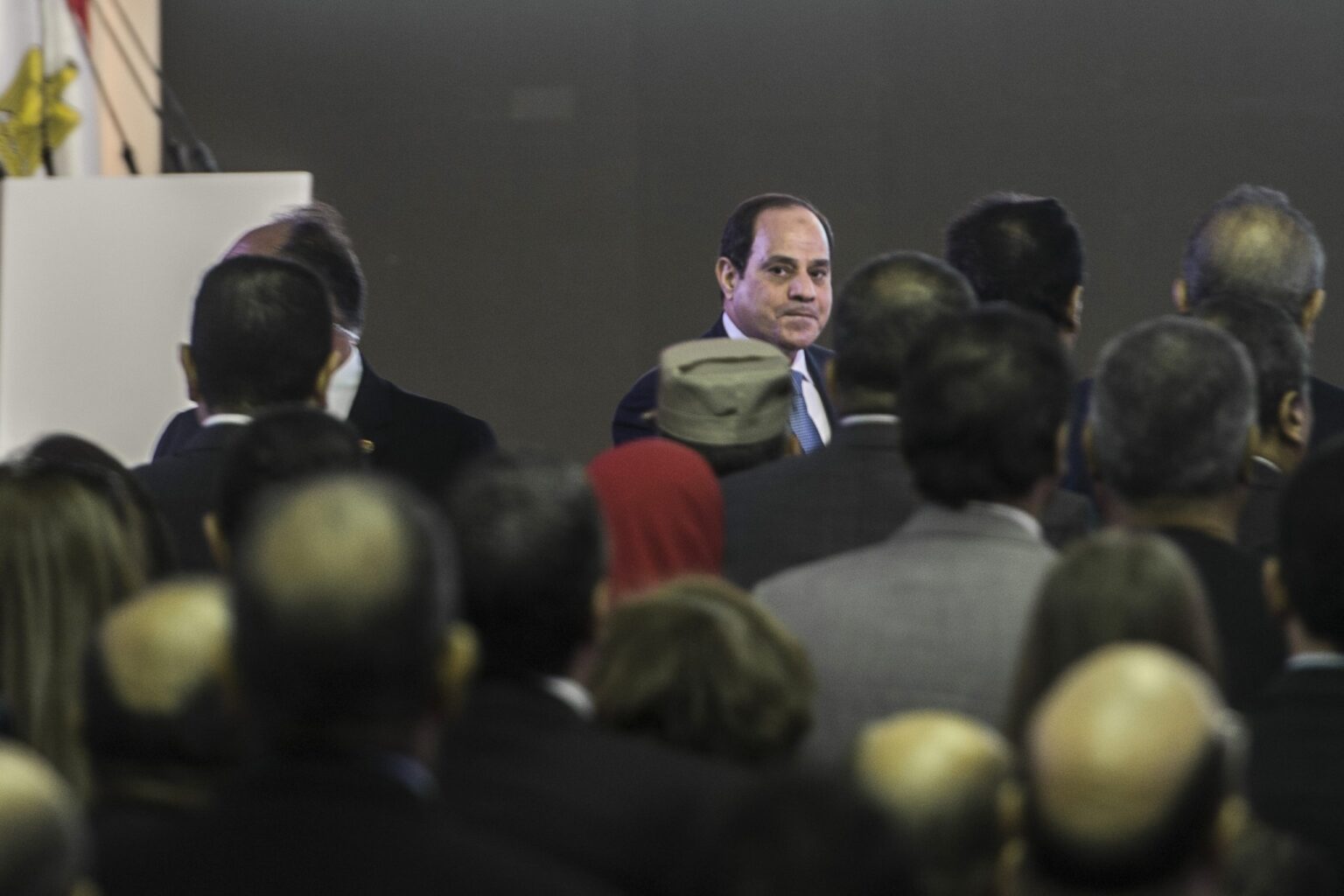
Fresh from re-election, President Abdel Fattah al-Sisi has grand plans to tackle Egypt’s alarming range of domestic challenges. His people need results. Report by David Wood.
During last month’s presidential election, a Cairo shopkeeper lamented “Being Egyptian is like being in a long, sad marriage. Every year, the same problems – and nothing changes.”
Abdel Fattah al-Sisi, who unsurprisingly won a second four-year term, already has the gauntlet at his feet. His nation is staring down crippling shortages of jobs, food and water. A ballooning population is aggravating the dire situation. The number of Egyptians has doubled in the past three decades and continues to increase at roughly 2% each year. Last July, President Sisi ranked population growth and terrorism as Egypt’s two greatest threats.
Sisi’s administration has announced various mega projects aimed at addressing the country’s domestic woes during the next four years. These range from developing a lavish new capital city, to building enormous desalination plants, to fulfilling a decades-long ambition of reclaiming’ farmland from the unforgiving Sahara Desert.
While Sisi’s power seems firmly entrenched, so does his people’s frustration. Reports claim that many Egyptians crossed out both presidential candidates on last month’s ballot and voted for Mohamed Salah, Egypt’s footballing idol.
The Egyptian people will hope that Sisi begins scoring some goals of his own – starting with delivering on his much-vaunted economic promises.
Getting back to work
Egypt’s employment figures do not make for pretty reading. Government statistics placed the 2017 unemployment rate at around 12%, while indicating that 79% of those without jobs fall between the ages of 15 and 29 years old. Four out of 10 people have not yet celebrated their 18th birthday.
The Sisi administration has promised a series of state-led construction projects that will generate jobs during the coming presidential term. The marquee project is the New Administrative Capital, an extravagant metropolis set to end Cairo’s centuries-long reign as Egypt’s political heart.
The city’s plans do not want for ambition. At a potential cost of $300bn, the government envisages towering skyscrapers, a sprawling international airport and even a ‘tall monument’ to rival the Eiffel Tower.The New Administrative Capital promises to create construction jobs on paper, but attracting investment has proved difficult so far. The project’s first leader, an Emirati developer, quit in 2016. The China State Construction Engineering Corporation then secured a $30bn loan to construct part of the city, only to pull out as well.
A state and military owned developer has now taken over the project, insisting that the New Administrative Capital will be “built by Egyptian hands”.
Promise of Special Economic Zones
Beyond construction, the government has vowed to continue developing Special Economic Zones (SEZs) in strategic areas of the country, where foreign investors should enjoy favourable conditions and less red tape than usual. One SEZ promotes the reinvigoration of the Suez Canal shipping industry; another focuses on the resource-rich ‘Golden Triangle’, a region stretching from the Nile to the Red Sea in impoverished Upper Egypt.
These sprawling industrial projects hope to capitalise on Egypt’s increased competitiveness following the most momentous incident of Sisi’s first term – the November 2016 floatation of the Egyptian currency. Domestic prices immediately skyrocketed and have remained high since, heaping more economic misery on the already struggling working class.
But the Egyptian pound’s devaluation arguably makes Egypt a more attractive destination for much-needed foreign investment, with the IMF praising the government for “carrying out bold but necessary reforms”.
Egypt has generated some overseas interest since the currency float, even though the unemployment rate has only decreased slightly. Russia will invest $7bn in a Russian Industrial Zone near the Suez Canal, while Egypt ranks among China’s top five targets for mergers and acquisitions in terms of transaction volume, according to Chinese state media.
This will be cold comfort for Egyptians unless the government can translate investment into jobs. At present, even those with stable work often have trouble making ends meet. “Before the devaluation, I was able to both support my family and have a life,” said Yomna Shaheen, an English teacher. “Now I can barely cover my bills and God forbid if someone gets sick.”
Conserving resources
Sisi faces two crises even more existential than rampant unemployment. Egypt is running out of food and water.
According to the World Food Programme, 16% of Egyptians have ‘poor’ access to food. This figure rises to an alarming 38.7% in Upper Egypt, where more than half the population live below the poverty line. The parlous situation stems in part from geography. Egypt’s meagre supply of arable land clings to the banks of the Nile and its delta, amounting to less than 4% of the country’s total area.
The Sisi administration has vowed to address this problem by continuing a battle royale against Mother Nature herself. Its land reclamation project, which could cost up to $4.7bn, hopes to convert 630,000 hectares of Saharan desert into food-producing land.
The US Foreign Agricultural Service recently praised the government’s intentions, but raised concerns over the initiative’s price tag and logistical hurdles. Its report also pointed out that “in the past, the Government of Egypt began similar projects only to be delayed by these or comparable difficulties”.
Egypt’s search for water has become even more desperate. Egypt suffers an annual deficit of 7bn cubic metres, leading the UN to warn that Egypt could run out of fresh drinking water as early as 2025.
While poorly maintained pipes and infrastructure contribute to wastage, location has again conspired against the Egyptian people, who currently rely on the Nile to meet more than 90% of their freshwater needs. The river courses through nine countries before snaking across Egypt’s southern border. One of those nations upstream – Ethiopia – has sparked a diplomatic spat with Egypt by building the $5bn Great Ethiopian Renaissance Dam, which should open imminently. The dam’s potential impact has caused panic in Egypt. The river’s water levels could fall by up to 25% over seven years, according to a Geological Society of America study.
Egypt has not given up its quarrel with Ethiopia. In a recent public address, Sisi warned sternly that “water is a matter of life and death”. But the government is also developing a fallback strategy with yet another mega project. In February, the government pledged $50bn over two decades to building or upgrading more than 50 water desalination plants. The plans include an enormous Red Sea facility that, it is claimed, will become the largest desalination plant in the world.
Same problems, same solutions?
The Egyptian desalination project marks a fresh approach to tackling a major social problem. The same cannot be said for all of the Sisi administration’s grand designs.
The state has been creating SEZs since 2002. The land reclamation battle stretches back to the 1930s. And Egypt is littered with decades’ worth of artificial settlements like the New Administrative Capital, many of which have only modest occupation rates.
The New Administrative Capital has also drawn criticism for its high cost, especially in the current economic circumstances. In terms of audacity, perhaps the project is only outdone by plans to launch an Egyptian space satellite by 2020.
For now, however, Egypt’s decision-makers seem unbowed. “Other countries like Brazil and Côte d’Ivoire have built new capitals,” an offical for Administrative Capital for Urban Development (the organisation building the new city), told the Financial Times: “we have the right to dream.” NA








