
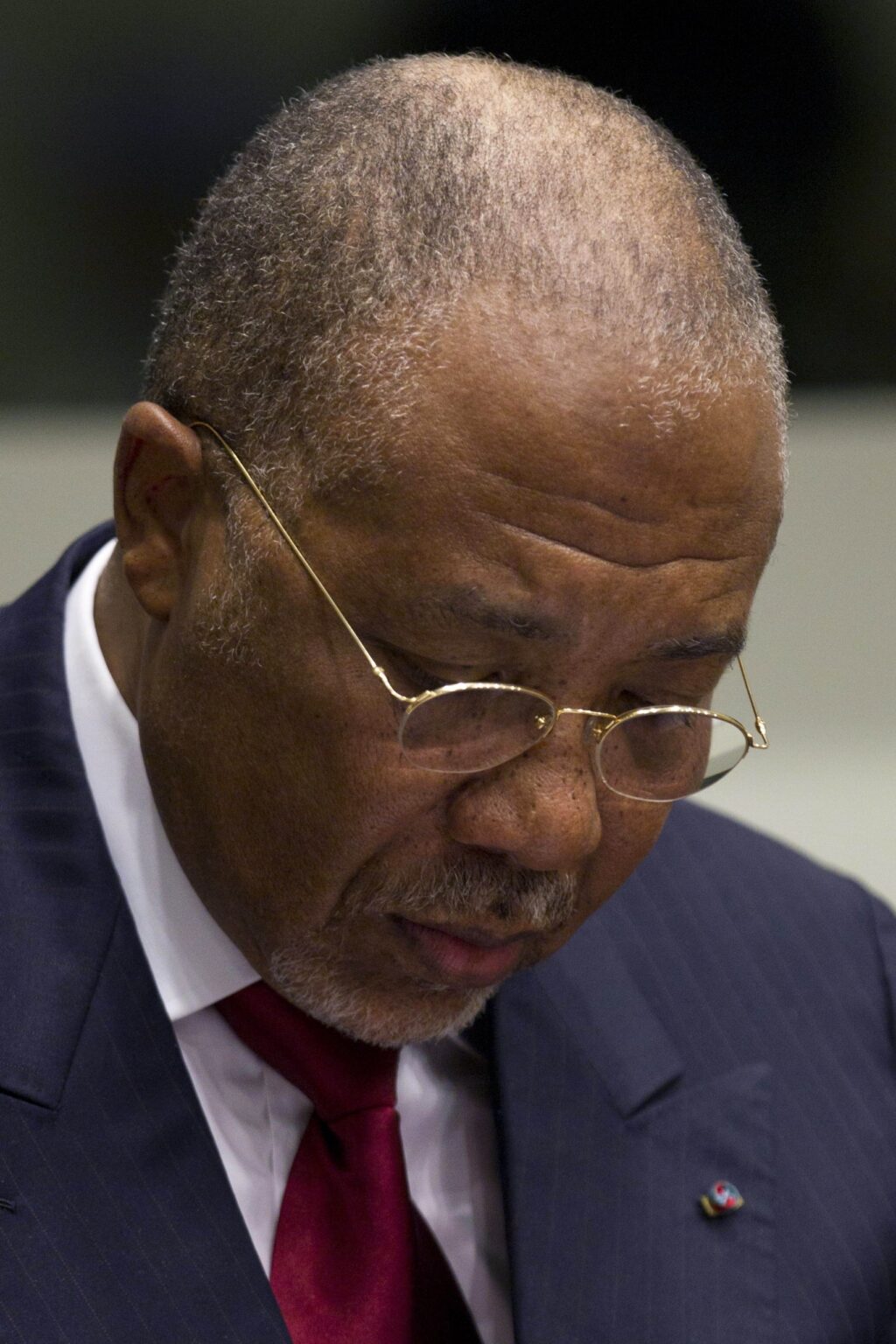
The mixed reception to the conviction of Charles Taylor clearly illustrates that, contrary to what many were thinking, the outcome has left many questions still unanswered. Desmond Davies reports.
GIVEN THE INTENSE EMOTIONS THE WAR AND THE establishment of the Special Court for Sierra Leone (SCSL) engendered over the years, the reaction to Charles Taylor’s guilty verdict was equally emotion-filled.
For instance, SCSL Prosecutor Brenda Hollis called it a historic conviction. “Today’s historic judgment reinforces the new reality, that heads of state will be held to account for war crimes and other international crimes,” she said. “This judgement affirms that with leadership comes not just power and authority, but also responsibility and accountability. No person, no matter how powerful, is above the law.”
Equally upbeat about the conviction was the UN High Commissioner for Human Rights, Navi Pillay, who said it was an immensely significant verdict, which constituted a stark warning to other heads of state who were committing similar crimes or contemplating doing so. Human rights organisations such as Human Rights Watch and Amnesty International reacted in the same manner.
So, after spending between $100m and $250m trying Taylor, he was found guilty of something that has always been recognised: that he backed the RUF after ECOMOG (the Ecowas military intervention force in Liberia, where Taylor had launched its insurgency in 1989), used Sierra Leone’s international airport to launch air raids against Taylor’s forces in Liberia in 1990. Months later, in 1991, the RUF began its war in Sierra Leone.
The country’s former President, Tejan Kabbah, who had to deal with the brunt of the RUF’s atrocities and instability between 1996 and 2007, noted this last October when he spoke at the Institute for Security Studies in Pretoria: “Military leaders of ECOMOG are of the strong opinion that had there not been a Liberian conflict, there would in all certainty not have been a conflict in Sierra Leone. The use of Sierra Leone’s territory by ECOMOG for operations against Charles Taylor’s National Patriotic Front of Liberia (NPFL) instigated attacks in the border areas of Sierra Leone where the RUF had easy access.”
Indeed, the seeds of discontent that germinated into the RUF had been sown in 1977 when the government of the late President Siaka Stevens unleashed the army against rebellious university students; and in 1982 after a violent election campaign left scores dead in the Pujehun District in Sierra Leone’s Southern Province. The disaffected young people, traumatised by these two incidents, gradually made their way to Libya where they received military and ideological tutelage under the aegis of Muammar Al Gathafi, who was using his Green Book philosophy to spread instability in West Africa.
So, long before Taylor “escaped” from prison in Plymouth, Massachusetts in the USA in 1985 and went on to Libya for military training, Sierra Leoneans were already there.
The issue of Taylor’s “escape” has been long debated by conspiracy theorists who suggested that the US government was behind it all. After all, Washington had got tired of Samuel Doe’s idiosyncrasies as Liberia’s leader and wanted him out of power.
The four other prisoners who escaped with Taylor were captured while he made his way to Africa to start his insurgency four years later.
Colin M. Waugh, author of Charles Taylor and Liberia, noted: “There had never been a breakout from the red-brick correctional facility in Obery Street, Plymouth, and the controversy over how Taylor and his group managed to do it was to continue for years afterwards. Divergent accounts of the Taylor escape and conspiracy theories involving the US authorities’ complicity in the breakout were in abundance, emanating both from within and from outside Plymouth.”
Waugh quoted a 1992 Taylor allegation that the CIA engineered his escape. The former Liberian leader was quoted as saying: “I wouldn’t even be in the country [Liberia] today if it weren’t for the CIA. My escape…I think they must have arranged that. One night I was told that the gate to my cell wouldn’t be locked …that I could walk anywhere.
“I walked out of jail, down the steps out into America. Nobody stopped me. I came home to Liberia. What was I in jail for? My dear, I don’t know.”
So, as Kabbah said, had there been no war in Liberia, Sierra Leone would not have gone through the turmoil it underwent even though there were underlying problems that had initially created huge discontent in the country. Tunde Zack-Williams from Sierra Leone, who is Emeritus Professor of Sociology at the University of Central Lancashire in the UK, made this point in When the State Fails: Studies on Intervention in the Sierra Leone Civil War, which he edited.
“It is doubtful if Taylor’s intervention [in Sierra Leone] would have been so successful without other underlying long-term factors including: the marginalisation of youth, patrimonialism and bad governance, deterioration of the economy and the general crisis of peripheral capitalism in Sierra Leone,” he wrote.
“By the time Taylor decided to show ‘fraternal revolutionary solidarity’ with [Foday] Sankoh, Sierra Leone was a failing state, with crumbling social and physical infrastructure, a regime that could provide neither social citizenship, nor security for its people, with an alienated youthful population and an electorate that was at its wits’ end with their tormentors,” Zack-Williams added. In all this, it is obvious that the conviction of Taylor is far from bringing closure for those who suffered gravely from the atrocities caused by the RUF and other combatants. Prosecutor Brenda Hollis noted that the “judgement brings some measure of justice to the many thousands who paid a terrible price for Mr Taylor’s crimes”.
The question victims are asking is why the others who were involved in fuelling the mayhem in Sierra Leone were not brought to book. Take Gathafi, for instance. According to the first prosecutor of the SCSL, the American David Crane, he had also wanted to indict Gathafi but Western countries and the UN stopped him from going ahead. Crane claimed that the British government, then being led by Labour prime minister Tony Blair, especially pressurised the UN, which agreed.
Crane told The Times of London: “It was my political sense, dealing with senior leadership in the United Kingdom, United States, Canada, United Nations and the Netherlands, that this [indicting Gathafi] would not be welcome. This [Gathafi’s involvement] is not speculation on my part. We named and shamed him in the actual indictment.”
Crane said he believed oil was the reason for the reluctance of the West and the UN to try Gathafi. Indeed, during that period, the West, spearheaded by Blair, was making overtures to Gathafi who had given up his weapons of mass destruction and was willing to do business with Western companies.
For Blair, his stance was ironic given that he had sent British troops to Sierra Leone in 2000 to shore up an inept UN peacekeeping force. This was well over a year after Nigerian forces had effectively ended the war after routing the RUF in Freetown in January 1999.
Another question that is still unanswered is what happened to the diamonds that the rebels were supposed to have sold to buy weapons? The prosecution continually spoke of a criminal enterprise, which, as the judges said in their judgement, could not be linked to Taylor. But a criminal enterprise in diamonds stolen from Sierra Leone, there was. Figures of up to $950m have been bandied about with regard to the money made out of the sales of these stolen diamonds.
However, when the SCSL prosecution spoke about this criminal enterprise, the trail tended to end with the rebels. Surely there were buyers of the diamonds in Antwerp, Amsterdam, and Tel Aviv? So why have these diamond dealers not been brought to book and ordered to make recompense to the government and people of Sierra Leone for knowingly buying stolen goods belonging to the government and people of Sierra Leone?
After all, this is what normally happens in Western countries. The money would go a long way to providing restitution to those whose arms and limbs were chopped off by sadistic rebels and who could now be seen roaming the streets of Freetown begging.
When the issue of so-called blood diamonds came up, spearheaded by Global Witness, everyone thought that the introduction of a diamond certification scheme would be the answer to dealing with diamonds mined in areas of conflict and that it would stop greedy diamond dealers from buying the stolen stones.
For a while the Kimberley Process Certification Scheme (KPCS), which was launched in 2003, appeared to be regulating the international trade in rough diamonds. But the non-governmental organisations that backed the process were mistaken in their belief that it would work.
Those who are familiar with the murky nature of the diamond business know the process was just a smokescreen by the diamond dealers who had bought stolen stones from Sierra Leone and wanted to divert attention from themselves.
“Historically, effective diamond regulation has proven almost impossible, whether in Africa, Europe, Asia or North America,” noted a report on the KPCS by the Diamonds and Human Security Project in 2006. Sierra Leone’s diamond industry is a perfect example of the free-for-all that can occur. It has always had smugglers hanging around ever since the British colonial government first discovered diamonds in the country in the 1930s.
While companies such as De Beers operated above board, there were scores of operators who carried out business on the fringes: small wonder that the South African diamond mining behemoth eventually pulled out of Sierra Leone.
By the time the Sierra Leonean government nationalised the industry in 1971, a free-for-all was the norm in the sector. Middle Eastern types – mainly from Lebanon – dominated the shadowy side of the industry. The government of Sierra Leone lost hundreds of millions of pounds through smuggling – which had a well-entrenched network. Many foreigners have acquired immense wealth through Sierra Leone’s diamonds – while Sierra Leoneans have not benefited much.
So, although the civil war in Sierra Leone was all about politics, whenever the various armies – be they on the government or rebel side – took control of the diamond mines, the stones became a priority. They were quite easy to get because Sierra Leone’s diamond mining sector is alluvial in nature. Thus, everyone mined diamonds. But it was the rebels who became the main culprits. Those in the global diamond industry and international NGOs that coined the phrase “blood diamonds” know where the diamonds from Sierra Leone went. But the industry has proven to be resilient in continuing in its bad, old ways.
So it was not surprising when in December last year Global Witness announced that it had left the Kimberley Process because of its “refusal to evolve and address the clear links between diamonds, violence and tyranny…”
Global Witness said in a statement that the process was outdated. The statement went on: “Despite intensive efforts over many years by a coalition of NGOs, the scheme’s main flaws and loopholes have not been fixed and most of the governments that run the scheme continue to show no interest in reform.”
Charmian Gooch, a Founding Director of Global Witness, added: “Nearly nine years after the Kimberley Process was launched, the sad truth is that most consumers still cannot be sure where their diamonds come from, nor whether they are financing armed violence or abusive regimes.”
This is a serious indictment of the diamond industry that has tried to shift the blame to others for fuelling conflict in diamond-rich countries. The diamond industry is the real culprit and its members should have been brought to book a long time ago. But will this happen?
Now, while Hollis and others are claiming that finding Taylor guilty is the end to the issue of the conflict in Sierra Leone, they are far from correct. Closure will only be reached when the big guns in the diamond industry are made to pay for fuelling Sierra Leone’s civil war.
As Hollis said: “No person, no matter how powerful, is above the law?” Does this also apply to the powerful players in the global diamond industry? This is the question the victims of the RUF would want answers to. There is still unfinished business to deal with in regard to justice for Sierra Leoneans.








