
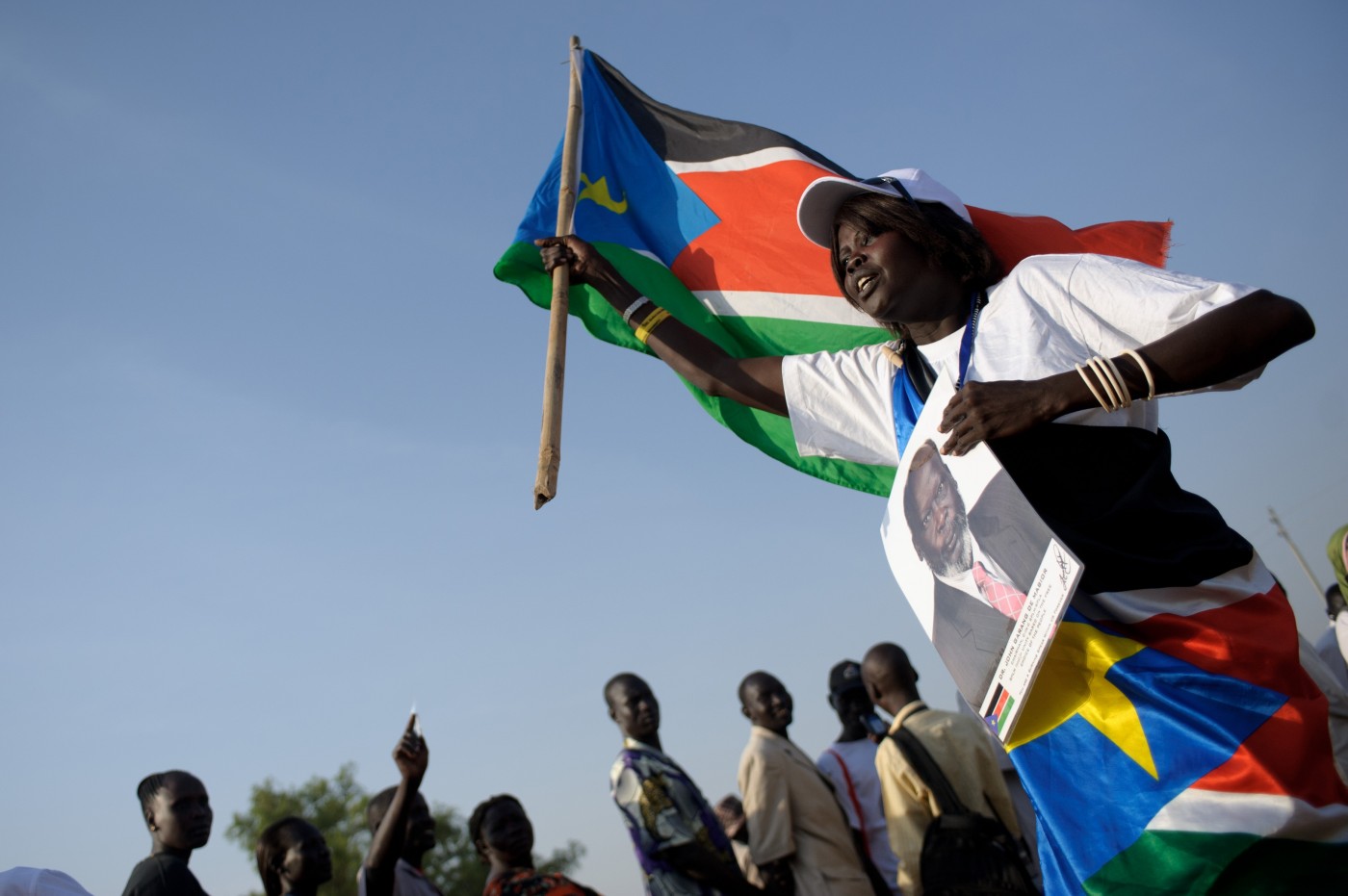
South Sudan celebrated three years of independence on 9 July with the concerns of the people ringing out loud and clear amidst the din of the celebrations: They are tired of war and yearning for peace. This is why the government of President Salva Kiir Mayardit is keen to reach a peace accord with rebels fighting in the northeast of the country. But Juba is cautious of peace imposed by outsiders that may in the end turn out not to be peace at all, but something that compounds and deepens the crisis.
From the outside, the pictures that come out of South Sudan are not pretty. War and the suffering of internally displaced people dominate the landscape. Or so the world is made to believe. But from the inside, the picture is different.
Yes, there is intermittent fighting or a war of attrition going on in three of the country’s 10 states tucked away in the far northeast corner close to the Ethiopian and Sudanese border, but that is the sum of it.
Elsewhere, in the seven other states of the country, there is perfect peace and people are going about their normal duties. The major downside, though, is the fact that the country’s cash cow – oil – happens to be produced in the three states affected by the fighting. Because of the insecurity, oil production has halved to 165,000 bpd from 350,000 bpd, thus depriving the world’s youngest country of the funds necessary to continue developing its much-needed infrastructure.
Everyone talks about “the fighting” in terms of its debilitating impact in stalling development in the country. No wonder everyone wants it stopped – and immediately.
Which is the reason why the government of President Salva Kiir Mayardit is keen to see progress achieved at the peace talks currently going on in the Ethiopian capital, Addis Ababa, moderated by the regional grouping, the InterGovernmental Authority on Development (IGAD), although several ceasefire agreements reached since May this year have not worked.
But on 10 June, IGAD (bringing together Ethiopia, Uganda, Kenya, South Sudan, Somalia, Djibouti and the Republic of Sudan), forced through a decision calling on both President Kiir and his former vice president now turned rebel and rival, Dr Riek Machar, to agree to the establishment of a transitional government within 60 days, leading to elections in the near future.
IGAD’s mediation efforts are being assisted by the African Union and a Troika made up of Norway, UK, and the USA. They are doing what they can to bring peace, but their transitional-government-in-60-days idea has not pleased many people in Juba. However, President Kiir says if that is what will bring peace to the country, he is willing to implement it.
But he adds two important provisos: (1) Provided the transitional government idea will not be used as a smokescreen to dissolve the current elected Parliament. (2) Provided it is not used to dissolve the Executive arm of government, and thereby force him out of office as the elected president. Both, he says, will be “a red line to us”.
“So if you don’t want grudges and conflict to deepen in South Sudan,” the president added ominously, “leave these two institutions untouched – Parliament and the Executive.”
Kiir is not shy to talk about where the “transitional government idea” is coming from and why. In an interview with New African, he pointed accusing fingers at the Americans. “They have put pressure on IGAD that the government in Juba must be dissolved so that a new system comes up in Juba,” Kiir said.
Asked why the Americans are doing that, Kiir explained: “They say that their companies are not allowed to invest in the oil industry here. But it is not our mistake. When we signed the CPA in 2005, we wanted to review the oil agreements that had been signed by Khartoum and China. The Americans refused … and went on to impose sanctions on President Omar Bashir and pulled out their companies from South Sudan.
“I appealed to them to bring back their companies when I became the First Vice President of Sudan … They said: ‘No, if this is done Bashir will benefit from the money. So we are not coming back.’ They wanted Bashir to fall. But Bashir cannot fall because he is with his people.
“Now when South Sudan became independent in 2011, I called the Americans again. ‘Let your companies come, so that if there are oil blocks that have not been awarded to any companies, I will give them to you, including Block 5B, which was originally awarded to an American company that later pulled out. Up to now that block is still not awarded to anybody’.
“… But they said no. Riek Machar had told them, ‘If you help me to become president, I will chase away the Chinese and the other Asian oil companies from South Sudan, and I will give everything to you’. And they believe him. So this is my crime. I haven’t offered them what Riek has offered.”
Kiir is, therefore, in no doubt that the transitional government idea is being pushed by the Americans and the European Union to get at him. “It’s just how to get me out of power. It’s a smokescreen,” he said laconically.
The fighting
The current intermittent fighting started on 15 December 2013 when Riek Machar, the former vice president who had his academic training in the UK, took up arms because of political disagreements with President Kiir, who is also a general. The President and his supporters call Machar’s move a failed “coup” intended to seize power because of Machar’s personal ambitions.
Machar, however, says he picked up arms to prevent a dictatorship from being imposed in Juba and corruption in high places going unpunished. Kiir rejects this accusation.
He is supported by the minister of information and broadcasting, Michael Makuei Lueth, who said that “the current senseless war was brought on us by an ambitious rebel leader, Riek Machar, who wants to be the president of South Sudan by any means other than through the ballot box”.
According to Lueth: “It is not true, as Machar is alleging, that the president wanted to impose a dictatorship here. For him, all that brought his rebellion is his removal from the position of vice president. Otherwise he had no reason at all. We have all the records and information concerning his and his group’s activities up to the first bullet.”
Lueth said Machar was removed as vice president because he was talking publicly against the same government in which he was the vice president.
“Actually,” Lueth said, “the president called him and told him: ‘Instead of talking against your own government, why don’t you resign? You are also my deputy in the SPLM [the ruling Sudan People’s Liberation Movement], why don’t you work and ensure that the reforms you want are implemented, instead of talking against your own government and party. This is not helpful. If you are dissatisfied, you should resign from the government and the SPLM and set up your own party, and then criticise us the way you want. You have freedom of expression’.”
It was only when Machar insisted on not resigning, Lueth said, that he was removed as vice president. “And after his removal he started his activities, although he was still the first deputy chairman of the SPLM. He continued to campaign against the government and the party. But realising that he could not make it through talking, he attempted to achieve his goals by force and lost it. The coup failed, and he resorted to a rebellion.”
However, the information minister strongly believes that “the war will be stopped through negotiations because there is no way we can stop this fighting through the use of force, simply because we don’t want to lose more lives. We have lost enough lives in the pre-independence wars from 1955 to date. That is why the government believes that the only way is through peace.”
But Lueth and many others inside and outside the ruling class in Juba are not happy at the way peace is being imposed by IGAD and the Troika mediators in Addis Ababa.
On 10 June, IGAD met in Addis Ababa and threatened to impose “punitive measures” on any of the South Sudanese parties which “stand in the way of peace” by not implementing the transitional government in the 60 days’ agreement.
Ethiopia’s prime minister, Hailemariam Desalegn, the current IGAD chairman, was quoted after the meeting as saying the two sides of the South Sudan conflict had “agreed to complete the dialogue process within the coming 60 days on what, how, when and who [will be included in] the formation of the transitional government. Any attempt to stand in the way of peace will have consequences.”
Reports from Addis Ababa said both Kiir and Machar “fully committed themselves to already signed agreements”. Which strengthened the IGAD chairman’s hand to say: “If they don’t abide by this [latest] agreement, IGAD as an organisation will act to implement peace.” Which was interpreted to mean military action.
But South Sudan’s foreign minister, Dr Bernaba Marial Benjamin, insists that “it is the people of South Sudan themselves, through an electoral process, that can elect or reject their leadership and nobody else”.
It is a point that Information Minister Lueth has more to say about: “There are some circles that want South Sudan’s democratically elected government to step down so that peace prevails in the country,” he said. “This is an unacceptable position, because we don’t want South Sudan to set a bad precedent for the region and Africa.
“Therefore those who call on President Kiir to step down because Riek Machar has rebelled and is fighting are setting a bad precedent for Africa and the region, because if this idea is implemented anybody can take up arms from now on and mediators will say ‘we want peace, so let the president go because a precedent has already been set in South Sudan’.”
To Lueth and like-minded people in Juba, this is a danger to democracy. “So I don’t quite understand why the region is not supporting the democratically elected government of South Sudan against a rebel who attempted to overthrow a democratically elected government by force,” Lueth said.
“This is what is happening at the peace talks in Addis. The Troika is in support of the idea, the European Union is in support, and even the East African region is in support. They are not saying it openly, but this is very clear from their body language. It is very clear that for the sake of peace, they want Salva Kiir to go, instead of supporting him against the rebels.
“Interestingly, they have already set a precedent in the region: In Somalia, IGAD moved in to support and protect the government against rebels. In Uganda, the LRA rebels have been fighting for a long time and the region is supporting and protecting the Ugandan government against the rebels.
“Up to now, we have Ugandan, South Sudanese, and Congolese forces in Western Equatoria [in South Sudan], assisted by a contingent of American troops, fighting against the LRA in support of the Ugandan government.
“But for us when our people rebel, they are supported against the government, instead of the region and the international community telling Riek Machar, ‘you want democracy, come and contest elections’. This should have been the best solution, but unfortunately President Kiir’s government is being asked to resign and give way to a rebel against all the principles.
“And they keep preaching democracy to us, yet when somebody rebels against democracy, they support him. But we have been telling them that unless they give us a different definition of democracy, the democracy we understand is not what they are trying to impose. And this is a double standard.”
Which is a shame because since 2005 when a Comprehensive Peace Agreement (CPA) was signed between the two Sudans – North and South – which ultimately led to South Sudan’s independence on 9 July 2011, the government (both during the transitional period from 2005 to 2011, and also after independence) has been doing very well to defeat and bury the old hatreds in the country and bring the 64 ethnic groups in Africa’s youngest nation together to forge the necessary harmony for national development.
Since 2005, Juba, South Sudan’s neglected capital, has seen impressive improvements. The changes have been so dramatic that anyone who used to live in the city before 2005 and has gone away, will find it difficult to believe their eyes when they return. High-rise buildings are going up all the time, and there is a feel of a real city in the making.
But all this has now stalled because of the current crisis engendered by Machar’s rebellion, which presents a real risk of killing everything and taking the country backwards – if, and it is a big if, the mediators in Addis Ababa do not handle the peace talks sensitively and sensibly, or in other words, let justice fall where it may.
Country background
South Sudan, only three years old as an independent nation, has an old and troubled history. Until three years ago, the country of nearly 12 million people was part of the Republic of Sudan whose capital is Khartoum.
But because of the evils of war and politics, successive governments in Khartoum deliberately neglected the South and left it totally undeveloped. In this, however, the British colonial overlords of Sudan are partly to blame. They set the tone of the neglect when they had the whole of Sudan under their sway. As a result, you cannot find a country anywhere in the world that became independent and inherited almost nothing from the colonial era, except South Sudan.
Apart from the land and the people, and maybe the River Nile and its many tributaries, South Sudan became independent in 2011 with almost nothing to inherit. There were no roads, no electricity, no pipe-borne water, no schools, no hospitals, no government offices, nothing! Everything has to be built, and is being built, from scratch.
Foreign Minister Benjamin says: “People think that South Sudan is like any other African country that became independent during the decolonisation era, where they walked into offices that were left by the colonial authorities and where they found files already on their desks. But here in South Sudan we have to put up the office buildings ourselves. We have to bring in even the desks and tables and the files ourselves! That is why President Kiir keeps saying we are beginning from zero. We are not only putting up the structures, we are digging even the foundations for these structures.”
Kwong Danhier Gatluak, the minister for transport, roads and bridges, agrees. “My predecessor in this ministry used to say, ‘This is a ministry of one bridge and no roads’. He was right.”
Gatluak tells the story of how the country’s late leader, Dr John Garang, was asked at the signing of the CPA in 2005 what would be his priority, in fact the most urgent thing he would do if the country could have peace the next day. “Dr Garang replied, ‘No.1 roads, No.2 roads, No.3 roads, No.4 roads’.”
The lack of roads in the country means that Juba holds the world record of the largest concentration of four-wheel-drive vehicles in the whole wide world. And it is the first thing that hits any first-time visitor.
The lack of roads also brings many other problems. According to Minister Gatluak: “Most of the food we eat either comes from Uganda or Kenya or by air from as far as Dubai, not because we don’t have food in some areas in this country – in fact there are surpluses in Western Equatoria, Central Equatoria, and Upper Nile states – but because there are no roads in these areas we cannot get the food from there to where it is needed, and people are suffering. As a result, we import almost everything we eat just because of poor road connectivity.”
The criminal neglect of South Sudan by successive governments in Khartoum also means that there is only one bridge – the Juba Bridge to the south of the capital city – across the 1,000km stretch of the River Nile that bisects South Sudan into two equal parts, from the Ugandan border to the Sudanese border.
Thus living on either side of the Nile and not being able to cross Africa’s largest and longest river easily to the other side, has been a major inhibiting factor to development in South Sudan from time immemorial.
This past neglect also means that even with the efforts of the SPLM government to improve life in the country since 2005, there is only 78 km of tarred roads in the sprawling and growing capital city of Juba. The rest of the roads in the city and in the rest of the country are in the hands of God, and with the traditional heavy rains of South Sudan, you can imagine the state of these roads.
Which is why South Sudan needs help, international help, and not war. This is a country gifted with enormous natural resources, and if peace and investors can be found, the country can be turned into a pleasant place to live.
“In fact,” says Information Minister Lueth, “if we had not been interrupted by the rebellion last December, we had held an investors’ conference here in Juba, which was attended by hundreds of business people from all over the world who expressed their satisfaction with the country and were ready to come and invest in all fields. But unfortunately
with this interruption, because they say capital is the most cowardly, up to now they are not coming. But we are still encouraging them to come. The lack of peace is an obstacle to development.”
And South Sudan does not only have oil, it is endowed with gold, uranium, diamonds, nickel, iron, and a lot more besides, as Foreign Minister Benjamin attests. “And these are proven minerals which are not even yet exploited,” he says. “It is only oil which has been exploited and in a very minimal manner, it has not even reached its full potential.”
In terms of agriculture, Dr Benjamin says: “South Sudan is one of the most fertile lands you can think of because it has not been exposed to any pollution of any kind. In fact our late chairman, Dr John Garang, used to describe South Sudan as a huge organic farm. Its fertility is absolute, you can grow anything in this country without fertilisers.”
Benjamin goes on: “In terms of livestock, we have one of the largest livestock populations you can think of on the African continent. You are talking about 33 million herds of cattle for example. And there are also goats and sheep.”
But the Minister of Agriculture, Beda Machar Deng, is not happy that much of the 33m national herd are not utilised commercially but held for prestige purposes.
“The people are just proud of having large herds of cattle but not converting them into money on a commercial basis,” the minister says ruefully. “A cow can live to 15 or 20 years and dies. Just like that! Instead of being sold and bringing money to the owner! Or instead of them being culled when they are 5 or 6 years old. Someone can build himself a very good house out of cattle, and send his children to school, but people are not doing so. They are just holding the cattle for the sake of prestige. You can marry a girl with 100 cows, no problem, and then live in poverty. They don’t value the money. They value the prestige that the holding of cattle brings.
“My ministry has started educating the people to change their mindset. Money from cattle can increase farm sizes, buy tractors to mechanise the farms, and thereby increase the productivity of the farms.”
Worryingly, the same happens in fishery. South Sudan’s Sudd region, 35,000 sq km of wetland in the middle of the country, is home to 30 rivers (12 on one side and 18 on the other) that flow into the Nile in this region, thus creating numerous small lakes full of organic fish that nobody harvests.
According to Transport Minister Kwong Danhier Gatluak, one study in the Sudd region, by the oil giant, Chevron, (the first to prospect in South Sudan) found that fish actually die of old age in the Sudd. Local fishermen do not have the capacity to harvest the millions and millions of organic fish in the Sudd, and yet – God have mercy – South Sudan imports fish from Uganda and elsewhere!
Agriculture Minister Beda Deng thus appealed to investors in the fish industry to take advantage of the huge opportunities in South Sudan. “And the Nile is also good for tourism,” he added.
It is therefore not difficult to fathom why the current crisis sparked by the December fighting has to be resolved soon. It is the more reason why the mediators and the protagonists in the conflict should let South Sudan’s national interests determine the outcome of the peace talks in Addis Ababa and the fighting itself, not personal and superpower interests.








