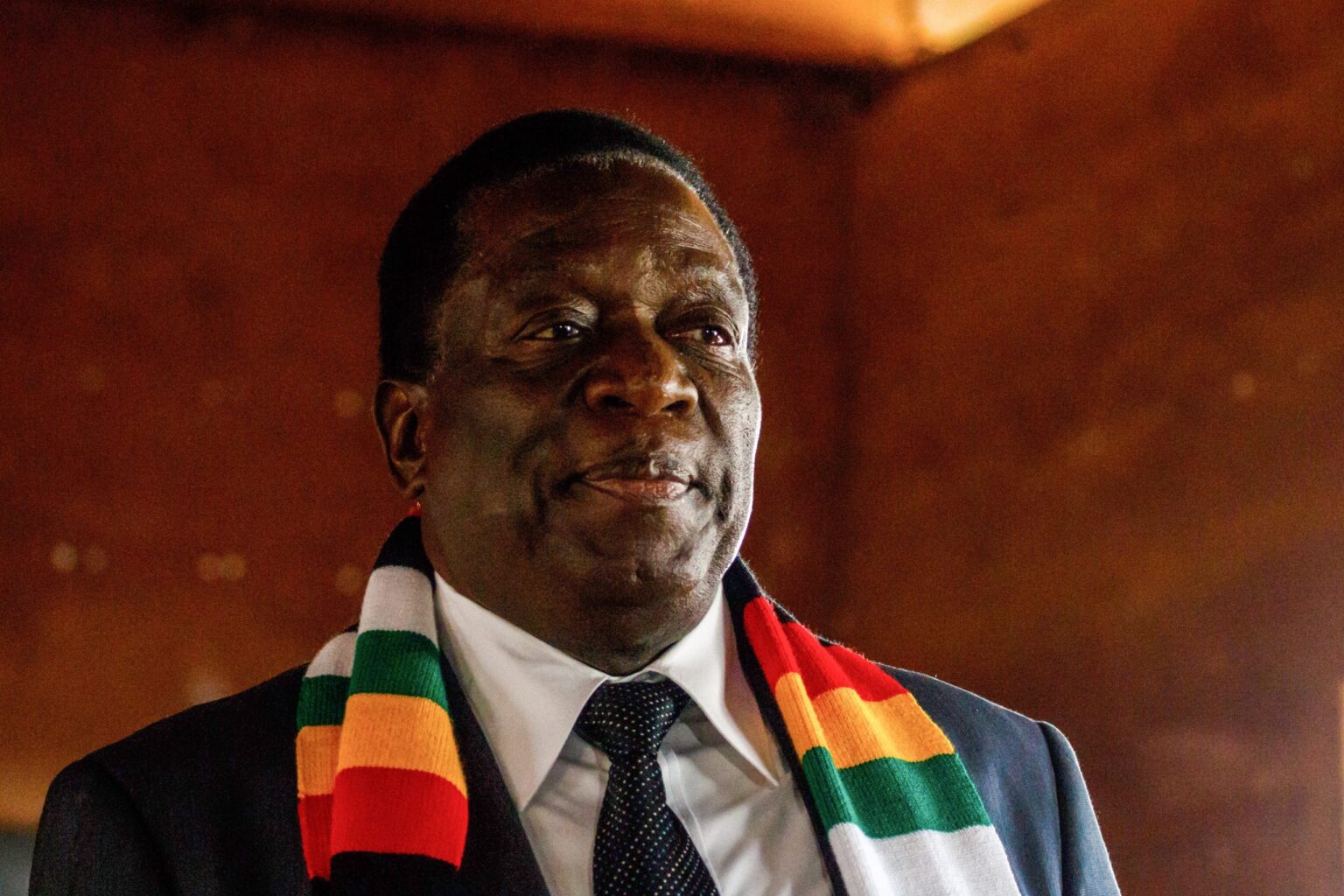
Under President Emmerson Mnangagwa, the political life of Zimbabwe has moved at a faster pace than its economic life; and because economics is about bread and butter issues which affect real lives, Mnangagwa’s government is struggling to maintain the high approval ratings it came into office with last year. With elections scheduled in a few months, time is running out for the new administration to make a decisive mark. Baffour Ankomah reports from Harare.
Zimbabwe’s immediate problem is economic. For the past two years, there has been an acute shortage of cash in the banks, affecting not only the smooth flow of personal life, but business and industry as well.
The failure to resolve the economic crisis, especially the lack of cash in the country, where it has become nonsensical to do business with the banks (if you put your money in the bank at 10am and go back five minutes later to withdraw it, the bank will not have the money to give you), was one of the main reasons for Mugabe’s downfall.
Though Mugabe’s government tried to overcome the lack of cash by introducing a quasi-currency, called Bond Notes in late 2016 and encouraging people to use more plastic money, it did not help. Business and industry suffered as the acute shortage of forex continued, leading to thousands of business closures and job losses, thereby worsening the high unemployment rate in the country and eroding hope for millions of people who were desperately looking for jobs or yearning to improve their lives.
This is the massive challenge facing the new Mnangagwa government, and because it takes time to fix broken economies, Mnangagwa and his two-month-old government have barely started.
But public opinion cannot wait and has (unjustifiably) started to crucify him on the grounds that things are getting worse under his government, especially price increases in the shops.
Unfortunately for Mnangagwa, time is his biggest enemy. He has only “four or five months” (according to his own reckoning) before facing a general election. He announced the time-span for the elections on a trip to Mozambique on 18 January.
“Zimbabwe is going for elections in four to five months’ time and we have to preach peace, peace, and peace because we know it is good for us and we have no doubt that we will have peaceful elections,” the President said, adding: “I assure the regional leadership that the forthcoming harmonised polls will embrace the tenets of democracy, fair play, and standards set by us in the SADC. We will ensure that Zimbabwe delivers free, credible, fair and indisputable elections to ensure Zimbabwe engages the world as a qualified democratic state.”
But if Mnangagwa’s government is not able to bring a marked improvement in the economy in the next four or five months, especially finding a solution to the lack of cash, which will have a ripple effect on other sectors of the economy, he and his ruling Zanu-PF party will have a hard time convincing the electorate to vote them into power again. This despite the fact that the main opposition MDC party is at its weakest going into the elections.
Already hints by the long-time MDC leader, Morgan Tsvangirai, about stepping down ahead of the elections on grounds of ill-health (he is battling colon cancer), have led to infighting within the party for his crown.
Politics moving on apace
Remarkably, while there has not been much movement on the economic front, the political life of the country has been travelling in the fast lane since Mnangagwa’s inauguration on 24 November 2017.
There have been many changes in political and public posts, including the removal of the longstanding police chief, Augustine Chihuri (who led the police force from 1994 to December 2017) and 30 of his most senior officers. It is a cull never seen in 38 years of independence.
What is more, for the first time in the country’s post-independence history, serving military officers have been converted into civilians and given high political appointments, perhaps as a thank-you for the role the military played last November in facilitating Mnangagwa’s rise to power.
General Constantino Chiwenga, the Chief of Defence Forces (CDF) who spearheaded the military intervention on 15 November that led to Mugabe’s resignation six days later, has been pulled out of the armed forces (“retired” is the official description) and appointed Vice-President by Mnangagwa.
Zanu-PF’s constitution allows for two Vice-Presidents (one each from the Zanu and Zapu wings of the party), and Chiwenga, coming from the Zanu wing, effectively becomes First Vice-President. Although officially the two Vice-Presidents are considered at par, by convention, the Vice-President from the Zanu wing is seen as number one and in pole position to succeed the president in case of incapacity due to illness, death or resignation.
The other Vice-President is Kembo Mohadi, a veteran Zapu guerrilla who served in various Ministerial positions under Mugabe. Apart from Gen. Chiwenga, other high-ranking military officers have also been asked to take off their uniforms (again, “retired” is the official designation) and appointed as ministers and political commissars.
The long-time Air Force Commander, Air Chief Marshall Perence Shiri (who had been Air Force Commander since 1992) has been retired and appointed as Minister for Lands, Agriculture, and Resettlement.
The general who announced the military intervention on national television at dawn on 15 November, Lt-Gen. Sibusiso Moyo, has also been retired and appointed Minister for Foreign Affairs and International Trade. Another military man, Major-General Engelbert Rugeje, has been given the powerful position of political commissar of Zanu-PF; effectively, he is now the man who runs the party’s nationwide branches.
However, there is now a public backlash against the appointment of soldiers to civilian offices, even though during the Mugabe era it was common to see already retired military officers serving in various positions in the public services and in Zanu-PF itself.
But now that a military man is Vice-President and others are in Ministerial positions, murmurs are being heard across the public spectrum to the effect that ‘the military are ruling’ or ‘the country has been militarised’.
As a result, in two short months the public adoration of the military that followed the intervention in November has given way to something close to resentment and even badmouthing, for the military allegedly capturing the state.
Perhaps if the economy can be turned around, or even some improvements can be registered in the next few months, it will not matter if a soldier or civilian did it. But the murmurs are increasing because the economy is stagnant, if not worsening, as retailers have increased their prices across the board and there is still no cash in the banks, and forex for business and industry has become more difficult to obtain even from the Central Bank.
In the meantime, President Mnangagwa has been travelling to neighbouring countries (South Africa, Angola, Namibia, Mozambique and Zambia) to appraise them of the political developments that brought him to power and the way forward. These are important regional (or SADC) countries whose support Zimbabwe will need on the road to economic and political stability.
High on the agenda of the President’s regional travels is the subject of his predecessor, Robert Mugabe, and how the new government is treating him. Everywhere he has been, Mnangagwa has been assuring his counterparts that ex-President Mugabe is safe and his welfare being taken care of by the new government, and that his legacy will be preserved as he has done a lot for Zimbabwe.
Mugabe returned from his annual medical check-up in Singapore in early January and has been resting with his family in his Borrowdale home, north of the capital Harare. He has been quiet so far, as has his wife Grace, not seen in public since the events of November. Against the family tradition, Mugabe travelled alone to Singapore, without Grace in tow.
In early January, the government gazetted Mugabe’s retirement benefits, which, looking at the economy, are quite generous.
Elsewhere, while President Mnangagwa has been preaching forgiveness, national reconciliation, and letting bygones be bygones, he has declared war on corruption, saying his government will fight the canker wherever it is found.
Taking a cue from the President’s words, some officials of the Zimbabwe Anti-Corruption Commission (ZACC), a statutory body empowered by law to fight corruption, have been using their positions to pursue personal vendettas against people they have had grudges with in the past, especially former ministers who sat for years around the same cabinet table with Mnangagwa, as well as creating the impression that the new president is out on a witch-hunt against his former colleagues. But that is not the intention of the President’s corruption crusade.
However, because these few but powerful ZACC officials are abusing their positions for personal vendettas, the Commission has been arresting people, including five former Cabinet Ministers, sometimes on very flimsy charges that have not brought honour to the name of the new government.
As a result, the arrests are building cynicism among the general population against the government, with the social media awash with calls on President Mnangagwa to take a critical look at the activities of ZACC, to prevent the Commission dragging the government’s good name in the mud at a time when a general election looms menacingly on the horizon. NA