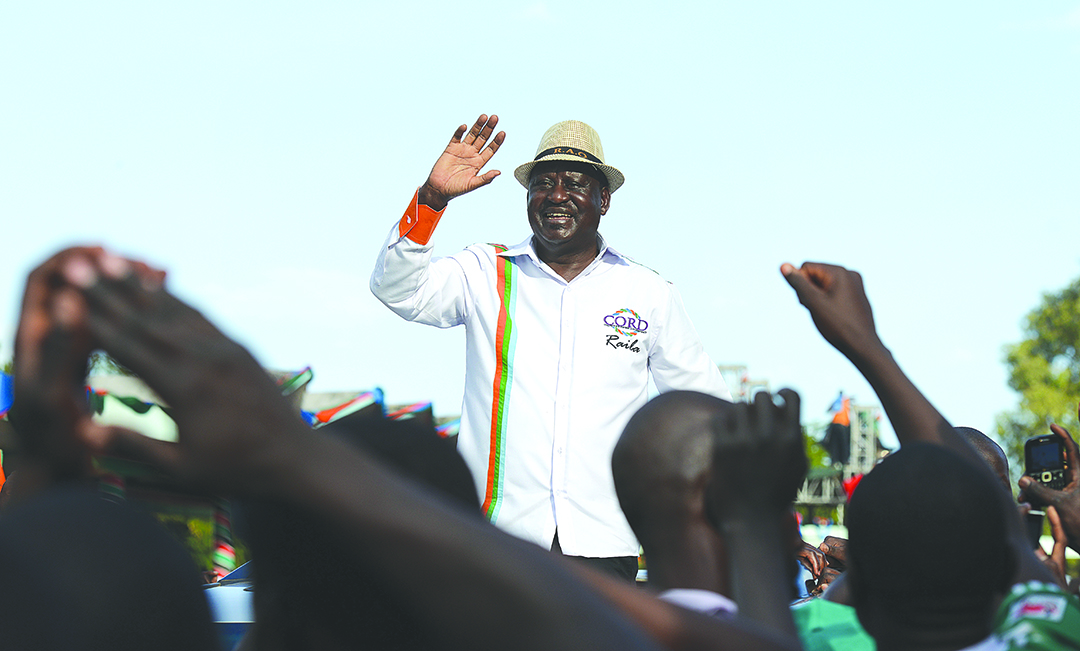
The political epitaph of Raila Odinga, Kenya’s former prime minister, began to be written a year ago. This started after his third attempt to become Kenya’s president floundered at the polls in which he was a favourite. Odinga lost to the less fancied Uhuru Kenyatta and some of his aides were contemplating his political retirement, with his star fading fast in Kenya’s political galaxy – but not any more. Wanjohi Kabukuru reports.
Just over one year in office, President Uhuru Kenyatta has spent the better part of his term to date complaining, talking tough on corruption and issuing ultimatums to civil service mandarins.
Little action has been seen from his government, which has found itself mostly reacting to situations as opposed to setting the agenda. Odinga, who had been in the US for a two-month sabbatical at Boston University’s African presidential centre, returned to Nairobi on the eve of Kenya’s Madaraka (self-rule) Day and unwittingly stole the Kenyan political show.
Initially, the word on the streets of Nairobi and in social media was awash with claims that Odinga had returned to Kenya to kick-start a hard-hitting “Kenya’s Spring” upheaval along the same lines as the revolutionary “Arab Spring” that started in 2010. However the former premier seems to have read the mood and the dynamics that define Kenyan society and instead opted for a softer approach and setting the agenda for the country as he bade his time.
A number of events conspired to give Odinga a much-needed political lifeline. Key among them was President Kenyatta’s slow pace in jolting the Kenyan economy into life; quibbling over devolution; dithering on bearing down on graft; and multiple gaffes in containing runaway insecurity.
Odinga did not rise to the centre of Kenya’s politics by sheer dint of luck but by playing bare-knuckled politics informed by an ability to sniff at opportunities and pounce on them when the prospect arose.
The highlight of Odinga’s address to thousands of his supporters at Nairobi’s Uhuru Park was a demand for a national dialogue conference, to be convened within two months. Odinga’s message was interpreted as meaning a call for a “grand-coalition government” similar to the one cobbled together in 2008 with former president Mwai Kibaki after the post election violence.
A few hours after Odinga’s call for national dialogue Deputy President William Ruto responded by saying there would be no dialogue, and Kenyatta made an announcement a day later echoing Ruto’s sentiments.
A day after Kenyatta told Odinga to forget a coalition government, Odinga and his Coalition for Reforms and Democracy (CORD) were at it again, setting the rules of engagement. Security, corruption, national unity, the electoral body and devolution, were the five points that Odinga tabled as the agenda to be discussed in the national dialogue conference.
Indeed the events of early June showcased Odinga’s political savvy and the ability to cash in his chips at the opportune moment. This skill has revived the man and thrust him back into the national limelight of Kenya’s politics. As was expected, Odinga is using every response from the Jubilee government as an opportunity to repackage himself as the alternative leader-in-waiting.
While inaction seems to be dogging the Jubilee administration, Odinga is openly using Jubilee’s missteps to reboot his political profile which three months ago had all but vanished.
In late February Odinga’s political party the Orange Democratic Movement (ODM) suffered its worst credibility crisis when its national elections were violently aborted at the last minute. To this day, ODM has not elected its officials. This inability to inculcate intra-party competition, which has been Odinga’s weak point for decades, is likely to blot Odinga’s re-engineering posture.However owing to the exigencies of the moment, Odinga’s Achilles’ heel is being ignored as the party is involved in a brawl with Jubilee.
Odinga’s message is apparently resonating with many of those who elected President Kenyatta, as they had expected the incumbent to speedily revitalise the economy towards the promised double-digit growth he pledged in Jubilee’s election manifesto.
The opposition, which appeared rudderless and beaten some three months ago, has now regained its composure and is running rings around Kenyatta’s government – putting them on the defensive. That the Jubilee government is now under pressure is in no doubt.
“We will keep the exchange rate stable and control the flow of money into the economy in order to lower interest rates and keep inflation in check,” the Jubilee manifesto reads in part.
However as Jubilee marked its first year since they were elected this promise is far from being met. Kenya’s economy is still wobbly, with manufacturers being saddled by the high cost of doing business and expensive electricity tariffs.
High interest rates, currently averaging 17%, have made access to credit difficult, and in a country with a population of 40 million there are only 20,000 mortgages in the market. Statistics from the Kenya National Bureau of Statistics (KNBS) only compound Kenyatta’s headache, who had promised to grow the economy by over 7% in the first two years.
According to KNBS the economy grew by a minuscule 0.5% with the main key sectors of agriculture and tourism declining as compared to previous years. Those who elected Jubilee expected Kenyatta to move fast and fortify the economy in readiness for middle-income status. Kenyatta’s pet project of a laptop for each child joining primary school still stands out as his administration’s largest failure.
Political intrigues and haggling for plum postings within the coalition government has seen the long-awaited reforms of state corporations taking longer than expected and in the process eroding the goodwill Kenyatta once enjoyed.
Matters have not been made easier for Kenyatta, whose efforts to revive the economy have been bogged down by travel advisories by the US, UK, France and Australia. UK travel agents went a notch higher by evacuating more than 600 British holiday-makers from Kenya’s coastal resort city of Mombasa.Modest estimates by the Kenya Association of Hotelkeepers and Caterers (KAHC) indicate that some 4,000 jobs have already been lost and more than 20 hotels closed as a result of the travel advisories.
Insecurity has spiralled and co-operation with Western nations deteriorated. Hovering in all this has been the continued threat of terrorism which has dissuaded investments, increased the country’s risk assessment and local insurance premiums.
On two occasions Kenyatta has been forced to come out fighting after his decisions were roundly criticised. The first time was when he launched the Chinese-funded $13.8bn Juba-Mombasa-Kampala-Kigali standard gauge railway line initiative, which critics had said was shrouded in kickbacks.
The second time was when he ordered for the corruption-ridden Anglo-Leasing related companies to be paid some Ksh1.43bn ($16.4million) by the state. While Kenyatta justified Anglo-
Leasing payments as aimed at getting Kenya to float the much awaited $2bn Eurobond, to the opposition this was akin to supporting corruption and they latched on to it with glee.
Other than these two controversial decisions Kenyatta’s government has also found itself confronted with the accusation of tribalism and failing to nurture national cohesion.
It is these collective faux pas by Kenyatta’s Jubilee administration that have helped bolster the opposition as they expose Kenyatta’s vulnerabilities, which a calculating Odinga has exploited to the maximum.
Kenyatta’s induction as the Kenyan president has not been easy. Conjoined by his deputy in their tribulations at the International Criminal Court (ICC) where they face charges for crimes against humanity, it is clear Kenyatta’s presidency will be faced by huge obstacles.
The return of Odinga into the Kenyan political matrix is likely to stir Kenyatta to action from his one-year honeymoon or distract him further. Apparently Kenyatta’s difficulties seem to favour Odinga and are according him a second fighting chance.
The events of the last one month are the clearest indication yet that the once outdone Odinga is firmly repositioning himself, for a fourth presidential bid in 2017, or the climate permitting, a “Kenyan Spring” before 2017.