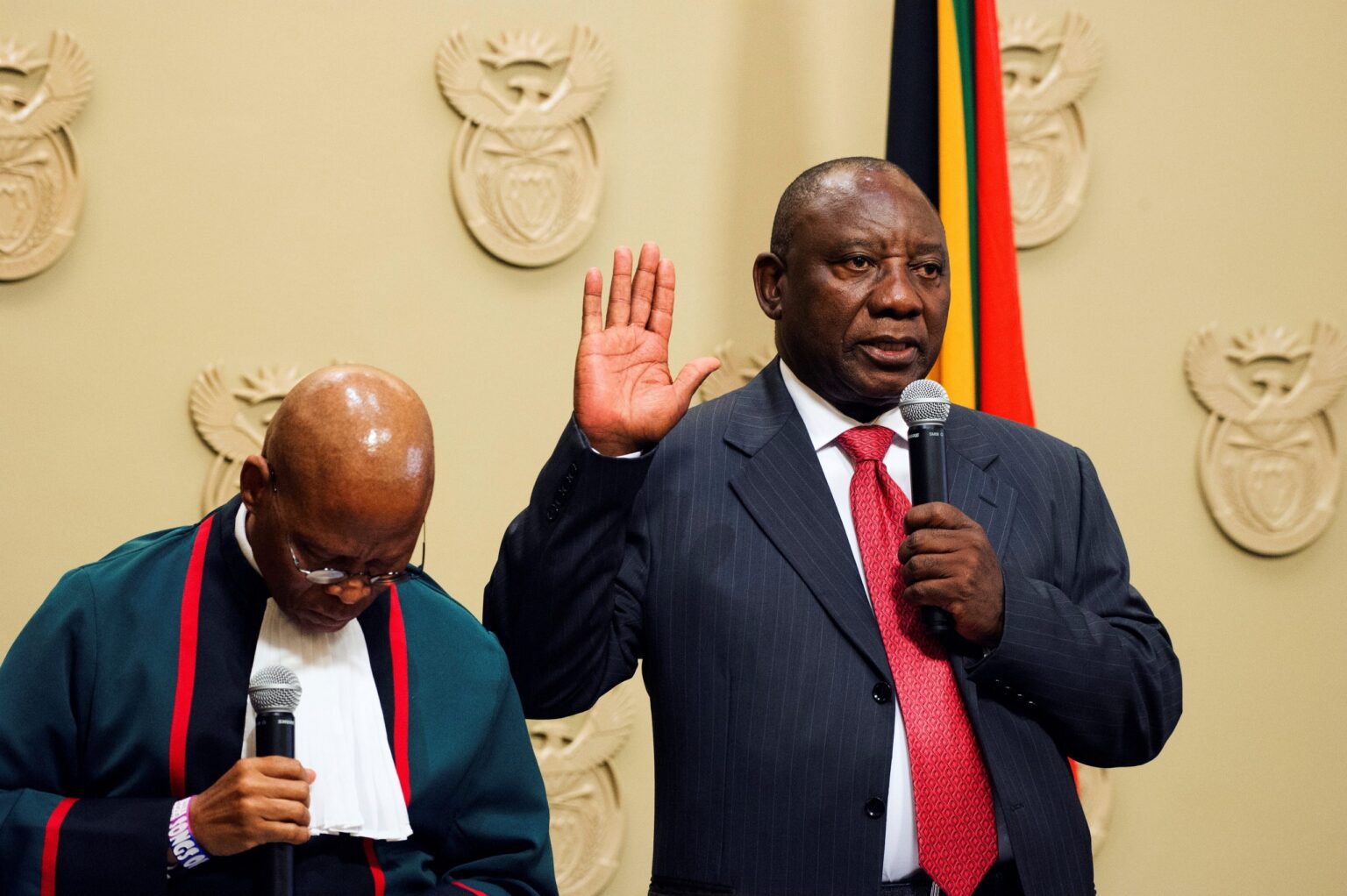
What does the report card say on Cyril Ramaphosa’s very early days as President of South Africa? Has his performance so far justified the sense of optimism that greeted the downfall of Zuma? Will he be able to cope with the increasing pressures that come with the job? Dr Desné Masie has been finding out.
In the March edition of New African, I explained how Zuma’s generally corrupt administration, and schisms within the ruling party the African National Congress (ANC) had hollowed out South Africa’s economy and institutions.
Zuma’s departure and Ramaphosa’s election are broadly positive developments, but there are still many question marks making the trajectory of South African politics difficult to discern, and their resolution will determine whether or not Ramaphosa can achieve electoral success in the 2019 elections.
While it is early days, the past two months have been crucial for Ramaphosa to cement his leadership. He has ostensibly been good for the economy, and has acted swiftly on the politically destabilising issues of land reform and free education. He even managed to squeeze in some foreign policy strategy by visiting Zimbabwe and Mozambique. But how has he really fared in the first months on the job and what other priorities lie ahead for him? I asked some top South Africa analysts for their thoughts.
Chief economist of the Efficient Group, Dawie Roodt says: “There is certainly a wave of optimism about Ramaphosa, but we need to be careful about this wave of optimism. Is it the case that we are feeling good that we got rid of Zuma? Or are we feeling positive because we got Ramaphosa in? So what is it? If you ask me, I think that getting rid of Zuma is weighing a little bit heavier”.
As far as Roodt is concerned, “Ramaphosa disappointed a little bit, but I can think of two things he did that are good, he replaced the board of [energy utility] Eskom; the second thing he did was he suspended Tom Moyane from the South African Revenue Service (SARS). But what I think is important for a political leader, is that they actually have to be a little bit ruthless, and I haven’t seen that in Ramaphosa yet.”
Ramaphosa’s early clean-up at SARS, by suspending its controversial head Moyane, has been particularly well-received due to his questionable and seemingly politically motivated behaviour, which has included the kidnapping of a senior tax official by the elite police unit and fast-tracking VAT refunds for Zuma cronies, the Guptas. The investigation is still under way, but one thing is clear, under Moyane revenue collection had not been working as it should.
Roodt adds: “While we understand that there are some political things that we don’t know about behind the scenes, and sure, he has the problem of an ANC that is split, and he needs to save what can be saved, what I am concerned about is that he has maintained some of the duds, and all the while the land expropriation issue is going on – certainly I think that is something that we all have to be very concerned about.”
Professor William Gumede, a political economy expert at the Wits School of Governance, says that the confidence and optimism that Ramaphosa’s presidency has generated in such a short space of time is key to longer term success in South Africa. Gumede feels that the mood in the country will shore up the economy and support South Africans in creating positive change over time.
The delicate balance of the divisions within the ANC at this time, he says, means that Ramaphosa can’t hire and fire people recklessly if stability is to be maintained, but otherwise, he is ticking all the boxes strategically.
I ask Gumede if he agrees with my analysis that the ANC is in power because it is a tripartite coalition with the left and labour; and because that coalition has recently been threatened by the split of the largest trade union, the National Union of Metalworkers of South Africa (Numsa) in 2014 from the trade union federation, Cosatu, the ANC may lose the 2019 election?
Gumede feels I have overstated the threat of Numsa’s departure. He believes one really needs a political party to effectively challenge the ruling party, as the Economic Freedom Fighters (EFF) have done. The EFF, a hard-left ANC Youth League offshoot, remain crucial to the balance of forces in South Africa, particularly in relation to land reform.
A toxic issue
Land reform through expropriation without compensation, which Ramaphosa has pledged, and the EFF has seized on, with violent, and often anti-white, rhetoric over the past month, is a legacy issue within the ANC, and there will never be peace in South Africa until it is resolved. Leading South Africa analyst Martin Plaut agrees. He says “the land issue is toxic, but it has to be dealt with”.
That land reform is top of the South African agenda again has created animosity and tension between white and black South Africans, with white South Africans, particularly farmers, fearing they will be murdered and kicked off their land, and some have drawn parallels with Zimbabwe, with dire warnings for food security. Investors, while broadly confident about Ramaphosa’s impact on the currency’s strength and on business confidence, wait nervously to see how the issue plays out.
The land issue has not only reopened apartheid wounds between left and right, white and black, but it has also, and probably most significantly, drawn in the advocacy and anger of South Africa’s first people – the Khoisan. The Khoisan inhabited the land before all these groups, and the most ironic and crucial aspect of the struggle over land is the reparations due to the indigenous first people.
Plaut says a month is too soon to make a fair assessment of Ramaphosa’s progress, but acknowledges it is already clear Ramaphosa is a very cautious and clever political player. Plaut says: “Ramaphosa has maintained security and has acted on the economy, and he has focused on it with laser-like intensity, which is the correct approach, because everything else is secondary to security and the economy just now. It was really good that he went into KwaZulu Natal and pacified the threats there from militias.”
The Zulu stronghold of KwaZulu is Zuma’s home turf and keeping it in line will be crucial to political stability. It has always been a volatile part of the country, and during the democratic transition in the early 90s, was plagued by explosive bouts of violence.
The efficiency and speed with which Ramaphosa has been able to build bridges and implement changes is impressive. However, it beggars belief that Ramaphosa did not have time to undertake some advance planning if the speed at which Zuma’s prosecution is now taking place is considered.
Zuma under legal cosh
With Zuma’s cronies, the infamous Gupta brothers, in hiding with largely frozen assets and Interpol in hot pursuit, he is being prosecuted for one charge each of racketeering and money laundering, two of corruption and 12 of fraud. Some of these charges involve longstanding allegations relating to bribery in the so-called ‘arms deal’ with French defence company Thales in the 90s.
It is very clear that the ANC could no longer hide the extent of Zuma’s kleptocracy and the rot it had spread within the party. How Ramaphosa’s presidency plays out therefore also depends on how Zuma’s trial plays out. There is no doubt Zuma will backstab others who colluded with him if any rent-seeking pillage can be proved, and this is when things will become ugly.
Former South African Minister for Intelligence and fighter in South Africa’s armed struggle, Ronnie Kasrils, said in London on 9 March, that Zuma’s Machiavellian tendencies were apparent to him during the armed struggle and he had warned Nelson Mandela about Zuma’s duplicitous and self-serving nature years back. There will be many members of the ruling party losing sleep over the coming year. NA