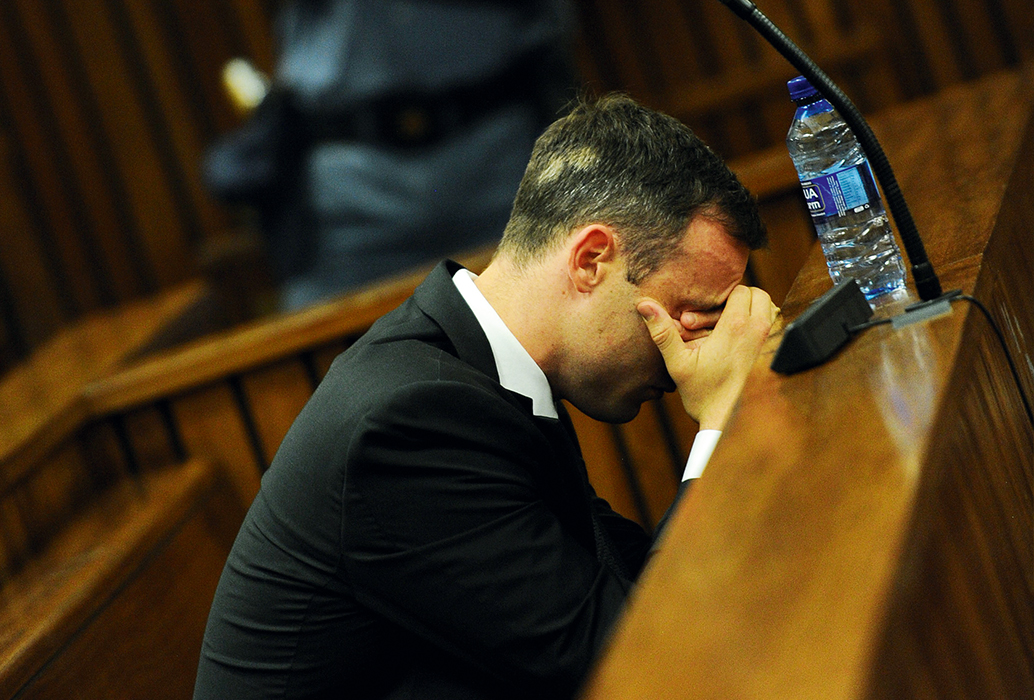
After a long battle in the courts in the full gaze of the media, Oscar Pistorius was convicted of culpable homicide and sentenced to five years in jail. The prosecution are now planning to appeal both these decisions. Pusch Commey explains what this means for Pistorius as well as for notions of African justice.
The Oscar Pistorius trial drama has been full of twists and turns, and these didn’t stop after his conviction. When it was time for his sentencing, controversy erupted once again and public opinion was split on whether he should go to jail, and, if so, for how long. Judge Thokozile Masipa eventually made her decision, passing down a 5-year sentence, but the battle is still not over.
Sentencing a convicted person under South African law is its own separate process to the trial. To begin with, the defence puts the evidence for the mitigation of the sentence, essentially putting arguments forward to the court as to why the accused deserves leniency. Part of this may consist of the convicted person taking the stand to testify themselves, whereby they are led by the defence, cross-examined by the state, and re-examined by the defence. There is also the option of calling witnesses, including experts on sentencing, who undergo the same process. If the accused chooses not to testify or call any witnesses at all, their lawyer may simply address the judge directly.
After this, it is the turn of the state to go through the same process, calling witnesses or not, in order to demand the augmentation of the sentence. Arguments are then made and the judge delivers a ruling. The exemplary case that is almost always cited on matters of sentencing in South Africa is The State v. Zinn. In this 1969 case, three main factors for consideration when sentencing were enumerated: 1) The seriousness of the offence, 2) The personal circumstances of the accused, and 3) The interest of society.
These often form the basis of decisions, but several other factors may also be taken into account, such as whether the crime was a first offence, the age of the convict, the level of remorse, and any relevant facets of the specific case. Lawyers may also refer to similar cases in the past, referred to as “precedents”, with the more recent cases and those that took place in superior courts given more weight. The Supreme Court of Appeal is the highest court of appeal, except where constitutional issues are raised, whereupon the matter is heard in the Constitutional Court, the highest court in the land.
Culpable homicide
Oscar Pistorius was convicted of culpable homicide, the unlawful negligent killing of a human being, for shooting through a closed door at a person he thought was an intruder. It was in fact his girlfriend Reeva Steenkamp. The crime carries no prescribed sentence.
In the past, first offenders for culpable homicide, who are usually individuals who killed through reckless driving, have walked away with a fine or a suspended sentence. Another recourse for an aggrieved party has been to sue the accused in court for civil damages. In South Africa, complainants can also appeal to get compensation from the Road Accident Fund, an account that is financed by a levy on fuel at the pump.
However, more recently, the courts have taken a more serious view of culpable homicide. Part of this is the result of popular anger at a spate of road accidents, many of which involved drink driving. These culprits have received longer sentences. A civil engineer, who drove under the influence of alcohol at dawn, killing four joggers and leaving one seriously injured, for example, was given a 12-year sentence in December 2013. Meanwhile, a popular musician who, under the influence of drugs, went drag racing through the streets of Soweto and fatally hit four school children was sentenced to 10 years for culpable homicide this October. He had originally been sentenced to 25 years for murder, but his appeal in the high court was successful.
Given these recent cases, Pistorius’ 5-year sentence has left many bemused, especially since cases involving firearms are judged more harshly than those without. Furthermore, some people have noted that under South African law, Pistorius could in theory serve just one-sixth of the sentence, or 10 months, in prison. If he applied to the Commissioner of Correctional Services on the grounds of good behaviour, he could serve the rest of his sentence under house arrest. Under these circumstances, he would stay at home and his behaviour would be monitored by a prison official for the rest of the sentence. Community work might also be included in this process.
The parents of Reeva Steenkamp expressed satisfaction with Pistorius’ sentence, but the prosecution have appealed it, describing it as being “shockingly light”. The prosecution had previously called on the judge
to hand out the maximum 15-year sentence for culpable homicide, and many members of the public agree that 5 years for killing an innocent woman is insufficient.
The defence, in its submissions, appealed to the African philosophy of Ubuntu, which is often translated as meaning “I am because you are”. In essence, the African mode of justice typically emphasises restoration and rehabilitation, rather than the kind of punishment, retribution or revenge that arguably lies at the heart of European justice.
The defence, in its submissions, appealed to the African philosophy of Ubuntu, which is often translated as meaning “I am because you are”
In the period before colonialism, African justice generally consisted of the guilty party making civil payments to the aggrieved. In serious cases, the person convicted might be banished from society. However, with colonialism came a prison- industrial complex that locked people away to waste and in which offenders were often sent to see out their lives on distant islands.
It was somewhat ironic then that the West lauded and applauded Nelson Mandela when he preached reconciliation and forgiveness, essentially letting off the perpetrators of gruesome crimes under the banner of the Truth and Reconciliation Commission.
Appealing rulings
In the case of Pistorius, the prosecution has applied for leave to appeal the conviction and sentence. Regarding the conviction, the main question is whether Pistorius should have been charged with the more serious crime of dolus eventualis murder rather than culpable homicide. In theory, the decision hinges on whether Pistorius foresaw that his actions would lead to the death of another person. However, in his case, the situation was complicated by the fact that he was on trial specifically for the murder of Steenkamp. And if Pistorius believed his girlfriend was in the bedroom when he fired the shots, he could not of course have foreseen that his firing of the four shots through the door into the bathroom would kill her. This is indeed what Judge Masipa ruled, but if this was overturned, Pistorius would face a minimum of 15 years in prison unless he was able to present compelling reasons as to why the minimum sentence should not apply.
The state meanwhile is also appealing the 5-year sentence, a move the defence will oppose. The date for another showdown has been set for 9 December when arguments will be heard.
If the judge determines that another court may rule differently, she will grant leave to appeal and the transcribed record of the trial will be placed before a full bench or the Supreme Court of Appeal.
Pistorius’ long-running story is far from over and what follows next will no doubt provoke more controversy regardless of the outcomes. However, whatever happens in the next chapter of the saga, it may be time to ask some more fundamental questions about what kind of justice should prevail in Africa. An African philosophy of justice or a colonial one.