
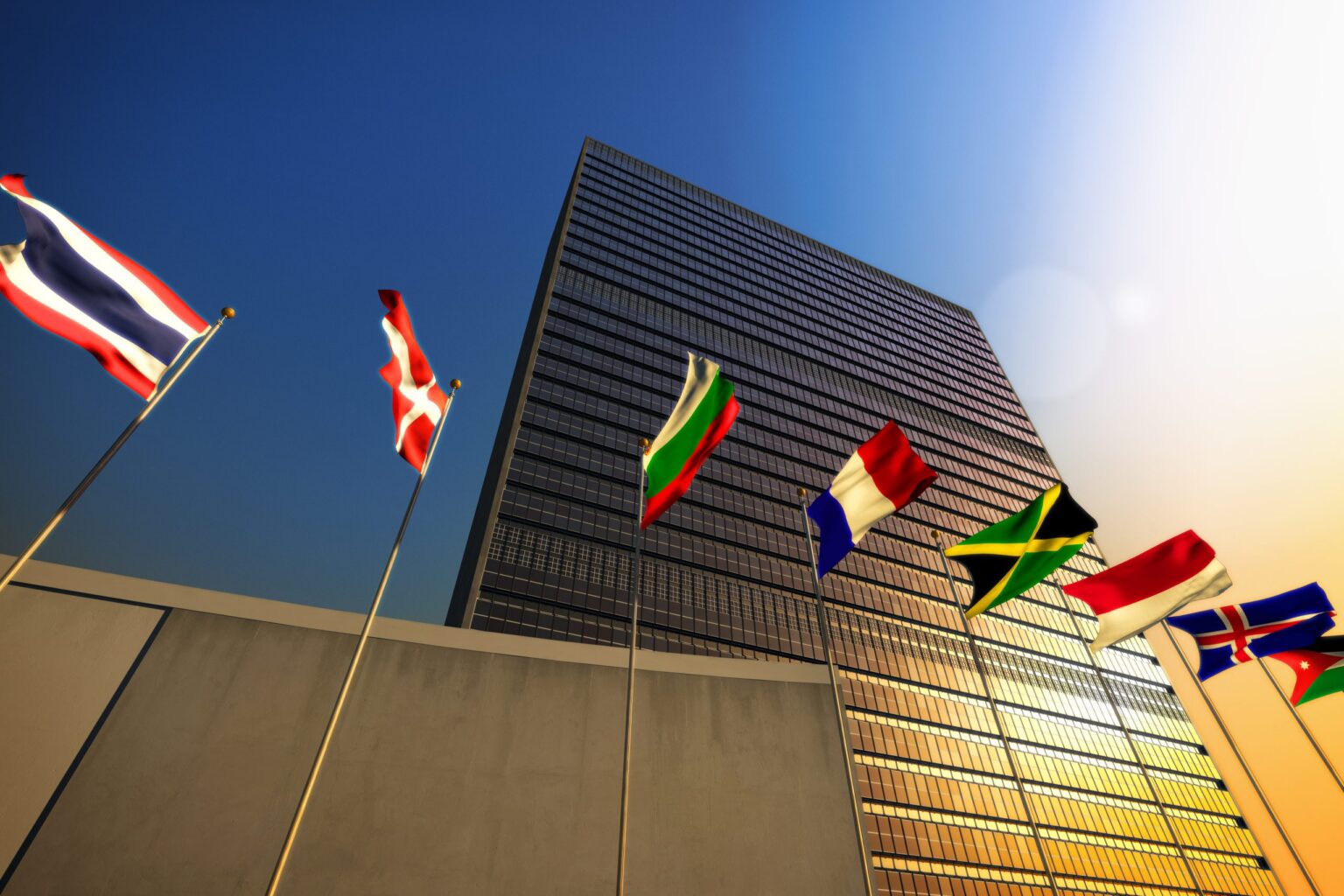
It is a given that times have changed at the United Nations, and the organisation itself is changing. But there are still some lingering issues when it comes to Africa. For example, why does a continent with 54 UN member countries still not have a permanent seat on the Security Council? This month, we devote our cover story to the African influence at the UN and what weight our ambassadors there exercise over decisions. Apparently not very much, if what one African ambassador says is any guide. He told our correspondent, Celhia de Lavarene, who wrote this piece: “I do believe that African diplomats are treated less than others because of the dependency the UN have developed on the superpowers… Yes, of course, things have changed, but you still have the same kind of racism as before, the same kind of approach when it comes to Africa, depending on the country of course. The continent is still divided into two parts: the rich and the poor. On the one hand, you have the countries that have oil and other natural resources that the West needs, and there are the other countries that have very little resources. So let’s be honest, nothing has changed!” Welcome to the UN, 2013.
Some 20 years ago, I asked Kofi Annan – who was then the head of what would become the UN Department of Peacekeeping Operations (DPKO) – if he thought that the time had come for an African to become the United Nations’ secretary-general. He burst into laughter before answering, “No, not in my wildest dreams.” We all know what happened next. For 10 years, from 1997 to 2007, Annan would become one of the charismatic UN secretary-generals ever. He was an African, but above all, he was Kofi. At the UN, the epicentre of global diplomacy, where every word has a resonance that carries incredible weight and importance, it is sometimes difficult for diplomats to drop their guard and dispense with the required diplomatic reserve their posts call for. In many ways, this is a microcosm that reflects the reality of international relations.
The French say: “On se cotoie, mais on ne se mélange pas”, which roughly translates into “we mingle but do not mix”. Living together at the UN is not always easy, and standing out or being excessively boisterous is not recommended. Rather, compromise and consensus is the golden rule.
The fact is that diplomats are at the heart of an echo chamber for all the problems and crises rebounding around the world. And it is an environment where one must be able to navigate the corridors of diplomatic power – what might be called soft or informal diplomacy.
The African continent – with 54 UN representatives in all – occupies a central place in the work of the Security Council, arguably the UN’s most powerful organ. No fewer than 60% of the Security Council’s activities are devoted to Africa – and half of the current UN peacekeeping operations are in Africa.
The unfortunate reality, however, is that at the UN, as elsewhere, everything hinges on the question of financial resources. There are the wealthy African countries and the poorer African countries. But in the temple of global diplomacy, it is the attendance of receptions and cocktail parties that is crucially important for the exchange of information and the making of personal contacts.
The appointment of some African ambassadors to the UN is often a sensitive subject. Indeed, for some representatives close to their country’s head of state, the appointment is a reward for their loyalty. But, conversely, for others the nomination is synonymous with a punishment or a sidelining, especially when they represent a political danger to their leader. In those cases, to be sent to New York as a UN representative is akin to being sent into exile.
“An ambassador who is a ‘political appointee’ merely attends the debates of the General Assembly and hardly sets foot in the committees or working groups,” explains Amara Essy, the former Ivorian ambassador to the UN and a former president of the UN General Assembly. “On the other hand,” continues Essy, the last secretary-general of the Organisation of African Unity (OAU), “a career ambassador may try to broaden his circle of friendship with the Asian and Latin-American ambassadors within the Group of 77 as he is fully aware that it is with the support of these groups that he can play a major role in the ACABQ, the committee which controls the finances of the UN, as well as in the thematic conferences, human rights, environment, and law of the sea committees.
“Let’s not forget,” Essy points out, “that the law of the sea has been a springboard for many ambassadors who have become members of the Tribunal for the Law of the Sea in Berlin. Among them are Paul Engo from Cameroon, and José Luis Jesus from Cape Verde.”
Not a nonentity
The UN is a tremendously competitive place and requires a representative to be truly organised, in order to deal with the many issues that arise, such as climate change, environment, sustainable development, political transformation, decolonisation, and peace and security.
“The more dominant the country, the better organised; the more ideologically clear, the better are the chances that the country’s objectives will succeed,” says Macharia Kamau, Kenya’s ambassador to the UN. “At the UN, you are engineering ideas, views and positions every day, and you want them to be dominant in that environment, so whichever committee you are on, you need to have personnel working and moving resolutions forward. These are resolutions that legislate the way in which the world works together.”
This is a point that most, if not all, ambassadors agree on. If countries are disorganised, underdeveloped, and do not have the human or financial resources to invest in the UN process, they are bound to be marginalised over time, and their ideas, whether they are about development, peace, environment or climate change, could well never see the light of day. Obviously, and regrettably, there are many African ambassadors who lack the power, personnel and resources to fully engage in the UN process. This is one of the reasons why the UN, in many ways, has become significantly the debating chamber for the rich and powerful nations of the world. It is quite obvious that the famous principle of the UN Charter – “one country, one voice” – does not apply to those poorer countries. Most African permanent representatives view the UN as reflecting a tough global reality. “No one can say it is unfair if one looks at the world as a place where there is a lot of pity,” Ambassador Kamau says. “It is something that only comes with time and understanding. If you do not appreciate this, then you come to the UN in a very naïve way where you think that you are going to get help or sympathy, passion or understanding gratis.
“The reason we take the UN seriously and try to bring our best and brightest here is because we have recognised that to be able to fully engage, we must invest in areas and position ourselves strategically, as we draft resolutions or when it comes to peacekeeping and negotiations. Thus, we [Kenya] have refused to be a marginalised nonentity because we have refused to take a cynical approach,” Ambassador Kamau adds.
Competition at the UN
So what does one mean when talking about competition at the UN? It is really a competition for ideas – for it is those ideas that govern the world in many ways; ideas about global leadership, global democracy, competition for political positions, and competition around image.But one must never forget that the UN is a platform about global democracy, and that the role of a permanent representative is to push for his country’s ideas. “When countries do not come here to promote their political, cultural and security objectives, they miss the opportunity of using the UN for what it really can be useful for,” says Ambassador Kamau.
The amount of work that a permanent representative is expected to undertake is considerable, and the pressures of the post are never less than intense. It is therefore especially difficult for small African states that are unable to support their representatives with adequate staff. Monitoring the many drafts of documents and resolutions that pass across a representative’s desk from the numerous structures of the UN is particularly demanding.
Nevertheless, some small missions punch above their weight and succeed in being heard because their ambassadors are deeply committed to certain issues and they become important players in the decision-making. In such cases, he, or she, might even be entrusted with the presidency or the coordination of a working group.
Nelsone Messone, Gabon’s ambassador to the UN, makes the argument: “In order to represent his country, a permanent representative has to take several factors into account: charisma is an important factor, but the interest shown to an issue is another factor, as well as the ability to mobilise groups of colleagues around a particular issue and the way in which he or she tries to achieve a consensus on a position around an idea or a decision. It is the combination of all these factors that makes an active ambassador stand out from the others.”
Being listened to, or being able to influence discussions or action on a particular issue, or articulate a position that goes towards the interests of Africa are essential if one wants his country to play a role on the international scene.
“When we are in a high UN position and are entrusted with issues that are not labelled specifically ‘African’, we have the responsibility not only to the entire system but to all the states concerned,” says Ambassador Messone. “At the moment, we have an African [Babatunde Osotimehin] who is the executive director of the UN Population Fund. It is clear that the scope of his position goes beyond Africa, although African issues, when it comes to population, are equally important. We have a special advisor to the UN secretary-general dealing with African issues. The success of Africa’s ability to be heard depends on these factors [the influence and respect they manage to engender].”
Ismael Abraao Gaspar Martins, the Angolan ambassador to the UN agrees: “There are decisions which we normally take collectively within the African Group, but there are other decisions on which we are divided. However, I would say, by and large, for decisions on candidature, on peace and security – since we also have the AU – we normally tend to reflect the African position.
“The main decisions at the UN are taken at the level of the Security Council, which is the main organ. There, we [Africans] do not always appear to be speaking with one voice. We do have views normally reflecting our countries’ positions, but these days we are more and more reflecting the views of the AU, especially on questions of peace and security. For example, on the very old question of the Middle East, every year – at the AU level – we take a decision on the recognition of Palestine. Most of us are in agreement that it should be a two-state solution,” Ambassador Martins discloses.
Africa’s weight
On another very controversial issue: the resolution which is passed every year on the US embargo against Cuba, all Africans agree that the embargo belongs to the past and must be lifted. But on other matters, Ambassador Martins says: “Sometimes, we do not agree at all. We did not agree on the question of Libya. Some countries were in favour of the new administration created in Libya, others were not. This is where some countries tend to reflect a bit more independence vis à vis the views of the major powers at the Security Council. This is when we normally find the need for more consultations. This is where we can draft resolutions or reach conclusions that are more consensual.”
Another ambassador who knows exactly the way the Security Council operates, is Messone of Gabon. His country was a non-permanent member of the Council between 2010-2011. “I can tell you that Africa weighs in on Security Council decisions,” he says, “because there are regional advocacy groups, focus groups and strategy groups that have an influence on the course of particular decisions.
“In fact, African ambassadors arriving at the Security Council have, as a basis, the African Group that is fairly active, that works and meets quite often on major decisions affecting the continent. Africa may have its word too, even by one or two votes, on an important decision that does not necessarily concern or directly impact Africa.
“When Palestine brought its application for recognition before the Security Council recently, one African country was among those who could have tipped the balance one way or another, if the matter had come to a vote. It goes without saying that in the sanctions committees created by the Security Council, Africa plays a role.”
And it is a role that can be tough at times – because the international reality is a “reality of power asymmetry, and asymmetry of power”, as Messone puts it. “When a decision is made to implement a mission following a crisis, it is not just the decision of the Security Council. It is what is behind the decision, whether it is financial, human, material, and military, that determines whether the mission will be effective on the ground.”
There is usually a debate that leads to the establishment of such a mission, its mandate, and what is done after the different phases of the mandate. “Once there is a consensus, we look into
the means, and of course, some countries are richer than others when it comes to those means,” Messone explains. “This is what I meant when I used the word ‘asymmetry’. We must take into account those who put considerable resources on the table, regardless of their opinions and concerns. The goal is to always get a relatively consensual decision which takes into account the concerns of all.”
According to Messone: “Africa today significantly affects UN decisions. We have just finished a major exercise, which was the Rio+20 Summit that contributed to the discussion on the development agenda after 2015. During the whole process, Africa has been exemplary in the sense that it spoke with one voice.
“Development primarily affects African countries, therefore on these issues the African voice is heard and weighs in on decisions. However, we need to go back to the question of means because once decisions are made, they should be financed. This is where the necessity of a consensus becomes important. We see it today in the negotiations over the Kyoto Protocol [on climate change] where Africa, the Group of 77, and China are not necessarily on the same wavelength. Within the Group of 77, you have emerging countries like India, China and others, who are not necessarily in line with the concerns of Africa.”
The changing times
Twenty years ago, Africa did not have quite such an impact on decision-making at the UN. Times have since changed and Africa now has a voice that has become stronger and more united. For example, “On the question of Sudan,” Ambassador Martins recalls, “Africa was not favourable to the views expressed by some of the major powers that there should be a prosecution against President el Bashir [at the International Criminal Court].
“We told the major powers that in our view, we had to have more dialogue on this question, especially listening to what Africa had to say on the creation of South Sudan. Africa was very much in favour of the creation of a new state as a result of negotiations between Sudan and South Sudan. We came to a position where our views were vindicated because we stood firm.”
When it comes to Africa and the economic questions, Ambassador Martins does not agree that the voice of Africa is strong enough to be heard by the major powers. “Sometimes our work does not have enough impact on the decisions taken. This is the reality. Most African countries, especially on economic matters, do not see an increase in assistance to Africa. Yes, some answers on the main questions are not in the hands of the Africans who themselves are in the hands of the developed world. So we don’t see the results of our work. As a result, we should have a more important voice in organs such as the Economic and Social Council. We have enough numbers, but our voice is not strong enough to be heard. So the decisions that are taken do not respond to the great need of the continent.”
This, in fact, echoed a concern expressed by another African ambassador, who wanted to remain anonymous: “I do believe that African diplomats are treated less than others because of the dependency the UN has developed on the superpowers,” he said. “It might be because we are the first victims [of this organisation]. So if one thinks that Africa plays a better role now than before, one is wrong.”
He went on: “Yes, of course, things have changed, but you still have the same kind of racism as before, the same kind of approach when it comes to Africa, depending on the country of course. The continent [in the eyes of the UN] is still divided into two parts: the rich and the poor. On the one hand, you have the countries that have oil and other natural resources that the West needs, and there are the other countries that have very little resources. So let’s be honest, nothing has changed!”
Yet, for most of the African permanent representatives at the UN, it is the only place where their demands can be aired and heard, and where they can speak openly. “There is no other forum in the world today similar to the UN, although it is not perfect, ” admits Ambassador Martins. “But let’s be realistic: the UN cannot resolve all of Africa’s problems because some of the countries that have political importance do not want to see a resolution of particular problems.”








