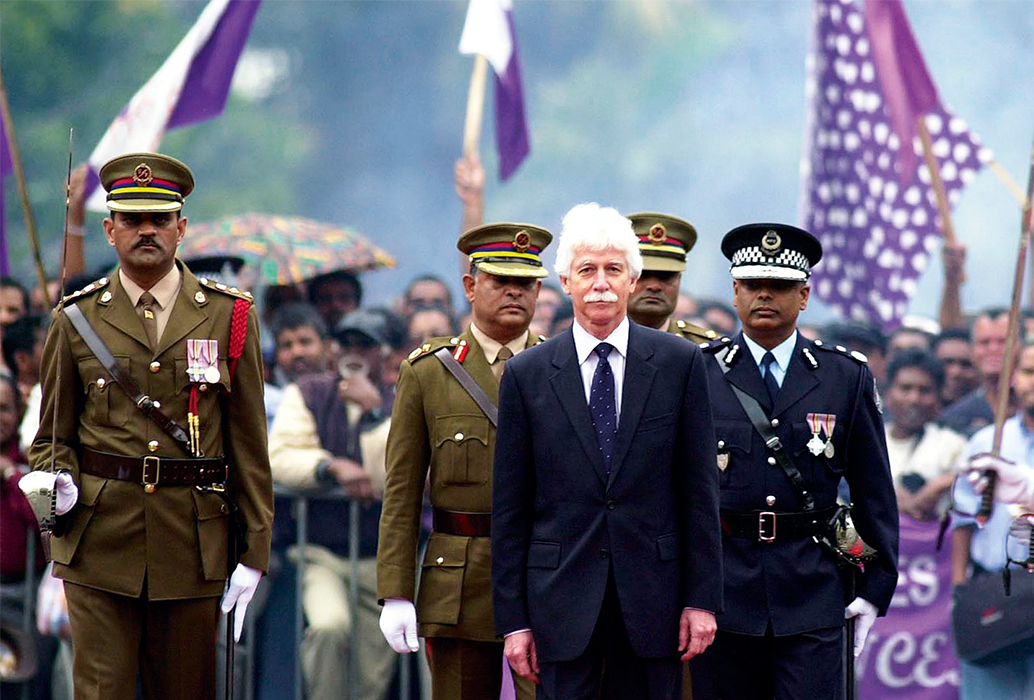
The political landscape in Mauritius, one of Africa’s most vibrant democracies, is shifting. Parliament has been dissolved, elections have been called, new parties have sprung up, and the prime minister and opposition leader have suddenly teamed up and want to create a new constitution. Sean Carey explains what it all means.
Mauritius is famed for its azure waters, white coral beaches and swaying palm trees, but it can also lay claim to being one of the liveliest multi-party democracies in the world. And since the announcement that the polling stations for the general election will open at 6 am on 10 December, the political temperature of the Indian Ocean island, which is always high, has risen to feverish levels.
Earlier this year it looked like the elections, which under the country’s current constitution are held at least every five years, would be a straightforward contest between the Mouvement Militant Mauricien (MMM) and Mouvement Socialiste Militant (MSM) coalition on the one hand, and the Labour Party and its junior partner, the Parti Mauricien Social Démocrate (PMSD), on the other. But all that has changed in the last few months. Paul Bérenger, 69, until recently the leader of the official opposition as head of the largest party, the MMM, unceremoniously ditched his sometime friend and sometime rival, former prime minister and president, Sir Anerood Jugnauth, 84, of the MSM, and found a new partner in prime minister and Labour Party leader, Dr Navin Ramgoolam, 67. Bérenger and Ramgoolam, son of Mauritius’s first prime minister, the late Sir Seewoosagur Ramgoolam, joined forces ostensibly to create a new constitution for the country – for a second republic, which, as well as introducing proportional representation, would transform the presidency from a ceremonial position into one with considerable power. Under this system, the executive function would be split between an elected president with a term of seven years and an elected prime minister with a term of five.
The claim put forward by Ramgoolam and Bérenger both to their supporters and the wider electorate, is that this new division of powers will herald a widening and deepening of Mauritius’ democratic space. The hope is that these changes to the political structures in place since independence from the UK in 1968 will revitalise the island’s economic fortunes, which have been badly hit by continued sluggish growth with its main European Union trading partners, such as France, Germany and the UK. But critics have been quick to point out that the new alliance is less about the nation and more about personal ambition – in particular, Paul Bérenger’s enormous desire to become prime minister for a second time (his first stint lasting just 2 years in 2003-5), as well as Navin Ramgoolam’s long-standing intention to assume the presidency whilst maintaining at least some grip on power. Otherwise, the argument goes, how is it possible to explain that the fierce, decades-old rivalry of the leaders and the teams of the two largest political parties in Mauritius, the MMM and the Labour Party, has been set aside so swiftly?
How is it possible to explain that the fierce, decades-old rivalry of the leaders of the two largest political parties has been set aside so swiftly
There are also concerns about the depth and strength of the relationship between Ramgoolam and Bérenger. Observers claim that their historical relationship has never been easy, and there is suspicion that the two men’s newfound friendship is only holding because they are not currently competing against one another. The expectation is that if they do eventually form a government – and some argue that it is a big if – then it is only a question of time before there is conflict over one or more areas of policy. If this happens, the proposed power-sharing agreement of president and prime minister in the second republic may never materialise.
Unsurprisingly in this febrile atmosphere, new political parties have emerged, including two parties headed by two female former academics: Ensam, meaning “togetherness” in Creole, led by English and Creole literature specialist Dr Roshni Mooneeram; and Le Parti Justice Sociale (PJS) headed by sociologist Dr Sheila Bunwaree. The main message of these parties is very similar, based on interlinked themes of political and moral renewal, including gender equality and environmental sustainability, underpinned by the promise of a future meritocracy. The hope of these new political entrants is that their message will appeal to young urban voters, many of whom cannot find jobs commensurate with their academic qualifications, or those who feel alienated from the politics of patronage. The message to the body politic is neatly summed up by a line from a poem on the Ensam website: “Ensam is the rush of fresh, fiery blood through veins tired with old, polluted streams”. That said, no-one quite knows how many votes the political metaphors of Ensam or the PJS will garner when it comes to judgement day.
A broader question, given the relatively poor turnout at recent rallies in the towns of Quatre Bornes and Vacoas, is whether the population is still engaged or whether it has lost faith in what can be achieved by supporting the large, traditional parties. If disenchantment is real, this prompts a further question: will scepticism about the policy delivery of the mainstream parties result in increased support for smaller parties, including those on the far-left or those campaigning on local neighbourhood issues?
Making these questions more difficult to answer, of course, is that it appears that no-one – neither political activists nor expert local analysts – can work out the intentions of the so-called Facebook generation, those younger voters under the age of 35 who make up around half the island’s 1.3 million multi-ethnic population. There is no doubt that these young people are far less deferential or loyal than their parents and grandparents to old political structures and lineages.
All this means that the outcome of the forthcoming election is difficult to predict. What makes it all the more interesting is that, in recent weeks, the respective leaders of the MMM and Labour Party coalition are no longer quite so confident about their prospects. Boasts of crushing the opposition by winning all available parliamentary seats are heard less frequently now, as adjustment is made to the rapid clustering of opposition forces, including the PMSD, headed by former finance minister Xavier-Luc Duval, 56, and the combative Sir Anerood Jugnauth. The veteran politician still commands respect among sections of the electorate for presiding over an economic boom when he was in power from 1982 to 1995 and again between 2000 and 2003, claims he will usher in another one, and is busy capitalising on the uncertain and lukewarm attitude of many long-standing Labour and MMM supporters towards the proposed changes to the constitution without a referendum. The fear is that such changes will benefit the executive at the expense of parliamentarians, indirectly jeopardising the prospect that Mauritius, which has cleverly positioned itself as the gateway between Asia and Africa, will make a smooth transition from a middle-income to a high-income country by 2020.
(Dr Sean Carey is honorary senior research fellow in the School of Social Sciences, University of Manchester.)