
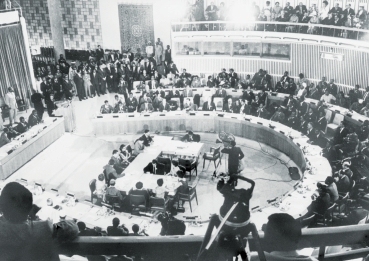
“The OAU is the one thing we’ve got that unites us,” said the Nigerian foreign minister Joe Garba. But President Julius Nyerere remarked bitterly and accurately that “Britain and France had more power in the OAU than did the African states”. This piece written by Guy Arnold and published by New African in September 1976 takes a close look at the OAU.
The disunity over major issues and individual quarrels between members that emerged at the OAU summit in Mauritius in June 1976 raised once more the question as to whether the OAU was about to break up. But as Nigeria’s Commissioner for External Affairs, Joe Garba, said earlier in the year at the time of the Angola Summit: “The OAU is the one thing we’ve got that unites us.”
It is always easy to belittle the activities of the OAU: any international gathering comprising more than 40 countries is more likely to expose differences than discover views in common. Once the base factors shared by OAU members have been taken into account, there are at least as many inter-Africa problems that will divide as will unite.
The base factors, however, are important. There is the business of being African, of sharing a continental background; there is the question of poverty and development, of recent colonial exploitation and the need for a common front to the rich developed world; there is the question of racism and the common opposition to white minority rule in the South.
Yet, given the unity that arises from a more-or-less common approach to these questions, there are otherwise no obvious reasons why the OAU’s members should find more in common with each other or less to quarrel about than any other group of comparable size and background. And, that being the case, the real wonder is that the organisation has managed to survive as well as it has for as long as it has. The OAU Charter talks grandly of governing Africa; what the organisation in fact provides for its members is a working body that is of limited practical use for some of the time. Many of its procedures are highsounding and ineffectual while all too often its sessions are dominated by meaningless speeches and slogans.
Yet it has also served as a bridge between heads of state and members who otherwise would have continued at loggerheads and it has made possible reconciliations which otherwise would not have been achieved. More importantly, it has helped produce a united African voice in the larger world forum of the United Nations.
Secretary General
The fact that there is no forceful OAU programme or policy on many matters of keen concern to all members lessens even that authority which the organisation does possess. The basic problem is that no effective power has been given to the secretary general and no country has shown any desire to surrender real authority to the organisation either. The secretary general has four assistant secretaries-general who are all political appointees and all have to agree before any action can be taken. To be more effective, the OAU needs an executive as opposed to an administrative secretary general. It is indicative of how little members would surrender authority to the organisation that the 21-man Commission of Mediation, Conciliation and Arbitration, which was set up to adjudicate interstate disputes, folded up in 1970, after three years of total inactivity because no state was prepared to submit to its authority.
Despite the unwillingness of members to surrender any power to the organisation, the OAU did still have some achievements to its credit in its first 10 years; there were solutions to disputes; the bringing of Africans together; the establishment of a joint African voice; and the regular meetings of heads of state which often led to agreements that otherwise were unlikely to have taken place. The search for unity in Africa, however, has been as difficult and elusive as comparable searches (where they have taken place at all) anywhere in the world. At least Africa tries.
Liberation movements
The major issue which over the years has been productive of more unity in the organisation than any other is that of Southern Africa and yet the failures in this field – for example, to bring warring liberation movements together – are not faults of the organisation; rather, they are the result of asking the OAU to do more than it conceivably could.
Always it has been a question of power. At the November 1966 summit that was dominated by the question of Rhodesia and at which no progress was achieved, Nyerere remarked bitterly and accurately that Britain and France had more power in the OAU than did the African states: “…This is sad for Africa. Africa is in a mess.
There is a devil somewhere.” Efforts to give the OAU teeth have failed; there is as yet no sign that members want true unity in Africa – that is, the kind of unity that entails the sacrifice of power to a central authority.
Over the years the OAU has learnt some caution. The 1965 resolution that members should break diplomatic relations with Britain over Rhodesia – of 36 members, only nine obeyed the resolution – was a farce that taught subsequent caution about such a demonstration of principle, for when it comes to the point it was pragmatism taking a look at British power that won the day. The formation of the OAU itself was a reaction to the tendencies of the early 1960s that threatened to split the continent into a number of rival and contending groups.
The coming into being of the OAU at least signified an African desire for joint diplomacy and continental handling of problems. The weaknesses of the OAU are certainly no greater than those pertaining to the UN; at least no one possesses a veto. But fundamentally the organisation can only act according to the political will of its members. Over a wide range of topics, members do not wish to act at all – so the organisation does nothing. Over a few topics it does act or would if the collective will of the members could actually be translated into action but that, of course, also requires power and in fact very little power resides in the hands of OAU members.
It is true that issues of racism, apartheid and liberation in Southern Africa provide the widest area of general agreement in principle for OAU members, but here too disunity is often engendered as unity. In the 1960s, the biggest problem was apathy: the white regimes were firmly in control and there appeared little likelihood of upsetting the status quo. The result was that at least some African countries wanted to come to terms with the situation they saw no prospect of altering and only a few leaders, such as Nyerere and Kaunda – of the “frontline” countries – persistently kept alive issues to do with the South. The OAU did endorse and adopt the Lusaka Manifesto of 1969 as the basis of its policy towards Southern Africa. Almost immediately afterwards, however, the question of “dialogue with South Africa” was to split Africa and it was not until 1972 that those opposed to dialogue had their way and ensured that the OAU would not follow that line.
With the fall of the Portuguese prime minister, Marcello Caetano (in 1974), events in Southern Africa began to move so fast that it really did look as though effective actions might be taken. So the détente exercise of 1974 was launched and that, too, threatened splits in the OAU. As a policy, it was far from universally popular and critics of the four frontline countries – Tanzania, Zambia, Mozambique and Botswana –were only too ready to say all approaches to South Africa should go through the OAU or not at all.
On two major issues concerning the South – the quarrels between the various Rhodesian nationalists and Angola – the OAU has appeared to outsiders to be singularly ineffective. It has certainly tried often enough to bring the various Rhodesian factions together so that they could present a united front to the Ian Smith regime; it has so far always failed.
Yet the failure was not for the want of trying; nor really could the OAU be blamed for it. Rather it was inherent in the kind of situation existing in Rhodesia: the quarrels between the factions are simply not going to be resolved because an outside force tells those involved to stop.
Angola – another divisive issue
The Angolan story is much the same. The OAU certainly tried. It was the OAU initiative that produced the Kinshasa Agreement of December 1972 between the MPLA and the FNLA. And throughout 1975, the OAU worked hard to bring about reconciliation between the warring factions in Angola, culminating in the extraordinary summit of January 1976, which split the organisation exactly down the middle.
The split that took place on this issue highlighted the inability of the Organisation to resolve such a question. This however is hardly surprising: 46 countries in Africa [as it was then] have as wide a range of interests and ideological inclinations as 40-odd nations anywhere else, and their “Africanness” alone is not enough to override all the other considerations – and that fact lies at the root of all the OAU problems and divisions.
The OAU was far more successful on a quite different issue, that of African unity, in negotiations leading up to the signing of the Lomé Convention. It was, indeed, a great victory for African unity that in 1973 it was agreed that there should be a continental approach to the European Economic Community (EEC). Effectively it was an OAU decision that all its members should form a joint front for any negotiations with the EEC. Towards the end of 1973, the African, Caribbean and Pacific group of countries got down to the essential bargaining with the EEC.
Africans discovered a sort of unity despite many individual differences, and agreed to negotiate as a bloc. By maintaining solidarity and working through the OAU, they hoped to ensure that there would be no split as between the Yaoundé members and the mainly Commonwealth associable states, and by November 1973 Nigeria’s ambassador in Brussels, Olu Sanu, could speak on behalf of all 43 [at that time] when he said that their target was “the increase in the volume of our countries’ separate remunerative prices to the markets of the EEC’s member states”, and he called for “complete free entry”.
In terms of African diplomacy, the eventual outcome – accession of the 46 to the Lomé Convention – is perhaps less important in one sense than the way in which it was achieved. As one commentator has put it: “The formation of a common African stand is probably one of the more interesting and significant diplomatic achievements in Africa in the last decade, for although Africa has managed to achieve a common stand on a number of issues, its future relations to Europe provided a much less obvious rallying point than that of Rhodesia, for example, or even Israel.”
Certainly the common front presented to the nine EEC member states in July 1973 by Nigeria’s Commissioner for Trade and Industry, Wenike Briggs, must have surprised many, both Europeans and Africans, aware of the huge differences that had to be overcome and the difficulty of persuading so many countries to act as a group.
The united front presented and maintained at Brussels was the result of many carefully planned meetings and in these the OAU had played a leading role. The point in this case was that the African countries had a sufficiently powerful reason to act together and knew that their best chance of success in negotiations lay in maintaining unity. In such circumstances the OAU could, and did, provide a framework for successful united action.
Sometimes the OAU helps bring about reconciliation, as, for example, at the seventh OAU Summit in 1970, between Nigeria and those countries such as Zambia and Tanzania that had recognised Biafra during the Nigerian civil war. And sometimes the pressures exerted by the Organisation have at least prevented quarrels from deteriorating beyond control – as, for example, between Uganda and Tanzania in the early 1970s.
Achievements
By the time that the 10th OAU summit was held in 1973, the organisation could at least, if only in a negative sense, chalk up a number of surprising achievements. By far the most important was that of simple survival. There had been plenty of predictions that it must fall apart. Yet not only had it survived its first years; it had also grown in strength.
The disparate interests of its more than 40 members are in fact far greater than those interests that precariously and only just have brought together the 9 member states of the EEC. By 1973, the African body was at least a viable force on the continent and had survived a sufficient number of crises to indicate the determination of its members to keep it in being.
Since 1973, the OAU has had to face extremely acute problems. It achieved surprising unity of support for the Arab cause in 1973, black Africa subsequently obtaining a quid pro quo in the promise of an Arab oil embargo on Southern Africa.
It has weathered – if only just – South African prime minister John Vorster’s determined efforts to bring about a split during the détente exercise with his various trips to West Africa.
It managed in the end not to let Angola destroy it, as one official wryly commented. It survived the bitter wrangles that preceded the Kampala Summit (as to whether or not it should be held in Uganda and be chaired by Amin), and the virtual collapse of the summit following the Nigerian coup against Gowon in 1975 and then a year of Amin’s chairmanship. And so, presently deeply disillusioned, only a handful of heads of state bothered – or dared – to go to the Mauritius Summit this June [1976]. Sad as all this may be, the OAU hardly works worse as an international grouping than any of the other major regional organisations such as the Organisation of American States, the Arab League, the EEC, or even the once monolithic communist world that has itself just demonstrated some bitter dissensions.
The failings of the OAU merely demonstrate that the dream of African unity has at least as far to go as any other dream. Its areas of agreement – opposition to white rule in the South for example – are too often marred by the factionalism that divides the very people that the Organisation would support.
Criticism is easy enough. The fact is that the OAU is no better at and no better equipped to solve clashes between its members than is the UN or any other similar grouping. On the other hand, it has so far prevented a good deal of warring between its members and made possible a sense of continental unity – if only as an aspiration – that could not have emerged in any other way.








