One party has ruled Nigeria since it returned to electoral rule in 1999. The People’s Democratic Party (PDP) has been described as an “opportunistic coalition of interests”, but, until very recently, has been the only truly national party in the country. Tolu Ogunlesi profiles the party, which claims to be Africa’s largest. Will that title be accurate at the end of the month?
In April 2011, while observing Nigeria’s state parliamentary elections in Victoria Island, Lagos, I met a local leader of Nigeria’s People’s Democratic Party called Joseph Chukwuyenum. I asked him why he had decided to pitch his tent with the PDP, a party in the minority in Lagos State. Gesturing at the crutches he was leaning on, he said: “I see PDP as an open party, a party that does not discriminate”, adding: “You can’t say it is a party where [a single] person has a say. No matter your tribe, we are one. Some parties are sectional. Immediately the name of the party is mentioned you know their godfather. In the PDP there’s nothing like that.”
His message was unambiguous. At that time the PDP was – and had been for several years – the closest thing Nigeria had to a party with national appeal. All others were primarily ethnic or sectional in outlook, drawing support almost exclusively from specific parts of the country: the Action Congress of Nigeria from the South-West, the Congress for Progressive Change and the All Nigeria Peoples Party from the north. The PDP, after twelve years of federal power, had entrenched itself deeply across the country – even where it was not in control.
“The idea of the party was not that it would be an ordinary party, it was intended to be a mass movement, that’s why I said everybody should come on board including people who were fraternising with [erstwhile military head of state Sani] Abacha,” recalls Alex Ekwueme, founding chairman of the party, in a recent interview with Nigeria’s Sun newspaper.
Ekwueme, Nigeria’s second republic vice president (1979-83) had, in May 1998, led a group of influential politicians to form the G34, a pressure group, to publicly oppose the bid by Abacha to transform into a civilian president. Abacha’s sudden death four weeks later put paid to those plans, and threw up another general, Abdulsalam Abubakar, as head of state. Abubakar saw himself as a transitional leader who would as soon as possible conduct elections and hand over to a democratically elected president. Governorship elections were scheduled for December 1998, and presidential elections for February 1999; with the handover on 29 May 1999.
The G34 – whose members espoused wildly varying political ideologies – metamorphosed into the People’s Democratic Party in August 1998. Ekwueme, as founding chairman, had his eyes on the presidential ticket of the party. But other elements – a group of wealthy and powerful retired military officers who had since swelled the party ranks – had different ideas. They preferred Olusegun Obasanjo, who ruled Nigeria as a military head of state twenty years earlier, and who handed over power in 1979 to the government in which Ekwueme was vice president. Unlike Ekwueme, Obasanjo was not a member of any of the main political blocs represented in the PDP. In fact, when the PDP was formed Obasanjo had only just emerged from three years in prison, having been accused and convicted by Abacha of plotting to overthrow him. A year after his release he was president. The PDP won the presidency, governorships in 21 states, and solid majorities in the bicameral federal legislature.

From early on, managing its success and pioneering status was a challenge. Factions soon broke off to form the All Peoples Party (later All Nigeria Peoples Party) and the Alliance of Democracy; the PDP’s earliest competition. All three parties contested the governorship and presidential elections. The PDP won with a landslide, and President Obasanjo set out to form an inclusive government, with a handful of ministers drawn from the opposition.
Since its birth the party has mastered the art of survival, bouncing back from the sort of crises that would have buried others; managing to coalesce again and again around the idea of maintaining its vice-like grip on Nigeria’s powerful presidency and its appurtenances. For most of its life its biggest threats have come from within – PDP senators impeaching a PDP senate president, a PDP governor accusing a leading party member of seeking to impeach him, a PDP president declaring very public war on his deputy. A PDP member is always more likely to be dragged to court by another member, than by someone from an opposition party.
There’s no real ideological core to speak of (in this it is far from unusual, by Nigerian standards); in a leaked 2007 American diplomatic cable it was described as “a highly fractious and opportunistic coalition of interests”. But it is regarded as being on the right of the APC, and a natural successor to the National Republican Convention (NRC) of the early 1990s, and the National Party of Nigeria (NPN) of a decade earlier.
Its manifesto, dating back to its early days, is an overly optimistic document that proclaimed that the party “would avoid mistakes of the past, namely, [the] politics of winner takes all loser loses all, politics of exclusion, and cash and carry politics.”
Much easier said than done. The PDP has never shied away from exploiting its powers of patronage to attract lavish donations from public officials and private businesses. In its early months a flood of donations came from lots of wealthy and influential Nigerians, like TY Danjuma, who would later claim he donated millions of dollars to the Obasanjo 1999 campaign, on behalf of himself and a group of friends. In the years since then, the party’s fundraisers, whether for the party or for a presidential candidate, have seen the rich and powerful struggling to outpledge one another. In the most recent fundraiser it attracted pledges totalling 21 billion naira ($110 million).
If only the party had half as much mercy as it does money. A few weeks ago, at the inauguration of President Jonathan’s campaign team, party chairman, Adamu Muazu, lamented to the president that party members were being “used and dumped” by the party. “People leave the party because of lack of equity or injustice … A lot of people who left (our party) did so because of injustice in our party. The party is full of injustice.”
Muazu was not the first party chairman to bare his mind to a president. In a public letter to then President Olusegun Obasanjo in December 2004, PDP chairman Audu Ogbeh said he was “deeply troubled” by the direction in which Nigeria was drifting. “I can tell you that an overwhelming percentage of our party members feel the same way, though many may never be able to say this to you for a variety of reasons,” Ogbeh added. He resigned barely a month later, at the prompting of an angry Obasanjo. It is rare to see a party chairman who left office with his head high – the party has had 11 chairmen since 1999; most of them after falling out with the president.
Bamanga Tukur, the man whom Adamu Muazu replaced, may have had the most divisive stint as chairman. Under his watch the party’s habitual experiment with strife threatened to fatally spin out of control. Five governors – two of them the governors of Kano and Rivers, Nigeria’s second and third biggest economies – defected to the APC in November 2013 (one newspaper described it as a “political earthquake”), setting the stage for its emergence as the most formidable opposition to the PDP since 1999. A second, smaller wave of defections has hit the party since the governorship primaries held in December 2014. (Newspaper reports suggested that the primaries in many states were anything but free and fair, and many disgruntled members have left.)
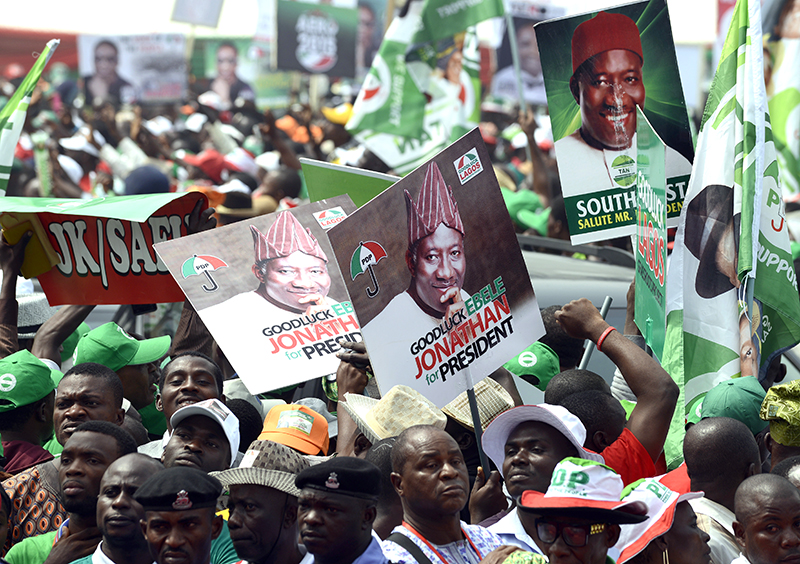
The party’s biggest ever failing arguably lies in its underestimation of the threat that the APC represented from the beginning, and how its emergence was guaranteed to alter the PDP’s own dynamics. Now, under Muazu – nicknamed “Game Changer” in Abuja political circles, for his invigorating touch since he took over – the PDP will be facing the battle of its life in Nigeria’s general elections this month. Already it is lagging behind the APC in the crowds being drawn to presidential campaign rallies. In his “this party is full of injustice” speech Muazu said the party “must find out what is wrong and correct it.” Will that correction come from inside the party, as it always has, or will it this time come from the chastening hand of outsiders? Is Africa’s largest party really about to lose top spot?