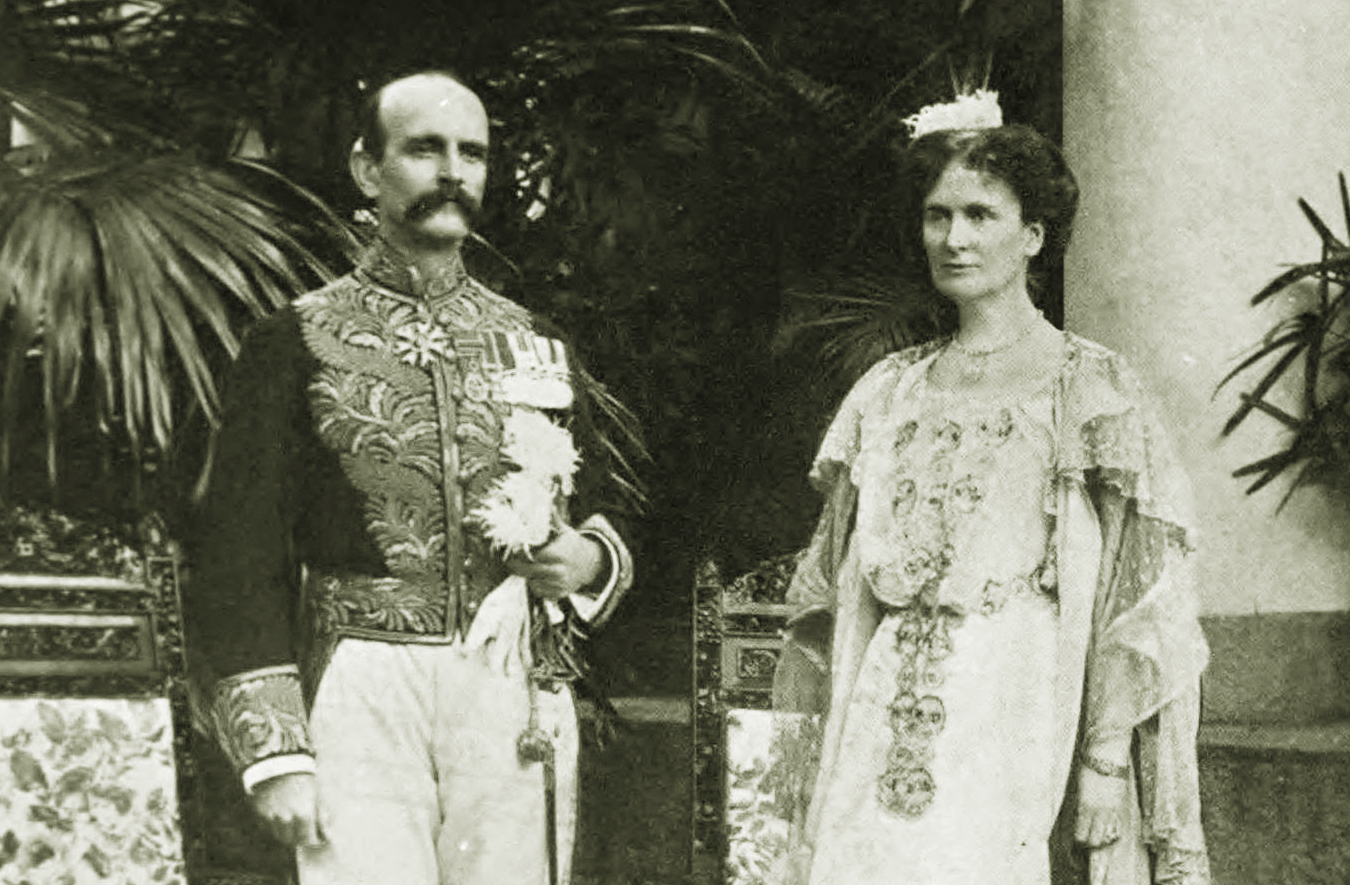
On January 1914, The British officially launched the union of Nigeria, which was initially lumped together in two entities – Northern and Southern Nigeria. There is a general agreement in Nigeria today that the “amalgamation” of the north and south was a mistake, yet the event has to be celebrated 100 years on. Femi Akomolafe reports on the year-long centenary celebrations that are causing controversy.
If Nigerians required any reminder about their rulers’ total disconnection from the reality of their everyday lives, it was amply supplied on 27 February this year when the country’s elite threw a lavish party in the capital Abuja. The occasion was the celebration the unification of the British protectorates in 1914. And the celebrations will go on for a whole year!
To many Nigerians, the merrymaking of the elite at the party, which was attended by many heads of state appeared all the more insensitive as it came a few days after Boko Haram had massacred 48 students at the Federal Government College in Buni Yadi in Yobe State, bringing the number of people killed by Boko Haram to close to 300 since January this year.
Little wonder that many Nigerians, including prominent figures, protested loudly against the anniversary celebration in Abuja.
Professor Wole Soyinka, the Nobel literature laureate, said beforehand: “I would have preferred that the entire day of infamy be ignored altogether. I am even thinking favourably of just ignoring the obscenity, then turning up at the counter-event.”
The former vice president, Atiku Abubakar, railed: “[President Goodluck] Jonathan ought to have been sober in view of the recent killings of secondary school students in Yobe State by the Boko Haram sect. I am appalled by this obscenity in the name of centenary celebration. It is inappropriate!
“I am proud of our history over the last 100 years. [But] I totally denounce the party in Abuja. It is a symbolic dance on the graves of those murdered at the Federal Government College, [and] a slap in the faces of the parents of the murdered students who are currently mourning their children, and those crying over their abducted children.”
The former minister of petroleum resources, Professor Tam David-West, fumed: “There is nothing to celebrate. Nigeria’s amalgamation is a mistake. From 1914 till today, Nigeria cannot showcase any tangible achievement. We are yet to get a nation because we don’t love ourselves. We still have divisions along ethnic and religious lines, which are now worse under President Jonathan. So far, it has been 100 years of motion without movement. So what are we celebrating? If we are a serious set of people, the celebration should be used for deep reflection on where to go from here?”
The centenary hoo-hah
Modern Nigeria came into being on 1 January 1914, when the British colonial power, on the advice of the governor of the Territories of Northern and Southern Nigeria, Frederick Lugard, decided to amalgamate the two protectorates to form a colony of the British Empire.
Looking at it, only cold colonial calculations impelled the union as it defied common sense, logic, geography, and history. The birth of the “nation” was made all the more problematic as the colonial midwives did not complete their job when they handed over power in 1960 to local politicians.
Forty-six years were too short a time to build a nation from a disparate group of independent states, but an irresistible clamour for political independence by nationalists and the exhaustion of the British government by the Second World War, compelled London to grant independence to the nascent state on 1 October 1960.
Documents since released by ex-colonial officials suggest that the British deliberately left enough politically-charged mines scattered around the land, to ensure that it was only a question of time before things blew up. It did so spectacularly in 1967 when the aggrieved Igbos of Eastern Nigeria launched an abortive secession bid.
The three-year civil war that ensued reportedly claimed a million lives. Since the amalgamation in 1914, geography and history have conspired to make Nigeria a very difficult nation to rule. The two great rivers of the country, Niger and Benue, appear to provide natural demarcations.
Historically, the territories that were cobbled together to form Nigeria harboured some of pre-colonial Africa’s strongest states with fierce independent dispositions. The empires of Bornu and Oyo, and the kingdom of Benin are a few of them.
Even at the beginning, two founding fathers of the nation expressed serious misgivings about the amalgamation. The powerful Sardauna of Sokoto, Sir Ahmadu Bello, called it the “mistake of 1914”, and the former premier of Western Nigeria, Obafemi Awolowo, said it was “a mere geographic expression”.
Celebration justified
Although the centenary celebrations have their numerous critics, many Nigerians and foreigners feel that the country has a need to celebrate.
Nigeria’s last military ruler, Gen Abdulsalam Abubakar, said the celebrations were necessary: “It should be a time to rebrand, rejuvenate and pursue the true ideals for Nigeria,” he said.
The secretary to the Federal Government, Senator Anyim Pius Anyim, agreed. “1 January 2014 marks 100 years of our union as a nation. There are not many nations privileged to have such longevity,” he said. “Notwithstanding our struggles and challenges, this is an epoch deserving of a celebration by the Nigerian people. It offers us a unique opportunity to focus on our country, its history, people, achievements, and aspirations for the next century.
“Our story is one of admirable and remarkable progress. Nigeria attained independence, fought and survived a civil war and is currently committed to building a stable nation, with a strong economy. We are blessed with a vibrant population and our democracy is maturing. This centenary celebration presents us an opportunity to count our blessings as a nation, celebrate our dexterity and resilience as a people, and resolve to launch into the next century with renewed determination, hope and expectations.”
On his part, President Goodluck Jonathan, in a 46-point address, was full of admiration and hope for the country: “One hundred years ago,” he said, “the British colonial authorities amalgamated the Southern and Northern Protectorates, giving birth to the single geopolitical entity called Nigeria which has become our home, our hope, and our heritage…
“We are a nation of the future, not of the past, and while we may have travelled for a century, we are not yet at our destination of greatness…
“In challenging times, it is easy to become pessimistic and cynical. But hope, when grounded in realism, enables and inspires progress. Therefore, as we celebrate our first century of nationhood and enter a second, we must not lose sight of all that we have achieved since 1914 in terms of nation-building, development and progress…
“We are a unique country. We have been brought together in a union like no other by providence… The whole world awaits this African success story. With our sheer size, population, history, resilience, human and natural resources, and economic potential, Nigeria is divinely ordained to lead the African Renaissance…”
The dignitaries at the celebrations included many other heads of state from across the world. Many of them lauded Nigeria for the role it has played in the maintenance of world peace and harmony.
They gave nice speeches, but Nigerians would rather that their officials spend more time solving the country’s myriad problems than celebrating a union that has brought more harm than good.