
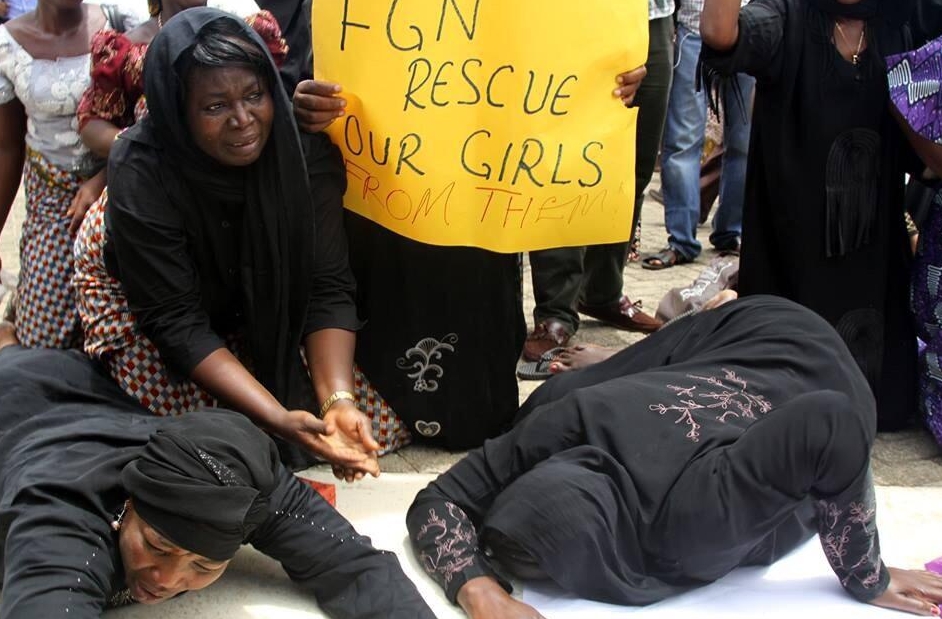
A million-woman march has been organised in Abuja to press for the release of the schoolgirls that were abducted two-weeks ago.
Demonstrators are set to march through the Nigerian capital Abuja to call for the release of some 200 schoolgirls that have been abducted two weeks ago.
The girls, aged between 12 and 18, were sitting a physics exam when gunmen stormed the school and forced the students onto a convoy of trucks.
The militant group Boko Haram has been blamed for the abductions, but has yet to issue a statement in response to the accusations.
Anger has been mounting in recent days, with parents criticising the government over its handling of the situation and lack of transparency.
Following the security forces failure to find the girls, some of the parents have now resorted to launch their own rescue attempts.
The exact number of missing girls is still disputed. While Borno State officials said 129 girls were kidnapped, locals, backed by the school ‘s principal, insist that more than 200 girls were abducted. It has now emerged that 52 girls have been able to escape.
‘Million-woman’ march
The organisation Women for Peace and Justice has now called for a “million-woman protest march’ in Abuja.
Protesters want the government to invest more resources into the investigation and provide more updates.
Several protests have already been organised since the abductions took place, but Wednesday’s march in Abuja is expected to gather the largest crowd yet.
More confusing reports
Recent reports suggest the girls are being sold as brides and mass ceremonies are being organised in neighbouring states.
Others however, claim that the girls are being sold as brides to Islamists militants in Cameroon and Chad while some of the girls who managed to escape, have said the hostages were taken to Borno’s Sambisa Forest area, where Boko Haram has well-fortified camps, the AFP reported.
Who is Boko Haram?
Boko Haram’s four-year-old insurgency has caused havoc in the country. The Islamist group is said to be responsible for the death of more than 4000 people and the displacement of just under half a million.
Despite its repeated attacks, little is known about the group and its objectives.
Boko Haram (translated as “Western education is forbidden”) is an Islamic sect that originally operated in north-eastern Nigeria, one of the country’s poorest region.
It rejects the current authorities, which it says are corrupt and instead calls for the establishment of an Islamic state in the North with strict adherence to Sharia (Islamic law.)
The group, which originally focused on proselytism by verbally attacking secularism and democracy became increasingly violent, burning schools and targeting government buildings.
By 2009 it came to prominence as it entered into an open and violent confrontation with the Nigerian state. The insurgency was suppressed and the group went underground.
Within a year however, Boko haram resurfaced with a grandiose prison break at Bauchi, in October 2010.
Since then Boko Haram has diversified its tactics, which include targeted assassinations, drive-by shootings, suicide bombings and more recently kidnappings.
Analysts say the group now models itself on Salafist movements such as Al-Qaeda. It is divided in semi-autonomous and dispersed cells while many of its leaders are said to be operating from neighbouring countries, including Cameroon and Niger.
It has become clear that to tackle the group, the federal and state governments need to implement a comprehensive plan and work in collaboration with surrounding countries.
The authorities’ mainly military response has until now proven unsuccessful. With Boko haram’s cells now dispersed across the North, perhaps it is now time to implement the political reforms the people have been craving for and address corruption, bad governance and socio-economic underdevelopment.








