
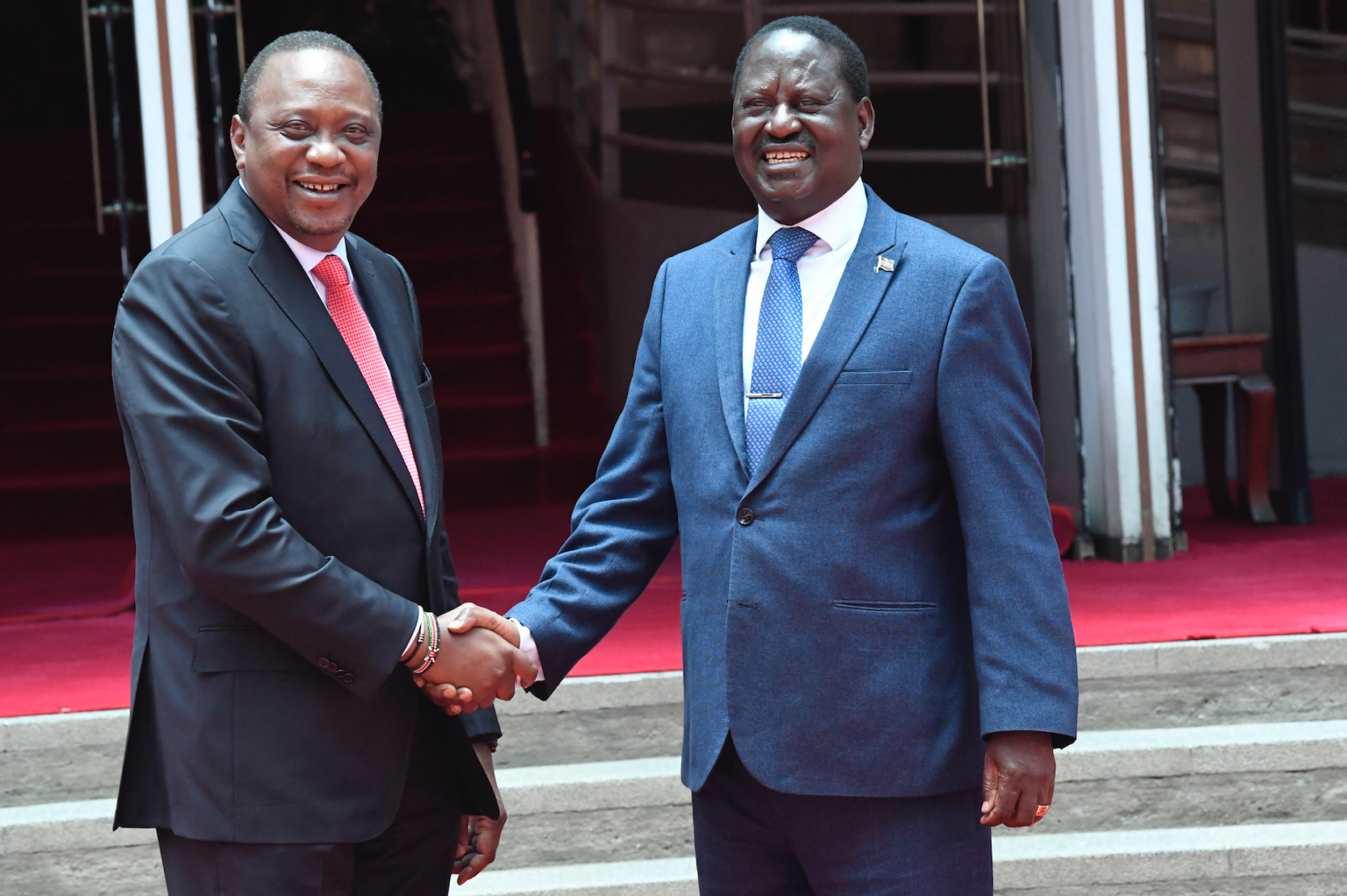
By burying their generation-old ethnocentric political rivalry, Kenya’s President Uhuru Kenyatta and opposition leader Raila Odinga have set an example for the rest of Africa to place national development ahead of ethnic interests. By Maxwell Gomera*
President Uhuru Kenyatta and the Honourable Raila Odinga, the two men who have dominated Kenyan politics in recent times, caught the world by surprise in March 2018 with the stunning announcement that they would work together, ending a row over the 2017 elections, and paving the way for a new national purpose, a ‘unified Kenya’. The meaning and impact of this declaration is largely in the hands of the Kenyan people.
While it may be easy to dismiss this announcement as deft nationalist manoeuvring by the two leaders, that would be a mistake. Rather, the two must be held to their word by the citizens of Kenya. This moment must be seized as the rare opportunity it is for Kenyan politicians and people to reject divisive stories and define a common vision of the future, embodied not in words, but in action, through inclusive nation-building.
The announcement by the two leaders makes way for a new national political environment, with the shift in discourse implicitly acknowledging that cultural diversity is not only desirable but also a precondition for harmony among people and the creation of a flourishing society.
This shift, building on the promise of political accountability embodied by the devolution of power to more local levels under the new Constitution, is an opportunity for Kenyans, individually and collectively, to genuinely claim and exercise power.
As a fellow African who has worked in this great country, and enjoyed the warm hospitality of its people, I have watched with growing anxiety as the country has, like many others, allowed itself to be defined by ethnic rivalries.
I have watched with trepidation as Kenya squandered its democratic promise to the narrow interests of ethnic rivalry, with such rivalry discouraging Kenyans from demanding accountability from their leaders.
By decisively rejecting such narratives, Kenya can set a global example in a world wracked by a resurgence of nationalism and populism. It can join with a handful of countries, my own country of Zimbabwe included, that are setting out to chart a new course.
President Uhuru Kenyatta is commencing on the first year of his last term in office. During his inauguration, he announced two principal objectives for the next five years: the first of which seeks “to strengthen the ties that bind us as Kenyans at every level of our society”, while the second focuses on socio-economic objectives including universal healthcare.
In identifying these two objectives, the President made clear that he is deeply aware that a failure to unite all Kenyans will ultimately undermine aspirations for the country’s economic and social progress. As such, he has committed to nation-building as the foundation upon which social and economic progress must be built and without which his vision for Kenya, and ultimately his legacy, cannot be achieved.
Likewise, at many times in his political career, including during his time as Prime Minister with the national unity coalition government led by President Kibaki, Raila Odinga has demonstrated a similar commitment to national cohesion. Whilst as recently as last month, members of his inner circle were being arrested or deported, he is today boldly embracing his former adversary in the stated interest of national unity.
Both leaders are nearing the end of their political careers and thus their legacies are at stake, providing them with pressing incentives to live up to their promises and commitment. The stage has been set for a more unified Kenya, the question now is how to make the most of this opportunity.
The answer to this question can in part be found in Kenya’s new Constitution. Through the devolution of power and authority from the national to county levels, the Constitution has provided mechanisms that greatly enhance Kenyan citizens’ abilities to hold their political leaders, from the ground up, accountable for their words and actions.
Hitherto, incentives for individuals and communities to act on newfound constitutional opportunities were curtailed by ongoing fears of ethnic rivalry. The new directive from the top to put aside such rivalries and embrace cultural diversity opens the way for all citizens to hold their political representatives accountable and enables them to use the democratic space afforded to all citizens in the new Constitution.
Indeed, ethnic rivalry is of little significance to most Kenyans, who have more pressing daily problems. Remote towns like Mutomo, in Kitui South, an area inhabited mostly by those who identify as Kamba, have seen little development. Not surprisingly, citizens have become indifferent to politics. When access to healthcare is hindered by unpaved roads and poor health literacy, and life in general is jeopardised by malnutrition and poverty, citizens can lose their power to demand accountability and development.
But when leaders at the top put aside their own rivalries with a promise to focus on essential avenues of development, hope can regain the upper hand.
If President Uhuru and the Hon. Raila Odinga are successful, they will create a new identity for Kenya. Then, they will truly stand on the shoulders of other African leaders who have successfully created new visions and identities for their nations. Preeminent among those is President Nelson Mandela, whose vision for South Africa as a ‘Rainbow Nation’ bringing together people of different races, continues to dominate political discourse in the country and invoke a sense of purpose.
President Uhuru Kenyatta and the Hon. Raila Odinga are due credit for setting aside their differences and embodying a new narrative of hope. With the mechanism and incentives manifested in the Constitution and the shift in national political environment, Kenya has been launched down a new runway.
It is now up to every Kenyan to hold politicians accountable for acting in accordance with this vision of national unity, made possible through supporting policies that promote inclusive economic growth. Kenya has the people, the resources and the support it needs to achieve this vision.
*Zimbabwean Maxwell Gomera is a 2018 Fellow of Aspen New Voices. He is an expert on public investments in agriculture and nature.








