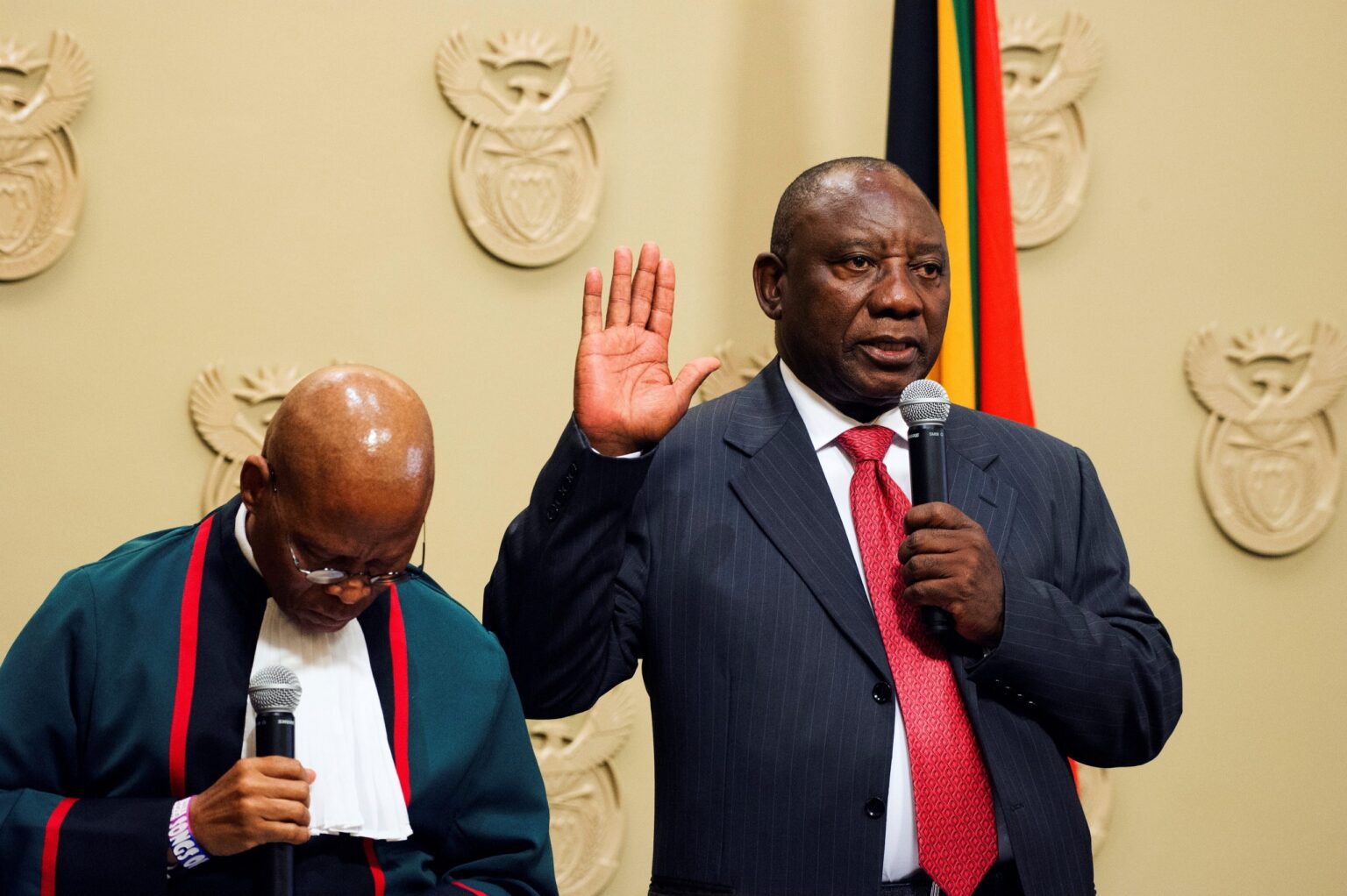
While business and investors have hailed Cyril Ramaphosa’s ascendancy to the Presidency, he inherits a wounded country and ravaged economy. He will also have to live down his role in the Marikana massacre, tackle land reform and bring about a more equitable distribution of wealth. Can he pull it off, asks Dr Desné Masie.
It will be a difficult juggling act for Rampahosa, who is the darling of investors and moderates, but regarded as an enemy of workers and the poor by many on the radical left.
He has also been heavily criticised for benefitting from the spoils of black economic empowerment.
Ramaphosa’s political career began in student politics and black radicalism in the 1970s; by 1982 he had helped establish the National Union of Mineworkers, and in 1985, Cosatu. He became instrumental in the release of Nelson Mandela and in 1991 became General Secretary of the ANC.
Ramaphosa became known for being a skilled negotiator in the talks towards South Africa’s democratic transition. And though he was known to
be Mandela’s favourite, lost out to Thabo Mbeki in the 1996 presidential competition. is is said to have led to him throwing himself into business over politics.
Ramaphosa has a fortune estimated at between $450m and is one of Africa’s richest men. His business interests, put into a trust to enable his return to politics, span the McDonalds and Coca Cola empires through his powerful Shanduka group, founded in 2001. Crucially, Shanduka also had a stake in Lonmin PLC’s South African operations, where he was also a non- executive director. It is this involvement with Lonmin that will haunt Ramaphosa’s presidency.
Though a former trade union leader himself, Ramaphosa was heavily censured, and called a ‘murderer’ by unionists and activists for his role in summoning armed police to Marikana, where 34 miners were killed at Lonmin Plc’s Marikana mine on 16 August 2012 a er miners embarked on a wildcat strike and became violent.
Saftu’s general secretary Zwelinzima Vavi said in a statement on 11 February that unions “demand the immediate arrest of those all those in government, Lonmin and police management who planned, organised and approved this murder. They, including former National Police Commissioner Riah Phiyega, former Police Minister Nathi Mthethwa, former Mining Minister Susan Shabangu and former President Jacob Zuma, must be arrested and charged with murder.
“Cyril Ramaphosa, using his influence in the ANC, called for the ‘concomitant action’ and labelled the strike ‘plainly dastardly criminal’. So said a man who had championed the rights of mine workers before, but once he crossed the class divide and participated in the class oppression and exploitation, made a 360 degree turn. He too can’t escape with a lousy apology. He is as guilty as those who under pressure from him, organised the brutal killing of workers.”
Ramaphosa, despite all this, is still generally perceived to be above board by the business community. Sadly, in the Faustian world of South Africa’s politics, he is both collateral and contributor in the unhealthy vested interests that have characterised public-private partnerships in South Africa. Yet, while one can be sympathetic to an extent, it sticks in the craw that Ramaphosa was always going to emerge from the Farlam Commission, the inquiry into Marikana, unscathed.
Balancing act
Ramaphosa’s presence has no doubt boosted investor confidence and the rand, but he will have to store up this international goodwill with resolute and disciplined policy measures to boost economic growth, tackle the widening de cit and address poverty and inequality. And closely tied to investor confidence will be social cohesion.
South Africa’s generous social spending has been a jewel in the crown of its post-democratic economic policy reforms. Over 17m South Africans, around a third of the population, depend on social grants; they have been instrumental in poverty alleviation, along with free water and housing. But helping South Africans who remain disadvantaged by apartheid’s structural discrimination will require Ramaphosa to get actively behind wider black economic empowerment policies, land reform, free education and radical economic transformation, including share ownership schemes.
Balancing human development along with investor concerns is the only way for Ramaphosa to ensure the business environment remains sustainable and the social environment stable. Ramaphosa will be mindful of the 2016 student riots, and the popularity of the EFF in the top universities.
This tricky balancing act was already evident in Ramaphosa’s first State of the Nation address in Cape Town on 16 February, where he began by invoking Mandela. is was a stroke of genius as he pretty much captured the mood of a nation, rapidly detoxing from a Zuma presidency.
As far as South Africans are concerned, Madiba was a saint who united us from a traumatised past to believe we could do better – no president will ever ll his shoes. He would have been 100 years old this year.
Ramaphosa said in his speech: “It is a day on which we, as South Africans, will remember the life of one of the most remarkable leaders this country and this continent – and indeed, the world – has known.
“We will recount Madiba’s long walk to freedom, his wisdom, his unfailing humility, his abiding compassion and his essential integrity. We have dedicated this year to his memory and we will devote our every action, every effort, every utterance to the realisation of his vision of a democratic, just and equitable society.
“Guided by his example, we will use this year to rein- force our commitment to ethical behaviour and ethical leadership.” The reference to Mandela in relation to ethical leadership, was undoubtedly a dig at Zuma.
Ramaphosa, in his address, also demonstrated that he had listened to the concerns of both investors and social reformers. He said: “We have taken decisive measures to address concerns about political instability and are committed to ensuring policy certainty and consistency.” Most politically important in the speech was the commitment to radical economic transformation through the announcement of free higher education and training for first year students that come from homes with an income of under $30,000.
Ramaphosa also promised “expropriation of land without compensation”, a phrase that normally sends shivers down the spine of investors and proponents of the free market. Yet Business Leadership South Africa, the powerful membership organisation and the voice of business in the country, welcomed the State of the Nation address and promised to support the President in his economic recovery plan. Saftu, while welcoming the land reform promises, complained that it was same “old neoliberal programme that has spectacularly failed to deliver a better life for all for 24 years now”.
The market has reacted to Ramaphosa’s Presidency through an almost immediate surge in the rand. Investment activity will be frenetic in South Africa, and the fall of dictator Robert Mugabe in neighbouring Zimbabwe will bolster investor sentiment.
Which Ramaphosa – the black radical Mandela loyalist or the international businessman – will prevail is so far unclear. He may, due to his diverse background, be capable of seeing the nation’s issues from several perspectives and bring about unity.
His immediate challenge is to ensure that Zuma’s exit takes place in an orderly fashion. Then the really hard work begins, to undo the destruction wrought by the Zuma regime, and to ensure that Zuma is held to account through due legal process.
It will have to be give and take between the rich and the poor to guarantee a peaceful South Africa from now on. And though Ramaphosa is by no means perfect, he is probably the least worst of a bad bunch. South Africans are right to be optimistic, but they should be cautious and remain vigilant. They should ride this tailwind and get behind the President – the biggest favour they can do him is hold him accountable to his oath to the state. NA
THE 2018/19 BUDGET
One of President Ramaphosa’s first tasks will be to deal with the effects of the ‘tough but hopeful’ 2018/19 budget delivered by Minister of Finance Malusi Gigaba on 21 February. Analysts predict that with VAT raised by one percentage point to 15% (the first time since the end of apartheid), the average cost of living will increase.
Unions have expressed unhappiness with the rise of VAT but Gigaba said there would be negotiations with the unions over this issue. The increase was due to a budget shortfall of R48.2bn, mainly because the South African Revenue Service failed to achieve tax collection targets. However, keeping poor families in mind, food is zero rated.
On the plus side, social grants will increase above infation, by about 7%. In fact, social services (R1.01trillion) get the largest slice of the R1.67trillion. The largest slice of the R1.67trn budget goes to social services, which account for R1.01trn. Education remains the biggest budget line item at R351.1bn, followed by health at R205.4bn and social development, including the 17m grants, at R259.4bn. Peace and security are allocated R200.8bn.
R57bn has been allocated to funding the progressive introduction of free higher education over the next three years for students from households earning below R350,000.
The main points of the budget:
-
VAT will increase to 15%.
-
Duties on luxury goods and estate duty on wealthy individuals.
-
Estates above R30m will now be taxed at a rate of 25%.
-
Fuel levy will increase by 52c per litre, effective 4 April 2018.
-
Carbon tax will be implemented from 1 January 2019.
-
Fee-free higher education amounts to R57bn
over the next three years. This year, R12.4bn will be allocated to poor students.
-
Social grants increase by 7% on average. Sin tax increases. It’s between 6% and 10% for alcohol. Tobacco products will increase by 8.5%.
-
A provisional allocation of R6bn will be set aside in 2018/19 (R10bn over three years) for things like drought relief and augmenting public infrastructure.