
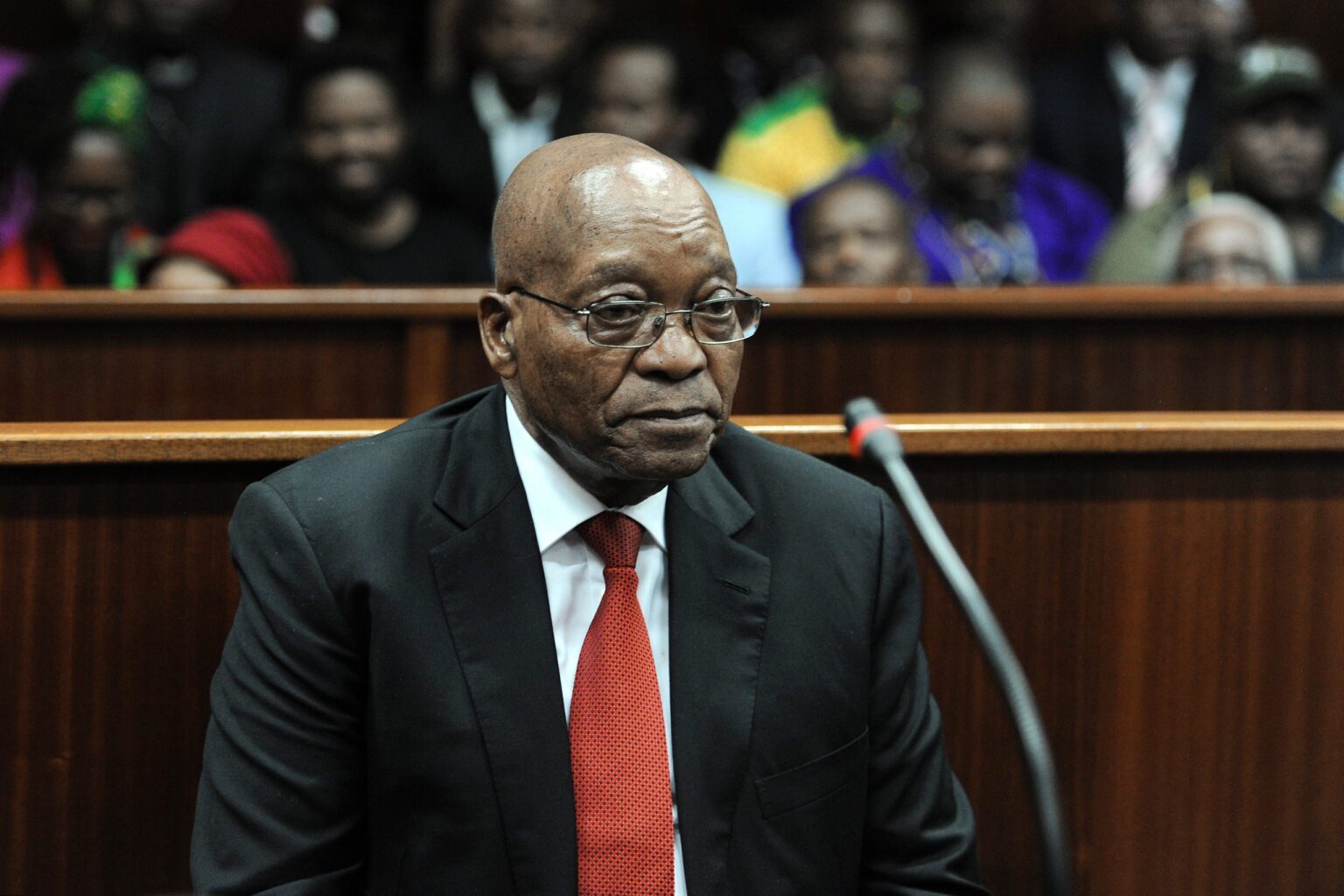
Former President Jacob Zuma appeared in court in April to answer charges of corruption going back almost 10 years. But a whole slew of allegations have dogged Zuma for most of his post-apartheid political life. The question is how he managed to survive them all and what lessons this has for the country. Report by Allen Choruma.
Jacob Zuma’s 20-minute appearance in the Durban High Court on 6 April was filled with drama inside and outside the courthouse. Outside, hundreds of Zuma sympathisers, including African National Congress (ANC) supporters (clad in party regalia, in open defiance to Secretary General Ace Magashule’s request for them not to do so), chanted slogans and support for the disgraced former President.
He was facing an indictment from the National Prosecution Authority (NPA) in which the State alleges that Zuma is guilty of 16 counts of fraud, corruption, money laundering and racketeering.
He is accused of having illicitly received R4,072,499 ($339,236) in 783 payments for a period of nearly 10 years, facilitated by his former financial adviser, Schaber Shaik, in order to protect Thales, a French weapons conglomerate, from investigation into a controversial R2.6bn ($216m) arms deal with South African Defence Forces.
This was the second time the same charges have been brought against him. The first time was just prior to his being appointed Deputy President but the charges were dropped in 2009.
Zuma entered the courtroom amid chants of his name by his supporters. He sat sombrely in the dock next to Thales representative, Christine Guerrier.
Soon after the court session, a seemingly upbeat Zuma addressed his supporters and broke into the liberation song, “Umshini Wami”. The song, now identified with his persona, refers to a machine gun as a symbol of resistance in the struggle against apartheid. Zuma, abandoned by ANC big-wigs, is already propagating the ‘victim narrative’ in the public domain.
The allegations and accusations are not new and the trial has raised the question how, during his long tenure in office, first as Deputy President (1999-2005), then as President (2009-18), did Zuma get away with his shenanigans for that long? During his presidency, Zuma survived an unprecedented eight motions in the National Assembly (Parliament) of which seven were ‘no confidence’ votes and one was an impeachment vote, under sections 102 (1) and 89 (1) of the constitution of South Africa, respectively.
Zuma had failed to uphold and defend the constitution as the law that is above all other laws, as required in terms of section 83 (3), yet he got away with it simply because he had the backing of a powerful faction within the ANC.
Also at issue were the principles of the rule of law and separation of powers (state, judiciary and executive), the very foundation of the constitutional democracy in South Africa.
Nkandlagate aftermath
The issue was highlighted during the ‘Nkandlagate’ controversy when Zuma was accused of using public funds, amounting to R246m ($20.5m), to make upgrades to his private compound at Nkandla in 2009.
Following disclosures over this issue by the Mail & Guardian newspaper, several complaints were lodged with the Public Prosecutor.
The Public Protector issued a report in March 2014, proposing that the President should pay a reasonable cost towards the upgrade. The report was sent to the President and Parliament, but for over a year nothing was done.
This led to the opposition filing a case in the Constitutional Court in 2015. The matter was heard in February 2016 and judgement issued on 31 March 2016.The Constitutional Court delivered a unanimous ruling stating that the Public Protector’s report was binding and Zuma and the National Assembly had failed to uphold the country’s constitution.
Constitutional Court rulings
The court ordered the National Treasury to determine the amount that Zuma had to pay back and ordered Zuma to do so within 45 days of the court’s approval of the National Treasury report.
Zuma finally apologised but although he was asked to resign by prominent public figures, including anti-apartheid activist Ahmed Kathrada, he did not do so.
The court ruled that Parliament had breached its constitutional duty by failing to properly maintain oversight on the national executive and ensure that all executive organs of the state are accountable to it in terms of section 55 (2) of the constitution.
After ‘Nkandlagate’, the opposition filed another case in the Constitutional Court, alleging that Parliament had failed in its duty to hold Zuma accountable for the Nkandla debacle and that he should be impeached because of the seriousness of the constitutional violations.
The Constitutional Court ruled that the Speaker of Parliament had failed in her duty to scrutinise violations of the constitution by President Zuma and to enforce the remedial action outlined in the ‘Public Protector’ report.
The Constitutional Court also found that Parliament had failed to take any action against the President, such as a vote of no confidence or impeachment.
The Constitutional Court judgement in December 2017 ordered Parliament to put in place impeachment proceedings and carry them out within 120 days. Impeachment did not take place as Zuma was then recalled by the ANC on 14 February and effectively removed from power.
Given the highly sophisticated checks and balances built into the system, the wonder is that Zuma, the ‘great escapist’, managed to survive and hold on to power for so long. How did he get away with it and what lessons does it hold for the future in South Africa?
The power dynamics in Parliament contributed to Zuma surviving so many times. Parliament failed to uphold the constitution, not because it was incompetent to do so, but simply because it was hamstrung by majority ANC members.
They were on many occasions accused by the opposition of not voting with their conscience, but voting to serve partisan party interests and protect their epicentre, Jacob Zuma.
The ANC has often been criticised for its failure to separate the party from state organs, resulting in the politicisation of state institutions, thus eroding their stability, effectiveness and independence.
The network of patronage and cronyism, prevalent within ANC structures, was also used to shield Zuma and his protégés from prosecution for corruption. ANC members did not speak strongly against corruption because some benefitted from looting state resources. Others were simply afraid to express dissent to ANC leadership for fear of being sacked from the party and government.
The current Zuma corruption trial is a litmus test of the strength, effectiveness and independence of democratic institutions in South Africa. It is also a litmus test for the unity within the ANC and whether the ANC and President Cyril Ramaphosa have the political will to fight corruption and enforce laws, without fear or favour.
Zuma’s legal team is already challenging the legitimacy of the decision to prosecute him. His application for review of the NPA decision is expected to be filed in May. If that fails, Zuma intends to apply to the court for a permanent stay of prosecution.
Jacob Zuma almost got away with it, but the dreaded long arm of the law seems to have finally caught up with him. NA








