
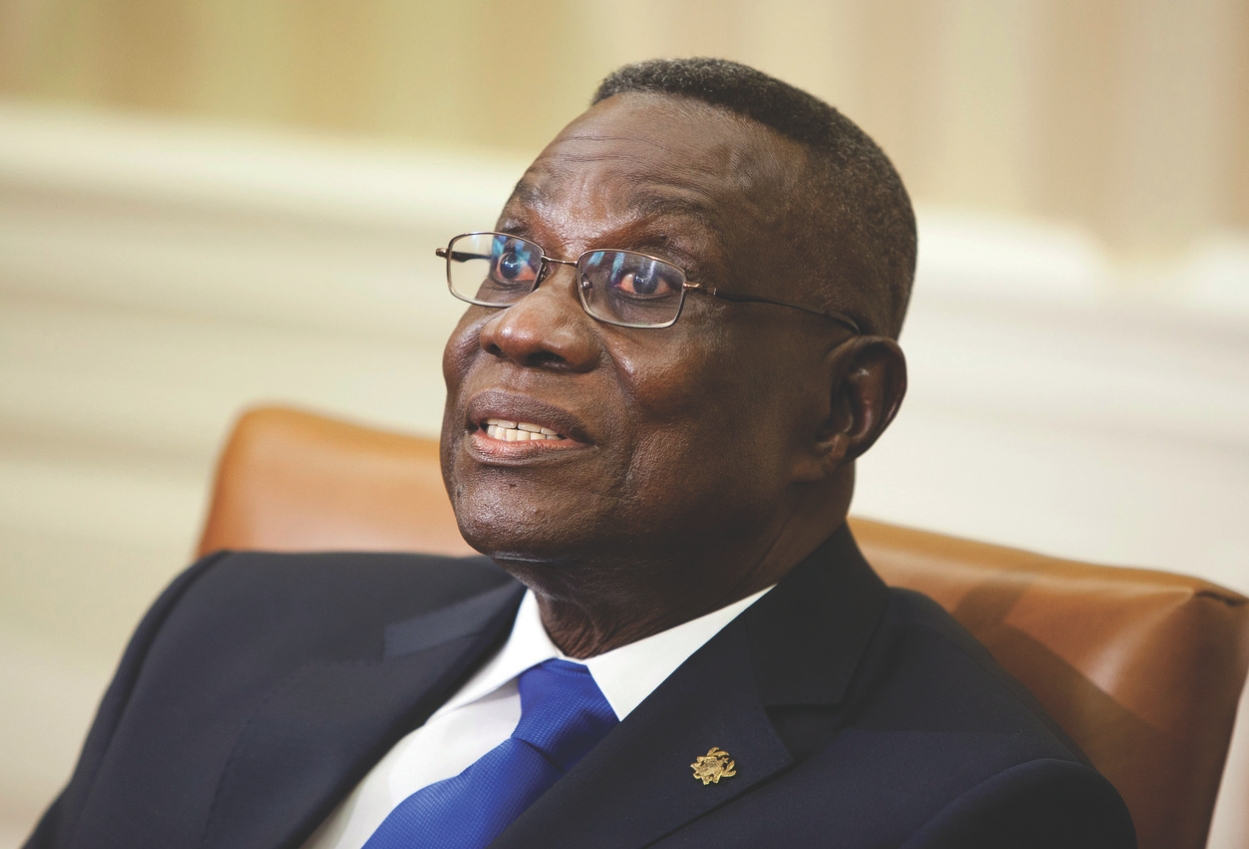
Ghana’s president, Prof John Evans Fiifi Atta Mills, died suddenly on 24 July and threw the nation’s politics into disarray.
The five months from now to the national elections scheduled for 7 December may be some of the most interesting in the country’s history, reports Femi Akomolafe and Stephen Gyasi Jnr.
Ghanaians were shocked when the news came on 24 July that President John Atta Mills was dead. The people were shocked because the president’s death had been rumoured so often that it was difficult to accept that now it was real. But a terse press statement by the president’s chief of staff put paid to all the speculation. Alas, the president was indeed dead!
That he died just three days after celebrating his 68th birthday made it worse for the men around him who kept the nation on a diet of untruths about his true state of health.
One of them, the operations director at The Castle, the seat of government, Nii Lantey Vanderpuye, who is also an MP for the ruling National Democratic Congress (NDC), had told the nation a mere three days before the president died that, “he is stronger and healthier than any presidential candidate”.
The president had long been rumoured to suffer from throat cancer. He had returned from a medical check-up in the USA a few weeks before he died, and pronounced himself fit for the gruelling campaign that lay ahead of national elections fixed for 7 December. He even jogged at the airport to dispel persistent rumours that he was a sick man.
But the rumours persisted that he was in bad shape. Yet his handlers continued to say otherwise. This led one journalist to lament that: “The issue about the president’s health has virtually become a taboo in Ghana, with those seeking to know the exact ailment affecting him being tagged as enemies of the NDC administration.”
Sadly on 24 July, the president died, a few hours after being rushed to the 37 Military Hospital in Accra. He was said to have died from acute cardiac arrest. Insiders said the president, a staunch Christian, had complained of neck pains on Sunday 22 July and thus could not take part in church activities. He was due to fly to Nigeria on an official trip on the evening of the day he died.
Atta Mills, a native of Ekumfi Otuam in the Central Region, was born at Tarkwa in the Western Region on 21 July 1944. One of the best educated presidents Ghana ever had, Mills attended the famous Achimota School in Accra, and then read law at the University of Ghana, before doing his advanced degrees at the London School of Economics, and the School of Oriental and African Studies, all part of the University of London.
After a long stint in the academic world, Prof Mills joined the Ghana Civil Service and became the acting commissioner of the internal revenue service (1986-93). He served as the substantive commissioner from 1993 to 1996.
His political career began when President Jerry Rawlings plucked him from his internal revenue job to partner him as vice-president in the 1996 elections. Mills served in this position until he ran as the NDC’s presidential candidate in the 2000 elections, and lost. He ran again in 2004 and lost. Luck smiled on him at the third attempt in 2008, when he won a bruising three-round election with a wafer-thin majority. He was sworn in on 7 January 2009 for a four-year term.
Interestingly, his humble style of leadership was perceived by many to be a sign of weakness. A few months into his presidency, his mentor and hitherto chief supporter, Jerry Rawlings, became one of his harshest critics – and Rawlings continued the public criticisms for the next three-and-a-half years.
Although the late president’s men dished out as good as he got, he himself so much respected the office he held that he never for once publicly responded to Rawlings’ criticisms and innuendoes. This earned him the sobriquet “Asomdwehene”, or “King of Peace”.
Ghanaians of all political stripes trooped out to mourn the late president, who became the country’s first leader to die in office. His main challenger for the December polls, the New Patriotic Party’s Nana Akufo-Addo, suspended his campaign tour of the Western Region and returned to Accra to pay a moving eulogy to the late leader.
Rawlings was away in Congo Brazzaville when Mills died. When he was asked by BBC Africa for his comments, he said: “It is quite a shock to both my wife and I, but it was not unexpected because he had been battling the cancer for quite a while; but it is certainly the wrong time for him to go considering that we have elections around the corner in December.”
When the interviewer asked if Rawlings was concerned about the elections, he replied: “Yeah, both of us actually,” and then added bizarrely: “Quite frankly, I think that had he been advised and done something wiser earlier on, he could probably have survived for, I don’t know, another six, seven months, I guess. But it got too tight, it got extremely tight; and now the poor professor has passed away.”
On what legacy Mills was leaving for the country, Rawlings said: “He’s played his part. As my vice president, he was one of the finest but there again, considering that the cancer affected his eyes and ears, he couldn’t sustain more than three hours a day; so it was naturally going to affect his performance.”
As expected, Rawlings’ comments outraged the nation, with many people condemning him for his “insensitivity”.
From beyond Ghana’s borders, the US president, Barack Obama, paid tribute and recalled with fondness the memories of his visit to Ghana in 2009, when President Mills hosted him in lavish ceremonies.
A few hours after the president’s death, parliament met in an emergency session and swore in Vice-President John Dramani Mahama, 53, as the substantive president, in line with the constitution.
Paying tribute to his former boss, Mahama, also an academic of some repute (he recently authored a memoir, My First Coup d’Etat), said: “I am personally devastated. I have lost a father. I have lost a friend. I have lost a mentor and a senior comrade … He brought a distinctive insight into Ghana politics. He was humble and a good example and inspiration to all of us. Our finest tribute is to maintain the unity and stability of this country.”
The scion of a famous family, Mahama was born on 29 November 1958 at Bole-Bamboi in northern Ghana where his father, Emmanuel Adama Mahama, had been a leading politician in the 1960s. He served as a minister in President Kwame Nkrumah’s post-independence government.
The young Mahama, a historian, communication expert, and a former MP and minister of state, has now become the first president of Ghana to have been born after independence (attained from Britain in 1957).
Many were impressed by the smooth transition and Ghana earned kudos for the serenity that followed the demise of its leader. The people generally mourned with superb dignity.
Now comes the difficult part. President Mills’ sudden death five months to the crucial national elections in December, has totally changed the political landscape.
The National Executive Council (NEC) of the ruling NDC party met on 26 July and backed Mahama as the party’s candidate for the December polls, but they need a special congress, fixed for 1 September, to confirm him by acclamation.
As time is the issue, the NEC’s decision is the best option, but it may not be the end of the matter as the NDC, like the opposition NPP, suffers from factionalism and internal strife.
The NDC faction led by the party’s founder, Jerry Rawlings (and his wife), has issues with Mahama, and so do the men who ran the show behind Mills, who make up another faction. It is likely that either or both these groups will raise an objection to the NEC’s decision and call for a full-fledged congress to “elect” a presidential candidate, rather than “confirm” Mahama.
The acrimony that such a congress will create is likely to damage the party’s electoral chances, and put the NPP and its presidential candidate, Nana Addo Dankwa Akufo Addo, in pole position.
The next five months may be some of the most interesting in Ghana’s history. According to an analysis by Barclays Bank: “Much will hinge on the manner in which the NDC is able to swiftly elect a replacement presidential candidate. Infighting already poses a significant threat to party unity, and any signs of an exacerbation of these tensions will favour the opposition.”
For the NDC, 2012 may turn out to be its annus horribilis.








