
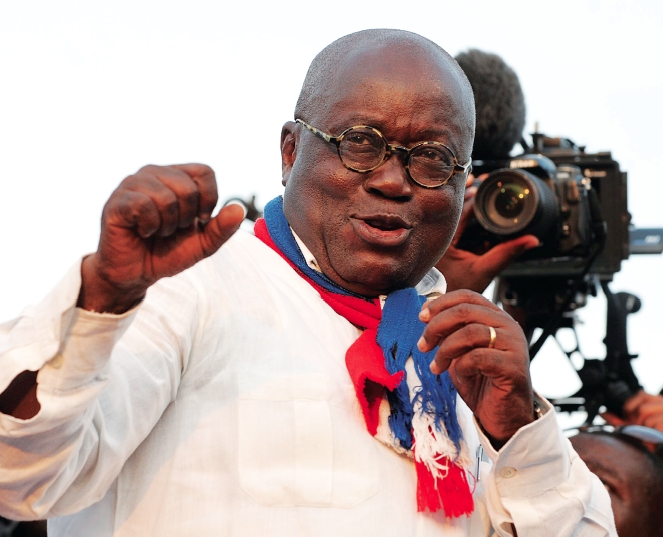
As Ghana’s Supreme Court begins to hear the mother of all cases – brought by the opposition presidential candidate, Nana Akufo- Addo (pictured right), seeking to overturn the December 2012 presidential result – evidence is emerging that desperation is making Akufo-Addo’s faction in the New Patriotic Party (NPP) plan extrajudicial tactics to get its way. Osei Boateng reports.
It is simply shocking! That in this day and age, lieutenants of a respectable presidential candidate in Ghana would discuss a strategy of deliberate instigation of violent street protests to cause general mayhem in the country, so they can attract international attention to their cause, beggars belief. But that is exactly what the “back-burner strategy” of the losing presidential candidate in Ghana’s December 2012 elections, Nana Addo Dankwa Akufo-Addo entails. It shows how desperate his faction has become in their bid to win power at any cost necessary.
Akufo-Addo, the candidate for the opposition New Patriotic Party (NPP), lost the December 2012 presidential race to the sitting president, John Dramani Mahama. But instead of conceding defeat, Akufo-Addo and his running mate, Dr Mahamudu Bawumia, and the national chairman of the NPP, Jake Obetsebi-Lamptey filed a case before the Supreme Court challenging the official result announced by the Electoral Commission (EC), claiming that the EC had connived with President Mahama to rig the election in Mahama’s favour. They, therefore, asked the Supreme Court to overturn the official result and declare Akufo-Addo the winner.
Preliminary preparations for the hearing of the case have been going on since early December, during which Mahama’s ruling National Democratic Congress (NDC), has applied – and it has been granted by the Supreme Court – to join the case as one of three defenders. The other two are the EC and President Mahama.
In the meantime, though Akufo-Addo and his supporters say they have a cast-iron case of electoral fraud to convince the Supreme Court to rule in their favour, behind closed doors they are discussing ways to use unlawful means to instigate violent street protests that will lead to general “cacophony” in the country, bad enough to attract international attention to Akufo-Addo’s cause.
Unfortunately for them, their plan leaked out when an email sent from New York, USA, by a cousin of Akufo-Addo’s who is also a member of his inner circle, came to light. The cousin had been sent to the USA in February to drum up international support for Akufo-Addo. But what he heard in New York was not music to his ears.
Reporting back to Accra, Akufo-Addo’s cousin said in an email: “My very good friend and former flatmate at university who works at the UN put together an informal dinner meeting with some 13 UN department heads and ambassadors, including an AU ambassador to the UN, Dr Ayebare, in my honour to brief them about our court case.
“At the beginning I asked the Rwandan permanent secretary, Ambassador Eugene Gasana, who is also a member of the UN Security Council, to sum up their impression of Ghana’s 2012 election. ‘It was free and fair, smooth. It made us all very proud’, he said, to nods all round.
“At the end of the 3 hour dinner, it fell on him again to sum up the sentiment around the table, and this is what he said:
‘This is all news to us. There are 54 of us [African ambassadors] here. I can tell you that at least 53 of us don’t know this story… You must communicate more.’ “To appreciate the extent to which others went to dim down our story, the AU rep and former Ugandan ambassador to the UN, said he has a friend at the Tullow Oil office in London who told him of how much money the company pumped into PR to ensure that the international media told a positive story about the Ghana elections. ‘They did not do it for the government but to protect their business interest in Ghana’, he explained.
“Awa, a lawyer and dept head at UNDP, said it all: ‘Well, in Africa now, what has become normal is that opposition parties always cry foul after a defeat’. “… I will suggest that as the hearing [in the Ghana Supreme Court] begins, we must activate the back-burner strategy of getting the outside world to hear us, too.” That was temperate enough until the cousin [name withheld] started to talk about what their “back-burner strategy” entailed. In a second email sent from New York to Accra on 23 February, the cousin explained: “The truth is [that] the country is not showing enough anger. Apart from [the] cash-strapped ‘Let My Vote Count’ mobilisation efforts, which [are] receiving lukewarm endorsement and support from the party, what have we done?” the cousin asked his colleagues back home, frustration and anger taking over his tone. “Isn’t it a serious indictment that we have not been able to mobilise thousands of people onto the streets?” he asked them. “Are we not going to feed on the current anger, precipitated by fuel price increases, water and energy crises to express mass anger and mass support for our case? “We are sleeping! And we shall once again have our tilapia stolen right from our noses in this judicial pond if we don’t wake the heck up with the kind of cacophony that can disturb the tranquility of the international community. Let us get them to pay attention to us even before we mount the witness box to lay out our evidence. Otherwise this whole thing, I fear, could be academic.”
‘Let the country burn’
The frightening prospect of deliberately going out to manufacture “cacophony that can disturb the tranquility of the international community” by “mobilis[ing] thousands of people onto the streets” in a country that has shown since the December elections to have no such wish, has shocked many people. It clearly demonstrates that the Akufo-Addo faction does not believe they can win the court case, and thus need extrajudicial means to gain power even if it means the nation they want to govern burns. Unfortunately for them, even the NPP as a party and their MPs who can fight their cause in Parliament have little enthusiasm for the court case, let alone going out to mobilise thousands of people into the streets to cause general mayhem.
While the cousin was still in New York, the inner circle back home felt obliged to communicate the bad news to him: “If the reaction of our MPs to my presentation on Wednesday is anything to go by,” one of the three who took the matter to court wrote in an email, “then I am afraid we have not yet made our case even to our die-hard supporters in Ghana. Many got convinced for the first time. It’s difficult to get people out on the streets if they don’t know or believe in your case.”
The whole sorry idea that thousands of NPP supporters who “do not believe” in the court case can be cajoled into embarking on violent street protests to cause general mayhem three-and-a-half months after an election that their candidate lost, is a very risky and selfish strategy.
“Back-burner strategy” or “front burner”, the news is not good for Akufo-Addo and his inner circle. In its latest report on Ghana, published in February, the Londonbased Economist Intelligence Unit (EIU) said matter-of-factly: “The Supreme Court is likely to uphold the [presidential] result given a lack of evidence of systematic malpractice.” The EIU continued: “The court’s rejection of the case would anger opposition supporters and could trigger isolated unrest, although it would be unlikely to lead to widespread instability given the general population’s respect for the rule of law.”
Three-man show
The trouble that Akufo-Addo and his kitchen cabinet have is that most of the NPP’s senior members do not share his enthusiasm for the court case. In fact the bulk of the party did not want to challenge the election result in court at all. They think the party should move on, and stop reinforcing the damaging perception in the country that the NPP cries foul every time they lose an election. In 1992, 1996, 2008, and now 2012, the party disputed the election results, claiming the NDC had rigged the elections against them.
This time round, perhaps knowing that there is not a strong case to go to court, the majority of the party hierarchy advised against it. But Akufo-Addo’s faction in the party, which has control and influence over the national executive committee, decided against the general wish of the party and took the matter to court. This explains why the case has now become a “threeman petition”, disowned by the generality of the party. According to one NPP elder statesman, Kwame Pianim: “It is not factually correct that the NPP is in court over the election result. The NPP as a party is not in court, nor is it a party to any petition challenging the [election result]. My understanding is that three of our party members, Nana Akufo-Addo, the 2012 presidential candidate, and his running mate, Dr Mahamadu Bawumia, and our national chairman, Jake Obetsebi-Lamptey, are the ones who have gone to the Supreme Court to dispute the result. They did so in their individual capacities and apparently not as representatives of the party.”
In a major interview published in February, Pianim, a leading light in the party, argued that the NPP has a “lot of legal luminaries”, and “if we had had a broader consultation with some of these luminaries, we might have been advised to join the NPP in the action in order to make it a party matter. After all, the outcome affects the party, and those in court are key elected representatives of the party.” Explaining further, Pianim said: “For those of us who believe in Ghana’s embryonic democratic system, we should all be careful in dealing with election results. The last thing we [want to] do is to make people lose faith in the electoral process and lose confidence in the democratic dispensation in the country.
“As politicians, we must know that one of the basics of democratic culture is patience. When the results of an election are announced, we should be ready to accept the results no matter how bitter, assess where we might have gone wrong, where we need to improve upon our performance, reinvigorate ourselves and begin the preparation and campaign for the next election. Ghana has a lot of goodwill as a beacon of democracy and hope in Africa, let’s not waste the goodwill and destroy our international reputation with post-election squabbles.”
The NPP’s elder statesman wants the NPP and the country to move on. “The elections are over and this is not the time for partisan politics,” he pleaded in the interview. “There is too much backlog of work to be done in the war against poverty, disease and ignorance. We don’t have the luxury or the time to waste on diversions and things that are destructive to our cohesion as a society.”
According to him, the NPP will have to reach a level soon “where the leader and the campaign team will have the courage to face party members and say we lost the elections. There is no need for an apology. But simply admitting to defeat will help in the future with identifying mistakes and shortcomings and help with the efforts to move to a new and higher level of performance for all of us. I think by making a fuss about the court case, the NPP is losing the opportunity to really do a proper review of their performance – which is important for the future success of our party.” Pianim continued: “So to me, it is time for us to sit down and find out what went wrong and why we failed. For instance, the critical point of this campaign was when President Atta Mills died and was replaced by John Mahama, a young, vigorous, modern man, easy on the senses, calm and smiling all the time. Was there a strategic shift in our campaign to confront this new situation?
“For a centre-right party, which believes in a property-owning democracy and in wealth creation, did we get unnecessarily stuck on one policy – free Senior High School (SHS)? And when the NDC ridiculed the policy, was there timely and adequate reaction?”
To Pianim, there is only one thing left now for the party. “We have to start rebuilding the NPP and we can only do so if we know what went wrong in the 2012 elections. We should not sacrifice the rebuilding of the party for a court case.”
Sound advice, but it appears to cut no ice with the hotheads in Akufo-Addo’s inner circle who want violent street protests and “back-burner strategies” to take them to State House.








