The latest elections have left Frelimo’s dominance weakened but still very much intact. The only way for President Nyusi to arrest this decline and the country’s growing discontent is to ensure the country’s rapid growth benefits ordinary Mozambicans, argues Simon Allison.
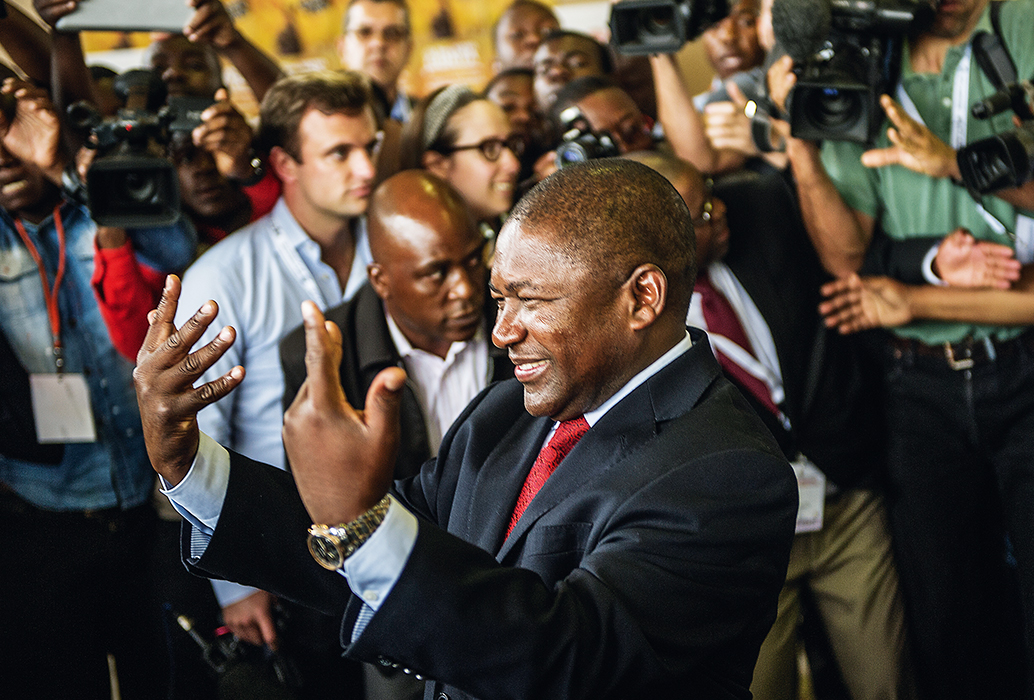
On the surface, not a lot has changed for Mozambique’s ruling party, the Mozambique Liberation Front (Frelimo), since October’s elections. Its presidential candidate, Filipe Nyusi, won the presidential vote with a comfortable majority, while the simultaneous parliamentary poll delivered control of the national assembly yet again. There is little doubt that Frelimo is still firmly in charge of Mozambique.
Scratch that surface, however, and it is clear that Nyusi won’t have it quite as easy as his predecessor, Armando Guebuza. For one thing, Guebuza received a much stronger mandate from the people, having garnered 64% of the vote in 2004 and a whopping 75% in 2009. Nyusi received just 57%. For another, in his last term Guebuza also enjoyed a two-thirds majority in parliament, allowing the party to dictate legislation at will. This time round, Frelimo lost 47 seats, meaning their majority is not nearly as convincing.
Overall, it’s a precipitous drop in support for the party that has ruled Mozambique since independence in 1975. Even more disturbingly, it comes despite an enormously expensive campaign, stage-managed by the team that led Luiz Inácio Lula da Silva and Dilma Rousseff to repeated victories in Brazil.
Several factors account for this relative decline, including the country’s youthful population, divisions within the ruling party, and Nyusi’s own shortcomings – although reasonably charismatic, and having occupied the high-profile position of defence minister for several years, Nyusi was a relatively unknown quantity going into these elections. But two issues stand out in particular.
First, there are the country’s economic problems. Sure, Mozambique’s economy has been growing at a steady clip, attracting significant foreign direct investment and averaging an annual 6.35% GDP increase since 2000. Not bad for a poor southern African country in the midst of a global financial crisis.
But the government has failed to share the wealth efficiently. While development indicators have improved over the last decade, progress has been incremental at best. According to the Ibrahim Index of African Governance, Mozambique still lags well below the continental average in the key measures of health, education and infrastructure. Jobs are hard to come by, with unemployment at 27%, and more than half the population lives below the poverty line. While foreign investors are gambling on the economic boom narrative, many Mozambicans aren’t buying it – and have punished Frelimo accordingly.
The second major factor is the renaissance of the ruling party’s old civil war foe and main opposition, the Mozambican National Resistance (Renamo). Renamo took a hammering in the 2009 polls, and looked to be sliding into irrelevance. This perception appeared to be confirmed by the gains made by a new opposition party, the Mozambique Democratic Movement, which now governs three of Mozambique’s largest cities.

But Renamo, and specifically its veteran leader Afonso Dhlakama, (see above) came up with an unorthodox plan to reverse this trend. In 2013, the party tore up the old ceasefire agreement that ended the civil war in 1992 and declared the resumption of hostilities with Frelimo. This was more than just an empty threat: Dhlakama retreated to a heavily-armed bush camp, from which his fighters launched attacks on government buildings and military convoys. Dozens were killed in months of sporadic violence. Eventually, the government was forced to the negotiating table, where Renamo extracted several key concessions including better representation in election management bodies.
Dhlakama re-emerged into public life at the start of September this year, depicting himself as the last bulwark against Frelimo’s total domination of the state and appropriation of public resources. It worked. Huge crowds greeted him at every campaign stop. “Incredibly, Renamo’s strategy of eschewing politics for violence has resonated with both the political elite and the voter,” observed Grant Masterson and Olufunto Akinduro, researchers at the Electoral Institute of Southern Africa, who were in Mozambique for the recent elections. Dhlakama garnered 37% of the vote, up from 16% in 2009, and Renamo won 89 assembly seats, up from 51.
And still Renamo weren’t happy. Dhlakama maintains the vote was rigged (although, eternal optimist that he is, he has made the same claim about every election in which he has participated). Meanwhile, he has used his re-energised support base and the threat of new violence to push for potentially lucrative positions in Nyusi’s new administration: a few cabinet positions, or perhaps even a ceremonial vice-presidency for himself.
Of course, the economic issues played a role in Renamo’s renewed popularity too. “I think Renamo capitalised on growing discontent with the current government,” said Aditi Lalbahadur, a country analyst with the South African Institute of International Affairs. “There is a historical reason why Renamo has enjoyed support in certain pockets of Mozambique, but what you’re seeing now is…people are taking stock and are saying hang on, we’re hearing about all this wealth, why is it not having a direct impact on our standard of living?”
With Mozambique about to become much richer, this question becomes even more pertinent. If all goes according to plan, by 2018 Mozambique will become the world’s third-largest producer of liquefied natural gas, behind only the US and Russia. The state oil company estimates that the country is sitting on 250 trillion cubic feet of gas, enough to meet the entire world’s demand for two years, according to Bloomberg estimates. The huge reserves will provide a windfall that, managed properly, could and should change the life of every Mozambican.
The huge gas reserves will bring a windfall that, managed properly, could and should change the life of every Mozambican. This will be the defining issue of Nyusi’s term
This will be the defining issue of Nyusi’s term – and, potentially, a way to arrest Frelimo’s declining popularity.
“[The new administration] must translate economic growth into socio-economic public goods for the majority of Mozambicans,” continued Lalbahadur. “The one way they can resolve a lot of the tensions and undercut the opposition to the government is by stepping up to the plate and taking responsibility.”
In other words, if Nyusi’s government can turn Mozambique’s new prosperity into jobs, services and infrastructure, it could diminish Renamo’s appeal – perhaps fatally for the ageing movement.
More importantly, 22 years after the end of the civil war and 39 years after the declaration of independence from Portugal, ordinary Mozambicans could finally begin to see something of the peace dividend which has already made the country’s political class enormously wealthy. If Nyusi can pull it off, it would be quite some achievement.