
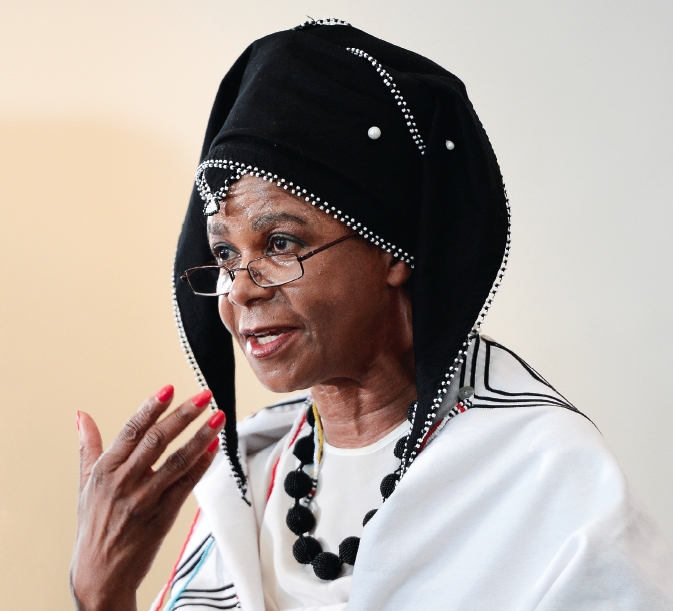
She says she is ready to take on the behemoth that is the ruling ANC by forming her own party, a first by a woman in South Africa’s political history. “The era of left, right, this-ism or that-ism is over. What we need are economic, social, political and foreign policies that best meet the needs of the majority of South Africans,” says Dr Mamphela Ramphele. Fred Khumalo reports.
When the maverick South African academic turned business woman, Dr Mamphela Ramphele, launched her political party at the end of February, she could have done so at one of Johannesburg’s posh hotels befitting her stature; or, at a football stadium as is the tradition; or, better still, at one of the country’s world-renowned conference centres. But Ramphele launched the party at Women’s Gaol – a tiny venue that used to be a real prison for women in apartheid South Africa. Remarkably, the venue is located within the same precinct that houses the country’s Constitutional Court, a proud reminder that South Africa is one of the world’s most successful constitutional democracies. It is the kind of venue that speaks eloquently to the former World Bank managing director’s oft-repeated mantra: “We must unlock our country’s potential, while we try not to forget where we come from.”
At the launch of the party, Ramphele, who is from the Pedi ethnic group, was resplendent in Xhosa traditional garb. The name of her party is Agang, “let’s build” in the Setswana language.
Ramphele is all about symbols and messages of a nuanced South African consciousness.
Some have found this at odds with her past: with Steve Biko, Barney Pityana and others, she was one of the founders of the Black Consciousness Movement which made an impact not only on South Africa, but on a larger part of the Southern African region, and whose rallying cry was: “Black Man You’re On Your Own.” In the many interactions that I have had with her, she has argued that Black Consciousness is not an end in itself, but a means to an end. We served together on the Dinokeng Scenarios four years ago – a project that was meant to imagine various scenarios for the future South Africa, from best to worst, and systematically brainstorm possible solutions and remedies for them.
The 65-year-old has consistently argued that Black Consciousness was a necessary phase in the country’s march towards a completely non-racial society. She might not exactly be singing from the same hymn book as Archbishop Desmond Tutu and Nelson Mandela, who embody the somewhat elusive Rainbow Nation concept, but she believes the time for ideologically-inspired sloganeering is now over.
“The era of left, right, this-ism or that-ism, is over,” she says. “What we need are economic, social, political and foreign policies that best meet the needs of the majority of citizens… What we need to be looking at is what are the best economic policies that produce the greatest competitiveness and sustainability?” In a country with more than 100 registered political parties – even though the lion’s share of voters are still divided between the governing ANC and the Democratic Alliance opposition – one wonders if the addition of a new party is not a complete waste of time, or a weakening of the existing opposition.
The governing ANC, which won the 2004 election with a two-thirds majority under the stewardship of Thabo Mbeki, is still a force to be reckoned with, despite numerous demonstrations by ordinary citizens against its failure to deliver essential services such as water, sanitation (some places still use long-drop toilets, or the bucket system as it’s called) and jobs. Being the oldest liberation movement on the continent, the ANC still has the moral high ground as the organisation which brought the majority of the South African populace to the plains of political liberation. In South Africa, race matters. The ANC does not even have to raise the race issue as a campaigning ticket – the legacy of apartheid social engineering is there for all to see.
Even though the lot of black people has improved radically since 1994 when apartheid collapsed, the gap between rich and poor is still largely informed by race. For the record, the latest census results show that black people’s average annual household income improved between 2001 and 2011 from R22,522 (US$2,450) to R60,613 (US$6,600), which amounts to around a 35% increase in real terms. Even though their lot has improved, many black people are still angry that the progress is not being shared equally. Those historically at the top – because of their race – are still progressing.
When the ANC goes on the campaign trail and uses the slogan “A better life for all”, the black majority cannot help but be reminded of the economic gap that is informed by race. Hence their consistent support for the ANC when it comes to voting time.
However, Ramphele believes that what she calls black people’s “addiction” to the ANC has reached its sell-by date. She points out that at the last election in 2009, between seven and 10 million eligible voters stayed away from the polls. She believes that many of these were young people, rural people and women – target groups who, she believes, have been directly impacted by the ANC’s failure to deliver services. Young people are unemployed, or unemployable because they have not got the requisite education. They can’t get an education because it’s too expensive to go to university, or enrol at one of the technical colleges because the government has failed to make these necessary opportunities accessible to poor people.
But how does she deal with issues such as the provision of education, which impact directly on economic growth and job creation, thus helping to gradually combat social ills such as drug abuse, crime and disease that are the terrible travelling mates of poverty and unemployment?
In answering this question, she does not try to be politically correct by pointing to developing economies such as Brazil and India, as would be expected from one of her political background. Instead, she points to Germany as her party’s model for economic and social recovery.
She draws parallels between Germany and South Africa as countries that come from a traumatic past, that had to dig deep into the goodwill of their people for what appeared as “miracles” to outsiders. Germany has successfully dealt with economic disparities and ideological hang-ups from the past, she points out, referring to the reunification of Germany – the West carrying its ailing Eastern bloc brother on its back, on the way to economic recovery. Painful though it might have been, West Germany had to bite the bullet and realise that you needed to throw funds into levelling the playing field so that both Germanies had access to equal opportunities and infrastructure. But she is quick to point out that that need not necessarily mean taxing the big guys to alleviate poverty.
“It’s all about rethinking our expenditure as a country,” she points out. A huge proportion of government spending goes on education – but she complains about the quality and kind of education that is being thus funded. The bulk of high school graduates have no skills, and can’t proceed to university; hence they are a huge loss to the economy. Another chunk of spending goes on defence. Her critics argue that she is chasing a pipedream: she is speaking the same language as the existing parties, and her opposition to the governing party is more personal than political or ideological.
While corporate South Africa is always crying out for the “multiplicity of voices in the political arena”, and has welcomed her as one of their own (after her stint at the World Bank, she sat on a number of boards of mining houses), Ramphele’s critics have been stinging.
After the launch of her party, one tweeter hollered: “The poor are poor; not stupid! They won’t vote for Ramphele. I will tell everyone what she did to workers at UCT (University of Cape Town, where she served as vice-chancellor in the 1990s).” Some noises have been made about who funds her party. ANC secretary-general Gwede Mantashe said that Agang was an outfit funded by the West (particularly the USA) in an attempt to destabilise South Africa – Agang’s chief of staff is Tim Knapp, an American, and its chief of communications is veteran journalist and Archbishop Tutu’s spokesman John Allen. However, the story about the party’s funding died a sudden death because, if there is anything that South African political parties are united on, it is their unwillingness to disclose who funds them.
Political analyst Karima Brown poohpoohed Ramphele’s messianic posturing and her claims that she is the first to mount a campaign against government corruption. Brown called her an opportunist with a chequered past and wrote: “While the chattering classes are rooting for her in the hope that she gives the ANC a run for its money, the reality is that her outfit is likely to go down like a lead balloon and will tank rather than soar, not only because she doesn’t have an election machine or clear set of policies, but because her entry into politics denies the lived realities of the majority of voters and their own efforts to bring about change.”
Indeed recent experience in South Africa militates against a sustainable opposition to the ANC. During Mandela’s era, Bantu Holomisa, a rising star in the ANC, thought it was time to leave the nest and set up his own United Democratic Movement. It was welcomed by big business as a positive development in the promotion of pluralism in South African politics. Today, the UDM is just one of the almost inaudible whimpers in parliament.
In the aftermath of the fall-out between Thabo Mbeki and Jacob Zuma, the Congress of the People (Cope) was formed by a handful of Mbeki loyalists who sought to give their erstwhile ANC a run for its money. Cope soon fizzled out, itself breaking into smaller, inconsequential factions that have not done opposition politics any good. There was a time when Ramphele seemed to be ready to go to bed with the Democratic Alliance’s (DA) Helen Zille. But the intimations of a coalition petered out.
Apart from the fact that they come from divergent ideological backgrounds, Zille and Ramphele do not strike me as strategic individuals who would be willing to be in each other’s shadows, or play complementary roles.
Ramphele, feisty, articulate, and some would say “hungry”, wants it all. But so does Zille. Ramphele would have seen what happened to Patricia de Lille who, once the leader of the Pan African Congress of Azania, was supposed to have entered into an alliance with Zille. But de Lille was simply swallowed whole by Zille. She was given a position as mayor of Cape Town on the DA’s ticket – and has been shunted to the kitchen, so to speak, never to be heard from, while Zille talks politics with the boys in the lounge. It is hard to imagine Ramphele playing second fiddle to Zille. But how long can she stand on her own against the ANC behemoth?
I believe that by joining active politics and forsaking her activist role as a critic of government, Ramphele has joined the rest of the gang, and will be perceived by the general populace as “one of them”. Colourful, articulate and interesting though she is, as South Africans go to the polls next year, Mamphela Ramphele’s voice will be lost in the cacophony of South Africa’s rambunctious politics.








