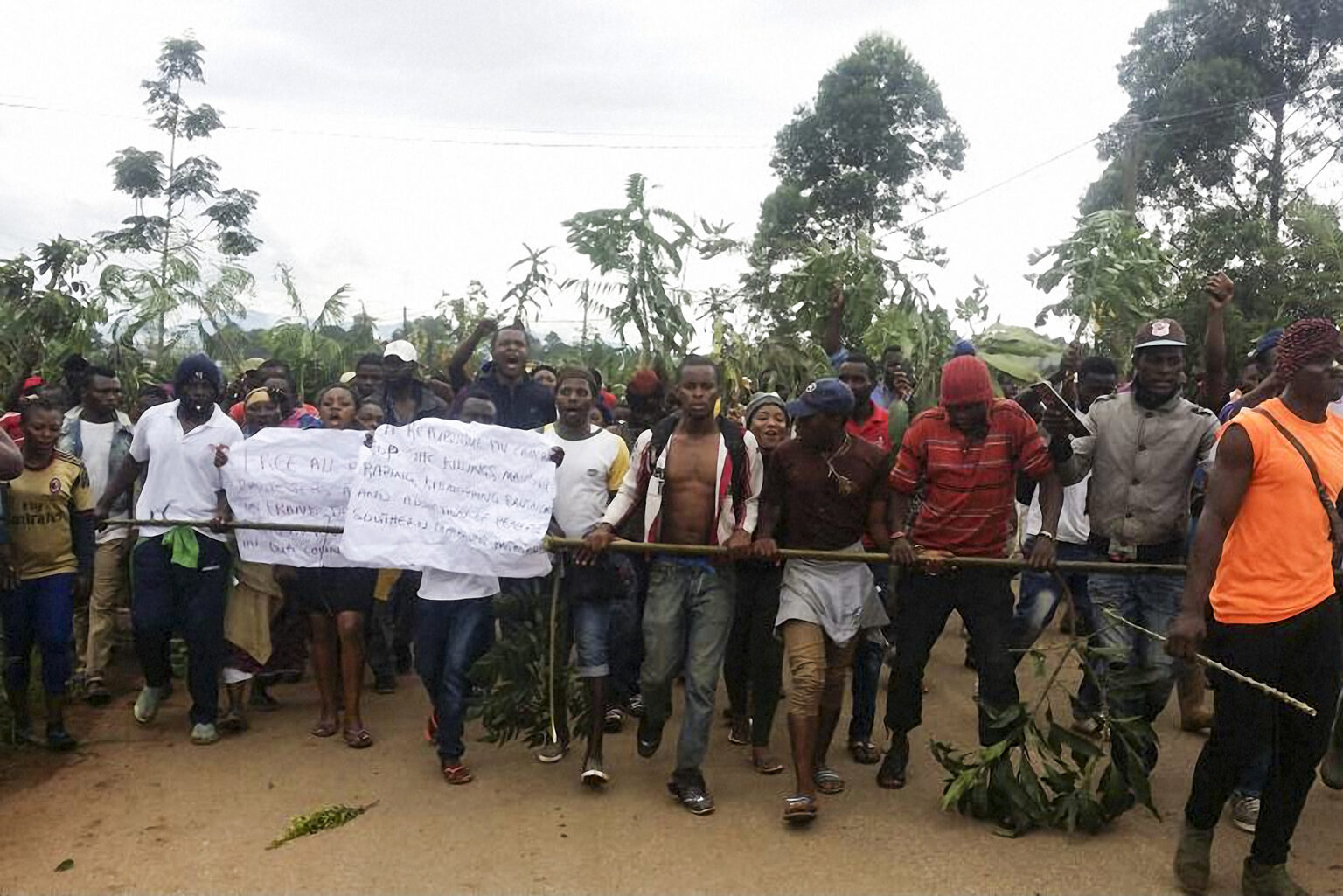
In this piece, the Cameroonian international film- maker, Moise Shewa*, who considers himself an Anglophone, takes strong issue with what he calls ‘celebrity endorsement’ of the war.
Brief background: Although French and English are both official languages in Cameroon, some Anglophones believe they have been long discriminated against and marginalised in terms of development, jobs and in the official use of English within the Anglophone judicial system. In 2016, this took the form of a series of strikes and demonstrations by teachers and lawyers against the government of President Paul Biya.
In 2017, the Southern Cameroons Ambazonia Consortium United Front (SCACUF), after mounting a number of strikes and ‘Operation Ghost Town’ which called for the shutting down of schools and businesses, unilaterally declared independence in some English-speaking regions in Southern Cameroon.
Following clashes with government troops, a separatist Ambazonia Defence Force (ADF), known locally as ‘Amba Boys’ began armed resistance and attacks on state targets, with President Biya declaring war on the separatists.
The separatists’ main leaders are in the diaspora in the US and Europe.
Recently, an op-ed by the highly influential Nigerian author, Chimamanda Ngozi Adichie in the New York Times, as well as comments from the former President of Ghana, JJ Rawlings appeared to lay the blame for the violence on the Francophone segment of the country.
As a Cameroonian, I have recently found myself wringing my hands in shame and in pain, as I read or watched opinion pieces by the likes of former Ghana President JJ Rawlings, Professor PLO Lumumba and Nigerian author Chimamanda Ngozi Adichie, using their celebrity status to weigh in on the carnage ravaging Cameroon today.
By default, or design, they all refer to Cameroon not in the singular but in its plural form – Cameroons. This was the same manner in which the colonialists referred to this former German Colony after it was divided up and given to the British and the French as trust territories after WW1.
Their insistence on still calling this country in the plural form reminds me of those colonialists and some of the few Nigerians, especially amongst the Igbos, who still consider, albeit jokingly, English-speaking Cameroon as theirs.
Their attempts to get behind the picture postcard presentation of this sorry mess of a country that is on the brink of a disaster, hoping that their contribution will help us (English-speaking Cameroonians) in what Ms Chimamanda referred to, in her opinion piece for the New York Times, as “by political intent, an unjust union” is not fair and does not peel back the traditional mystique of the many incomprehensible, reckless, barbaric, senseless and futile wars that have been fought and that have ravaged Africa since independence. The reasons for such wars remain the same – tribalism. Former President Rawlings, I am sure would agree with me, because when I interviewed him back in 1993/94, for a Channel 4 (UK) documentary, most of his venom was reserved for members of the National Patriotic Party (NPP), dominated by the Akans who often referred to him as not being a Ghanaian, because his father was Scottish.
I am sorry to say that this kind of celebrity endorsement writing – or TV lectures, based on anecdotes their friends tell them, and which I suspect they do not bother to do any kind of proper research on – ends up misinforming and misleading.
Despite giving the appearance of great profundity because they are made by ‘Africans’ and therefore must be true, these views are nothing more than opinion pieces given by foreigners about a people and a situation they are not current with, and do not understand or comprehend.
These are opinion pieces that are, to borrow from Chinua Achebe, “feeling sorry for the beautiful feathers while ignoring the fact that there is a chick underneath dying”.
I live in Cameroon, and I can tell you that many of our English-speaking Cameroonian leaders living abroad are today living a lie of the past. The present narrative being put out is one of envy, jealousy, murder, greed and terror by the separatists, causing many in the Anglophone areas to flee to their friends and relatives in the French-speaking parts of the country, like Douala and Yaoundé – to the people our leaders call our enemies.
To them I say, forget the exaggerated stories that your friends tell you of their experiences and that of their families in the 59 years gone by, since re-unification. Yes, we have been marginalised. Yes, we have had the internet disconnected for months in the last two years.
Yes, we were brutalised and murdered when our teachers and lawyers went on a peaceful march. Did these require us to unilaterally declare independence, the next day without any planning or thinking?
On a sunny first of October morning in 2017, we stood up and unilaterally declared independence – even though we later claimed that it was just symbolic. “The state of Ambazonia was on that day born and had risen to fall no more,” our leaders proclaimed within an internationally recognised State. The bitter truth is that, anywhere in the world, any nation would take up arms to quell this kind of treasonous rebellion.
In the sub-texts of the stories your friends tell you, dear celebrity endorsers, are lies shrouded in an evil intent to lure the international community into sending an intervention force to help stop the so-called ‘genocide’ that is being committed by the forces of the French-speaking Cameroon which, we hope, will grant us our already- declared independence.
True enough, we Anglophones have been marginalised, but so too, one can argue, have the people in the East or the people in the North of the country.
Problem of tribal hegemony
The problem there is not a linguistic one, it is to a large extent one of tribal hegemony, which, true enough, is as a result of the government not really being able to serve the people properly and fairly.
Of course, this is symptomatic of most governments in Africa, and I am not trying to be an apologist for President Paul Biya’s government, but we English- speaking Cameroonians abroad and some few in Cameroon make it sound as if it is an Anglophone versus Francophone issue, so we can gain the fraternity of the English-speaking world to come and divide us up again.
That is the lie we are living in. That is the narrative we would want the world to know. NO! NO! NO! Even though a celebrity like Ms Chimamanda did not witness the Biafran War in Nigeria, she should have inherited the catharsis of that terrible civil war, and should have learnt from that that tribal hegemony and tribal identity does not work. In fact, her novel, Half of a Yellow Sun, is a masterpiece on long-enduring effects of the war on the psyche of Nigeria.
It costs too much and it kills too many people. It ruins lives and it ruins countries. Many Biafrans have today, albeit begrudgingly, accepted the fact that “to keep Nigeria one is a task that must be done”.
That is the kind of message we need to hear from our friends and neighbours today, not rabble-rousing, divide and rule rhetoric or finger-pointing at the Francophones for taking the country to the brink of a terrible disaster.
I say to the brink because I was in Somalia when the US Black Hawk helicopter was shot down, and can tell you again and again that war is madness.
In Cameroon, it is not too late by any means to pull back from the brink. What we are seeing now is just the dress-rehearsal, a foretaste of the past wars.
Was it not only yesterday we were shamed by the child soldiers of Sierra Leone? The matchstick- like, famine-stricken soldiers of the Biafran war? The dead soldiers of Liberia with their talisman that they thought would protect them from death still firmly tied on their arms? And those khat-chewing, cholera-infested gunmen in the camps of Mogadishu and Bidoa? And yet, we are today still cheerleading and clamouring and encouraging some more!
Please celebrity endorsers, and the few European and American politicians who have adopted this cause, try and understand the present complexities of this fragile nation which is teetering on the brink, and in which the present-day reality is far bleaker than in Joseph Conrad’s Heart of Darkness.
Confused identities
I was born in Anglophone Cameroon some 59 years ago. My parents came from Francophone Cameroon. I went to primary, secondary and high school in Anglophone Cameroon, I studied English Literature at university, I went to England where I have been living for the past 35 years, working professionally as a television producer and director.
Yet, I am being reminded all the time by the likes of JJ Rawlings (like JJ Rawlings was…), by my Anglophone brothers, that I am not Anglophone. Who is an Anglophone then, in the context of Cameroon?
Many of my so-called Anglophone leaders, who all carry American and British passports, today find it difficult to accept that I am Anglophone, just because I don’t belong to one of the tribes that originate from there.
These, my same so-called leaders, call themselves Americans or British and would not hesitate to brandish their American or British passports into the noses of anyone who dared ask them for their nationality, as if it were a white trophy in the hands of a black African, who now considered himself superior and untouchable.
They were not born in America or Britain, and yet they are now Americans and British! Yet a Cameroonian who was born in English-speaking Cameroon some 59 years ago, is not an Anglophone.
This word, ‘Anglophone’, in Cameroon is not a linguistic appellation. It is a tribal one. We are only using it abroad for convenience, hoping that Mr Trump will come to our help, in the kind of fraternity that Mercedes drivers would show to another Mercedes driver, on a road full of road-ragers.
This is the real “benign linguistic tint to what is in fact a blistering devastation” as Ms Chimamanda says in her piece in The New York Times. But that was in the beginning. Many of us, the silent majority, who have succeeded on the global stage in the mainstream, without any godfathers, have our dual heritage to thank as a major contributor to our success.
Now the narrative has changed. Do some homework please. The blistering devastation here and now, in the case of Cameroon at the moment, is the same gangrene that has devastated many African countries: tribalism, tinted by the Kodachromic lenses of a misguided linguistic appellation.
I am asking that all of you celebrities who have been co-opted to help, should use your celebrity status to give real and up-to-date context and comprehension to this very African problem.
It is being clouded with lies and more lies being told to a people who are shedding the last thing they have in life – their blood – in arguments that are enveloped by all kinds of socio-political and intellectual jargons by separatists and revolutionaries and irredentist historians; and leaders, who are only callously interested in their own popularity cults to the extent that the welfare of their own people is only a distant worry.
The mantra of a “little present pain for a bigger future gain” is the kind of slogan we are hearing from our leaders now, because they have realised that the international community hasn’t got the stomach to become involved in what Mr Trump will call a ‘Sh****le nation’.
Despite moving around the capital cities of the world singing and dancing and marching and throwing tantrums and insults at anyone, any nation or broadcaster that will not buy our story, we have now decided to make friends with individuals who have a following and some power, and can in the wink of an eye, bring millions of heavyweight supporters to our cause.
Back at home, there are no heroes there now, according to the new script – only the corpses of the ‘Amba boys’ being killed in their numbers, with the amulets that they claim protect them from gunshots, still tied around their arms, their mouths gaping wide open in death, from shock perhaps.
The reality is that these corpses now litter the rivers and can be found under trees and in holes in the forests that now have a pall of evil because their owners have fled to where they can find peace and jobs, and the spirits have taken over.
Those who are lucky to be alive have turned into preachers of fear, and are being told to send out terrifying messages for people to flee their homes as the ‘Amba boys are going to attack soon’. They then flee only for the Amba boys to provoke the soldiers from the emptied homes and they come firing and burning so we can use the pictures as proof of genocide in Cameroon. What a shame! This is what is causing the mayhem and the fear of an immense darkness to come. We did not bargain for this.
Those who write against them or disagree with them, are being condemned to death – and this is just a foretaste of things to come. Those with monies are being kidnapped for a ransom, extorted from or coerced to donate to the cause – or else. We know what that means.
Kidnappings and murders, all now in the name of the struggle, are rampant within the two Anglophone regions. And in the foreign capitals of Europe and America, our leaders are fighting amongst themselves, as to who gets the lion’s share of the money we donate to buy arms and to feed the families of our fallen heroes.
We send children, some as young as 14 years old and drugged to the hilt, with hunting guns to go fight a war of liberation, in the promise that for every one Francophone soldier that they kill, they will receive CFA200,000 ($400). We did not bargain for this.
The argument of marginalisation is passé. It is hollow and trite in the present dispensation. The armed factions of Anglophone Cameroon are at war at the moment with their own people, not with the Cameroonian state, while our leaders stay in the comfort of the West and regurgitate Marxist theories of revolution and struggle.
Our children have not gone to school for nearly two years now, because of the reign of terror by our very own leaders, threatening to cut their fingers if they are caught going to school, sending armed men to attack students in their dormitories as they sleep, or in churches as they worship, and then putting up lame arguments in mitigation of their crimes. How low can we get!
“The schools are not safe for them in a time of war and we cannot guarantee their safety,” they argue. “Let them wait until the war is over.” This is their own sacrifice for the struggle I guess, but how long will this carry on?
A year ago, we used to argue that it was the government burning down schools. Now we know the truth. This is a war we cannot win, it is delusional, pie in the sky, and we should remember most of all, that manna does not fall from heaven any more, so let’s take God out of the equation and bite the bullet.
We would be seen as a peaceful people around the world, not as terrorist, if we drop our guns, and our case will have a better winning chance, on appeal. We have spoken loud and clear, and the world now understands our problems.
Bridging the divide
The separatists have been very vocal until now, especially in the West, but they are a tiny minority. We have heard arguments that they are feared and respected on the ground. Yes, this is true. But what do you expect if they reign by terror?
What we, the silent majority, want in Cameroon is peace, not the kind of celebrity endorsement that still points fingers of blame, that will certainly fan the flames of bigotry and hatred and death.
We unilaterally declared independence. We should unilaterally declare a ceasefire. Peace is what we wish for, and is something we can make – by declaring a ceasefire, and engaging again with the outside world, and the state to peacefully express our civic grievances in nonviolent efforts to resolve the conflict credibly.
We should swallow our pride and call the bluff of our present leaders. Africa is changing, and Cameroon will not be left behind. We need to take time to build the institutions that will support any kind of democracy.
The divide can still be bridged despite the fact that we abandoned our democratic principles of the force of the argument, not the argument of force. Guns only kill, and in this case, it is more of our people who are being killed and displaced. It is our people who are being rendered homeless. It is our people who are feeling the pinch of uncomfortable shoes worn by our dim-witted leaders, who only reign by terror.
The way things are going, the last ones standing in the end will be our leaders living their comfortable lives abroad, and we will all be dead, buried and gone. Our people are the chicks underneath the beautiful feathers, not the beautiful words they can find to explain the reasons for war. War is madness.
We, the silent majority have not been as vocal as the separatists, nor as desperate as the Ambazonian warlords and their cheerleaders. We are #simplyCameroonians, with a proud colonial heritage that started with the Germans, the French and the Brits.
We should be neither Germans nor Francophones nor Anglophones. We should not be Ambazonians nor Southern Cameroonians, nor the Cameroons (ians) – and please do not condemn me to death for disagreeing with you – vive la différence!
We should be deeper than that. We the salient (SILENT) majority are now saying: “Not in our names’. All we want is peace – and now. NA
Moise Shewa* is a UK-based multi-award-winning television producer and director. His documentaries include Somalia – The Price of Peace (Channel4, UK); Black Survivors of the Holocaust (Channel4, UK); The Story of Soul to Soul (BBC2); Lagos Airport (Channel4, UK); Out of Africa (Channel4, UK); African Political Broadcast (BBC2) and many others.