
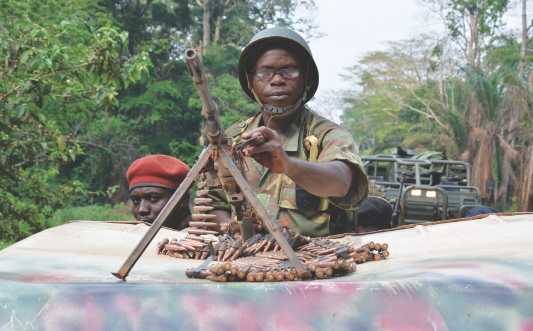
It is widely believed that members of the new rebel-led government in the Central African Republic are more interested in power and pursuing their own personal interests than in respecting the rights and fulfilling the demands of the people. Consequently, there are growing calls for the international community to provide assistance to the population, which is in increasingly desperate need.
The Seleka coalition (Seleka means “the alliance” in the local Sango language) was launched in August 2012 and is made up of breakaway factions from three former armed groups. It consists of Nureldine Adam’s Wa Kodro Salute Patriotic Convention (CPSK); Dhaffane Mohamed Moussa’s Convention of Patriots for Justice and Peace (CPJP): and a dissident faction of the Union of Democratic Forces for Unity (UFDR) led by Michel Djotodja.
The first two rebel groups had reached peace agreements with the government and were supposed to cease fighting. The rebels claimed that President Bozizé, who took power in 2003 through a coup and subsequently won elections in 2005 and 2011, had failed to uphold a 2007 peace agreement. They pledged to depose him unless he started negotiating with them.
After signing a ceasefire agreement in January 2013, the rebels recommenced fighting in March 2013, saying that Bozizé had failed to respect its terms. Bozizé fled the country once the Seleka coalition took Bangui and gained control of the presidential palace. Michel Djotodja assumed the presidency, but was only recognised by other African leaders as CAR’s legitimate leader after forming a 105-member transitional council which elected him as its interim president in April 2013. The transitional council acts as a parliament.
While the fighting might have ended, according to the UNHCR, the UN’s refugee agency, CAR remains one of the most dangerous countries in the world, with lawlessness and insecurity widespread and civilians (many of whom are displaced) living in fear and in desperate need of assistance. The UNHCR has reported receiving information about gross violations of human rights, including arbitrary arrest and illegal detention, torture, armed robbery, rape and abductions.
The CAR administration is limiting humanitarian agencies’ access to many of the 200,000 internally displaced people and the 20,000 refugees, mainly Congolese and Sudanese, in the country. Aid workers currently only have limited access to parts of Bangui and some areas in the remote central and northern parts of the country.
While it is extremely difficult for humanitarian agencies to access the population in need, the UN’s Central Emergency Response Fund (CERF) has allocated over $7.1m to provide desperately needed assistance. The funds have been allocated for 1.1m people, including nearly 600,000 children under the age of five. CERF has received 31 per cent of the required $139m.
Multiple UN agencies are currently collaborating in the field to deliver assistance. CERF has distributed $280,000 to the UN Population Fund (UNFPA) to improve emergency obstetrical and neonatal care and to assist victims of sexual violence; and $875,000 to the UN World Health Organization (WHO) to provide emergency health care including surgical treatment to those in need. UNHCR has received $375,000 to provide protection monitoring and assistance to IDPs. The UN agency is also assisting some 11,000 of the 60,000 refugees who have fled CAR since December 2012, in the DRCongo, Cameroon and Chad.
Given the fact that the DRCongo is still facing its own internal conflict (which flared up again in mid June) and that Chad only ended its five-year civil war in 2010, it is highly unlikely that the CAR refugees will receive any adequate protection from the state.
Humanitarian assistance will be needed for some time in the CAR as the politicians are intent on self-enrichment rather than governing for the people. President Djotodia, the current head of state, had worked under Bozizé and been appointed as the consul in Nyala, the capital of South Darfur state in Sudan. According to the director of Central Africa for the International Crisis Group, the then consul turned against Bozizé because he was not advancing quickly enough up the governmental ladder.
Djotodia proceeded to create the Union of Democratic Forces for Unity in 2006, most likely as an easier path toward gaining power, instead of trying to convince his co-nationals that he is worthy of their support. Bozizé is unlikely to give up power quietly, and many fear he may, in time, regroup his forces to support him and then try to fight to regain power.
There are significant benefits from being in power in the CAR, given the country’s valuable natural resources, which include copper, diamonds, gold, graphite, ilmenite and kaolin. Many of these resources have yet to be exploited, although there is significant interest from international companies. Whoever is in power can amply profit from determining which companies gain access to these resources. That is why it is unlikely that the conflict over leadership will end any time soon in the CAR.
Whilst politicians are fighting for power, CAR’s citizens will suffer, unless the international community assists them. Countries must pressurise the new CAR leadership to respect and fulfill its citizens’ human rights and to allow humanitarian aid to reach the communities that need it most. At the same time, the UN agencies must persuade donors to provide financial support.
Finally, the general public must be made aware of the horrendous human rights violations taking place in this African country. Individuals should not only feel personally compelled to stand up against these atrocities, but also demand action on the part of their governments and the international community, through organising protests, writing petitions and calling on their representatives to take action.








