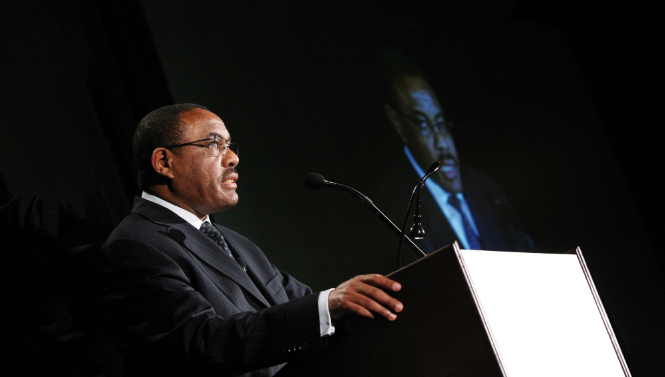
The shock resignation of Ethiopia’s Prime Minister Hailemariam Desalegn underscores the severity and relentlessness of the country’s ongoing protests and the depth of its ethnic polarisation. Who takes over will be decisive for the country’s future. James Jeffrey reports.
Just over a month after the Ethiopian government’s surprise decision to close a notorious prison and release political prisoners, on 15 February Prime Minister Hailemariam Desalegn announced his shock resignation, in another apparent bid to placate the turmoil that’s plagued the country for more than two years.
The day after the announcement, another State of Emergency was declared in Ethiopia – a preceding 10-month state of emergency, the first in 25 years, having ended in August 2017 – casting further uncertainly over the second-most populous country in Africa, which has one of the continent’s fastest-growing economics.
“The mood in Addis Ababa is a sort of anxious indifference, as over the last two-plus years of unrest, the capital city has been relatively quiet,” says local journalist Elias Gebreselassie. “Many residents feel unrepresented in the demands of the protesters, plus, it’s a cosmopolitan city trying to steer clear of Ethiopia’s highly ethnicised politics.”
Hours before Desalegn’s resignation, Jacob Zuma had to step down as President of South Africa, which was similar to the 2017 capitulation of Robert Mugabe in Zimbabwe, suggesting a burst of much-needed political reform among African ruling elites.
But many don’t see Desalegn’s resignation in such a light, rather as a desperate act of self-preservation by the tiny Tigrayan ethnic elite, accused of using Hailemariam Desalegn to entrench the domination of its Tigrayan People’s Liberation Front (TPLF) within the ruling Ethiopia People’s Revolutionary Democratic Front (EPRDF) four-party coalition, and thereby over Ethiopia, since the end of the country’s civil war in 1991.
Others, however, say this misses the point about the scale of change forced on Ethiopia’s political space.
“The resignation of the Prime Minister was not in the interest of the TPLF,” says Awol Allo, an Ethiopian lecturer in law at Keele University in the UK. “While the TPLF is still trying to arrive at a resolution that will continue to preserve its undeserved influence, the resignation is an outcome of the relentless protests of the last two years.”
Having succeeded Ethiopia’s long-term and charismatic ruler Meles Zenawi, who died in 2012, Desalegn was seen by some as being a caretaker figure without real power; there to implement the orders of more influential figures in the army and in the TPLF.
But as the protests have continued, the EPRDF has become increasingly riven by divisions, as its Oromo and Amhara wings have fought back against the Tigrayan over-lordship.
A more sympathetic analysis is that Desalegn, a proclaimed and committed Christian, was always surrounded by a viper’s nest of a government and increasingly caught between a rock and a hard place. Concessions have emboldened protesters, while hardliners in the party have bristled at the speed and scale of such concessions.
Rumours were circulating widely that he would resign after the party congress scheduled for next month. Some observers say the early resignation was brought forward because the ruling party wants a more assertive person in charge during a time of crisis.
Rapprochement or crackdown?
After a decade of double-digit growth, based largely on state investment in infrastructure, growth in Ethiopia has slowed in recent years amid severe droughts and social unrest. Ethiopia has aped the Chinese developmental state model of providing its populace with material gains to offset curtailments of civil liberties – but increasingly, Ethiopians have felt they were only getting the latter, resulting in the Oromo protest movement erupting at the end of 2015.
Having not lost steam during a repressive crackdown when no concessions were made, it seems even less likely to stall in its efforts now. That said, some in Ethiopia note there’s a limit to what protesters will endure, added to which, the security and military apparatus remains potently
capable. Hence all eyes are on who will succeed Hailemariam and whether the new Prime Minister will continue to pursue rapprochement with the disaffected segments of society or initiate a crackdown.
“Stopping the protest is impossible now,” says Jawar Mohammed, a prominent US-based Oromo opposition activist commanding a huge social media following – a hero to some and villain to others.
“It is possible to prevent them further intensifying and over-running the regime by taking bold, concrete action very, very quickly, which should include appointing a capable, popular Prime Minister with proven reformist credentials. There is only one of them in EPRDF. That is Lemma Megersa.”
Leader of the EPRDF’s Oromo contingent, Lemma burst onto the national scene in 2017. Articulate, confident and a youthful 47 years old, he has become a household name and one of the country’s most popular politicians.
But Ethiopia has a long history of being led by authoritarian strongmen figures – before Meles Zenawi it was the military dictator Mengistu Haile Mariam and before him Emperor Haile Selassie, continuing back to the 19th century and Emperor Tewodros II, who began building the empire that became modern Ethiopia.
If the EPRDF chooses a figure from its old guard rather than a rising politician with greater public support, it is feared this will lead to more, perhaps worse, unrest.
“Once appointed, the new Prime Minister should quickly hit the ground, making it clear he would lead the country to transition,
meet with opposition, begin charting a roadmap for transition and begin rapidly liberalising the political sphere, so that opposition groups and the media can build their capacity to play a role in building durable democracy,” Jawar says.
“Hence, what will stop the protest is its ultimate goal being achieved: the establishment of a true democracy. However, a bold and quick step towards that goal can give the regime breathing space,” he adds.
No guarantees
“People in Addis, in and out of government, think that eventually all will settle down,” says Sandy Wade, a former European Union diplomat in Addis Ababa during the first two years of the protests, who recently visited the city. “However, the possibility of real inter-ethnic problems, based probably on jealousy, is there.”
Ethiopia has always viewed itself as different to, even separate from, the rest of Africa. But there remains enough concern it could repeat the same mistakes and disasters seen too many times on the continent.
“There is no guarantee that Ethiopia will not descend into further chaos and violence,” lecturer Awol Allo says. “There is no magic formula here that doesn’t exist in other African countries. After all, we share a large measure of cultural and institutional similarities.”
The impact of the heavily influential Ethiopian diaspora opposition, especially in the US, could well swing matters, harbouring the potential to call for compromise or further stoke tensions.
“It is time for Ethiopians to decide whether they want the former empire that is Ethiopia to be one country or several countries,” Wade says. “If they want one country, the current obsession with ethnic nationalism needs to change because it will lead to several countries, not one.” NA