As Burkinabés filled the streets to call for President Blaise Compaoré to step down, the veteran leader would have also heard protesters chanting another man’s name: that of Thomas Sankara. Femi Akomolafe explains who this African icon was and how he helped end Compaoré’s rule.
As Blaise Compaoré, for so long Burkina Faso’s strongman president, watches events unfold in his country from exile, one hopes he recognises the irony of his demise. Before he was toppled by popular protests at the end of October, Compaoré had been one of Africa’s longest-serving leaders. Under the constitution, he would have had to step down after the November 2015 elections, but even if he had, there is little doubt that after 27 years in charge he would have been able to maintain some grip on power.
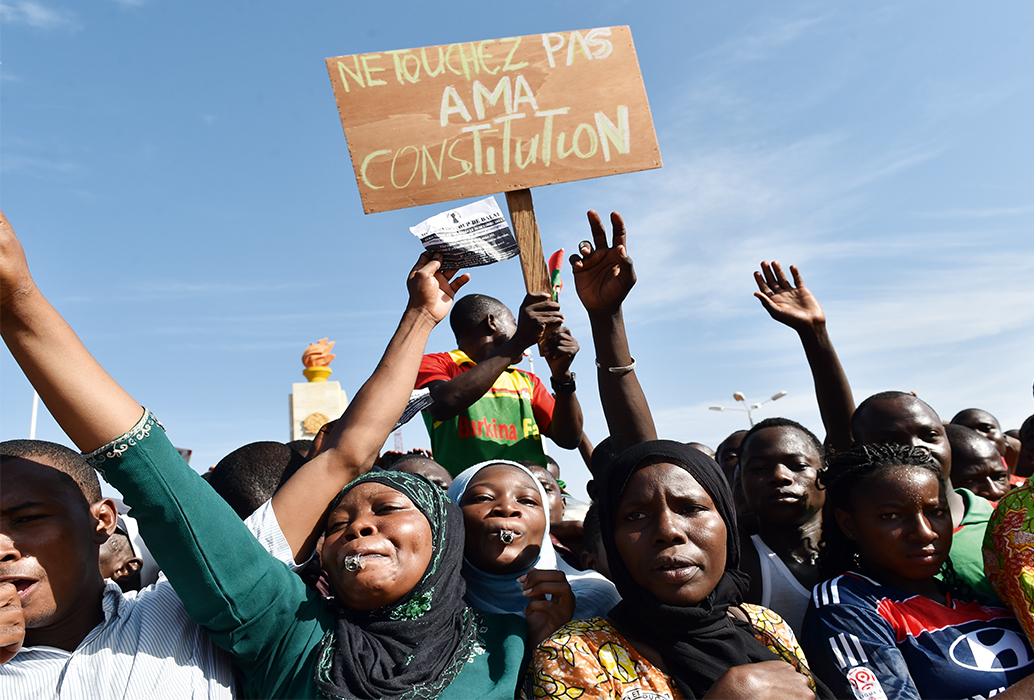
That wasn’t enough for Compaoré, however, and it was his very attempt to change the constitution in order to prolong his rule that ended it so suddenly, completely and dramatically. Compaoré could not have misjudged the public mood more starkly, and on 30 October, as MPs got ready to vote on Compaoré’s proposed constitutional amendment in parliament, tens of thousands of people took to the streets. They defied teargas and rubber bullets and torched several buildings including the headquarters of the ruling party and the parliament building itself.
Compaoré was stunned but still refused to leave until the next day when mounting protests and domestic pressure forced his hand. He announced his resignation, and after some dispute and confusion within
the army, Lieutenant Colonel Isaac Zida became acting president.
After nearly three decades, the Burkinabé people had had enough of their leader, and as Compaoré watched as vast waves of protesters filled the streets, he would have seen placards in their hands and heard their defiant demands of “Blaise, Get Out!” However, as it was dawning on him that his rule was coming to an ignominious end, Compaoré may also have noticed that his name was not the only one protesters were chanting. Shouts of “Thomas Sankara” were also ringing out from the streets.
Many protesters had even declared themselves to be Sankarists and demonstrators could be seen carrying photographs of the young man. The last time Compaoré saw that face in the flesh, he was a young man himself. And little would he have known at the time that 27 years after taking power from him, that iconic figure would be back to haunt him.
Who is Thomas Sankara?
Captain Thomas Sankara became Burkina Faso’s president in 1983 following a coup d’état organised by his then ally Blaise Compaoré. Sankara formed the National Council for the Revolution (CNR) and also established Committees for the Defence of the Revolution (CDRs) to “mobilise the masses” and implement the CNR’s revolutionary programmes.
Sankara was a charismatic leader who matched his fiery Marxist rhetoric with practical actions in his bid to make the country proud, self-reliant and self-confident. To symbolise the new era, Sankara renamed the country from the Upper Volta to Burkina Faso, which translates as “Land of Incorruptible People” in Moré and Djula.
Internationally, Sankara wanted to end the domination by France and reliance on foreign powers. To do this, he cut off ties with the International Monetary Fund (IMF) and the World Bank and refused to accept foreign financial assistance. “He who feeds you controls you,” he said.
It was domestically, however, that Sankara’s revolutionary zeal would be most felt. Sankara believed in a self-sufficient and prosperous Burkina Faso and set about launching visionary programmes. He nationalised land and mineral wealth, launched a nation-wide literacy campaign that saw school attendance double within two years, and organised a public health programme that vaccinated 2.5 million children.
Furthermore, Sankara launched far-reaching road and rail construction projects, oversaw the planting of over ten million trees to stop desertification, and abolished rural poll taxes and domestic rents. He encouraged every village to build a medical dispensary and had over 350 communities construct their schools using their own labour.His government redistributed land from feudal landlords to peasants, leading to a doubling of the country’s wheat production. And he managed to make Burkina Faso practically self-sufficient in basic foodstuffs.
Sankara’s commitment to women’s rights was also far ahead of his time. He banned female genital mutilation and forced marriages, and for the first time, Burkinabé women were allowed to initiate divorce. The president actively sought out women to serve in his cabinet and army. “The revolution and women’s liberation go together,” he said. “We do not talk of women’s emancipation as an act of charity or because of a surge of human compassion. It is a basic necessity for the triumph of the revolution.”
Finally, Thomas Sankara famously lived what he preached and disdained ostentation. He sold off luxurious government vehicles, leaving him and his officials to use the cheapest Peugeots on the market. He slashed his salary to $450 a month and reached his office by bicycle. At the time of his death, Sankara’s total assets reportedly consisted of a modest house on which he was still paying his mortgage, $350 in the bank, and a few bikes and guitars.
All these revolutionary programmes made Sankara a powerful icon for the African masses. But they also won him the enmity of many, including some unions, a nascent but narrow Burkinabé middle class, and the feudal leaders he stripped of certain powers and rights. The nature of his rule also won him the hatred of France and its allies in Africa, especially Côte d’Ivoire President Félix Houphouët-Boigny.
By 1987, this animosity towards Sankara had escalated to the point at which, on 15 October, the socialist president was overthrown and killed in a coup led by Blaise Compaoré. Sankara had trusted his right-hand man, but it seems he may have known he was in danger before the coup, as a week before his murder, he prophetically declared: “While revolutionaries as individuals can be murdered, you cannot kill ideas.”
Compaoré’s corruption and cronyism
When Compaoré took power, he set about reversing Sankara’s policies, embarking on a privatisation programme sponsored by the IMF and rebuilding close ties with France. And unlike the incorruptible Sankara, Compaoré’s administration has been one marked by cronyism and corruption on a gigantic scale.
Under Compaoré, Burkina Faso’s food self-sufficiency has been undone and a focus on large-scale mineral exploitation has benefited foreign investors and a small political elite but few ordinary citizens. 77% of people are unemployed and the country ranks at 183 out of 186 on the global index of living standards.
While Sankara had attempted to instil a revolutionary mindset of autonomy, self-sufficiency and sovereignty – a move that scared foreign powers and vested interests – Compaoré did the opposite. Like so many African leaders, his legitimacy and longevity rested on support from international friends and a small political and economic elite. Internationally, Compaoré established himself as a smooth operator and respectable elder statesman, while domestically, he split the opposition and embarked on political marriages of convenience that earned him landslides victories in questionable elections. In 2005, he won 80.4% of the vote, with the runner-up garnering a mere 4.9%. And in 2010, he managed 80.2%, with second place on 8.2%.
Because of the bravery and defiance of the Burkinabé people, Compaoré will not be winning any more elections, though what will happen next remains to be seen. The intervention of the military in filling the vacuum of power left in the wake of Compaoré’s departure stabilised the situation, but the people who finally rid themselves of one strongman will not want to see another take his place. Regional organisations such as the West African bloc ECOWAS and the African Union meanwhile are also watching events closely and have put pressure on the country’s new military rulers to hand over to an interim civilian administration as soon as possible.
If Sankara had simply been in exile these past 27 years, it is easy to imagine that he would now be being embraced by Burkinabés who would proudly march him back to his former presidential office. But that is not the case. However, as the socialist icon said himself soon before he departed this world, “individuals can be murdered but you cannot kill ideas.” This is a lesson that Compaoré learnt all too late as Sankara’s revolutionary message echoed loudly into the present, and it is something any future leader of Burkina Faso would do well to keep in mind too.