
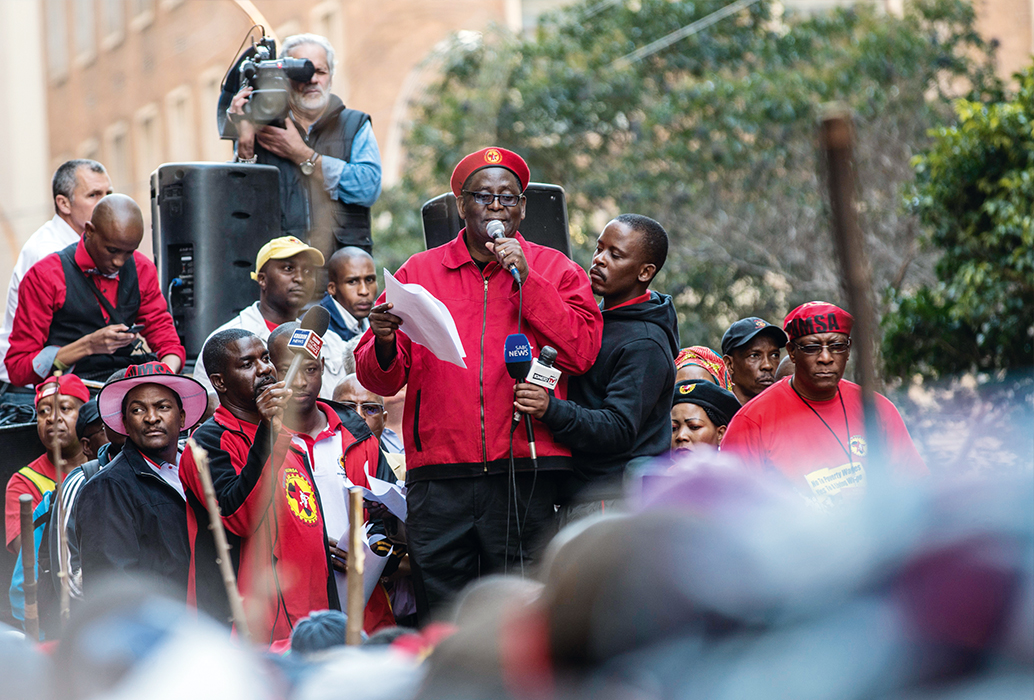
South Africa’s biggest union Numsa has been expelled from the ANC-aligned trade union federation Cosatu for its opposition to the ANC. The Numsa-ANC split represents the third revolt of the left in the ANC and, as our Editorial Director James Schneider reports from Johannesburg, a turning point for the country.
On paper, South Africa’s ruling African National Congress (ANC) should be sitting pretty. Just this summer, the party won its fifth consecutive national election with over 60% of the vote. But since then, the ANC and Jacob Zuma’s presidency in particular has lurched from crisis to crisis.
Zuma is no stranger to controversy. But what we are now witnessing is challenging the very roots of the ANC’s long-held hegemony, as the conflicting interests that came together under its banner in the closing years of apartheid and first 20 years of majority rule unravel.
The latest manifestation of these dynamics came on 8 November when South Africa’s largest trade union, the National Union of Metalworkers of South Africa (Numsa), was expelled from the country’s largest trade union federation, the Congress of South African Trade Unions (Cosatu).
Cosatu, with its 2.2 million members, along with the South African Communist Party (SACP), is strongly allied to the ANC in an arrangement known as the Tripartite Alliance. Numsa had previously broken with the ANC and refused to support the party in the 2014 elections.
The ANC is suffering from the contradictions within South Africa’s economy and society. And because of the centrality of the ANC to the structuring of the country’s post-1994 politics, its crisis is one of the South African system as a whole.
Building the Alliance
South Africa’s labour movement is large, militant and played a key role in ending apartheid. Founded in 1985, Cosatu quickly built itself up as a powerful force of labour militancy. There were many currents within the federation, but the body formed to create unity despite differences of perspective and approach.
One shared belief, however, was that the overthrow of apartheid was necessary to the improvement of workers’ lives, and so it allied with two other political organisations, the ANC and SACP, and agreed to work under the ANC banner.
As it became clear that apartheid would fall, Numsa became more aware of the possible complications of the labour movement being so closely allied to the government, especially when the government was the country’s largest employer. In 1993, therefore, it proposed that Cosatu withdraw from the Tripartite Alliance after the 1994 elections. Cosatu debated and rejected the proposal. The Alliance stuck together.
In government, the ANC has been redistributive via its social grants system but has broadly followed a market liberal macroeconomic policy. It has not radically intervened in the economy to restructure it in favour of the poor or working class. The Tripartite Alliance has maintained an extremely lively, and often highly critical, internal debate about policy and party direction. But at its heart, the unions have accepted a central compromise: that there will be some, but not structural, change, and that they will get a seat in the car, but not the driving seat.
The left revolts
This bargain kept the labour movement on board until the mid-2000s, but since then, there have been three revolts. All of these have claimed to be explicitly opposed to South Africa’s policy framework that developed following the Growth, Employment and Redistribution (GEAR) plan in 1996.
The first of these rebellions was the removal of Thabo Mbeki as ANC party president in 2007. In this revolt, the left of the Alliance – led by Zwelinzima Vavi, General Secretary of Cosatu, and Blade Nzimande, General Secretary of SACP – rallied behind Jacob Zuma to oust Mbeki. The left hoped Zuma’s ANC would tack firmly in its direction, abandoning the policies Nzimande dubbed the “1996 class project”.
The ouster was successful, and the left had something to cheer about when Zuma brought leftist figures into his cabinet. However, as time passed, many on the left began to see Zuma’s government as employing its people but not its ideas.
What we are now witnessing is challenging the very roots of the ANC’s long-held hegemony, as the conflicting interests that came together under its banner in the closing years of apartheid and first 20 years of majority rule unravel.
The second revolt came in the form of the Economic Freedom Fighters (EFF), established in 2013 and led by Julius Malema along with other expelled ANC Youth League figures. Malema, who had been a major part of the right wing of support for Zuma over Mbeki, now shifted to a trenchant critique of Zuma’s ANC from the radical left. The EFF, which combines socialism with Black Consciousness and focuses its critique on white monopoly capital and the ANC’s failure to confront it, won 6% of the vote this year. Its vote was firmly weighted towards the disenfranchised, young and jobless, although it did gain support from some older professionals too.
The EFF, which demands radical change from a left that mainly sits outside vehicles like the unions, is having an outsized effect on South African politics. The 25-member caucus in parliament has brought a fierceness, as well as a hint of pantomime, to debate in the chamber. The ANC has fought back aggressively, but the EFF demand that Zuma “pay back the money” (a reference to the more than $20 million of public money spent on his personal homestead in Nkandla) has captured the public imagination.
The third revolt, like the second, can be seen partly as a response to the ostensible success (overthrowing Mbeki) but structural failure (not transforming society) of the first. Numsa now sits outside the ANC alliance, while seven other unions have suspended their participation in Cosatu. Between a third and a half of Cosatu’s membership is thus at risk and with it more than R1 million ($90,000) per month in funding. Vavi opposes the expulsion of Numsa and must be seen as hanging by a thread in the federation, despite his nominal leadership of it.
A finger in every pie
The Alliance leadership has long been in a pressure cooker of interests, and in many instances, this has led to a situation in which the same individuals represent a number of possibly competing forces: from government to party to union to business.
This has generated a narrow elite that leads and holds together these disparate strands. And this is why much of the upheaval – whether in politics, labour, or, to an extent, business – seems like a revolt of the bottom against the top. The ruling elite contains so many competing interests that those individual interests can never be truly expressed, frustrating the membership that wants to push them.
Two figures in particular symbolise this predicament. The first, Cyril Ramaphosa, is Deputy President of both the ANC and South Africa, and is seen as the most likely successor to Zuma. He was the ANC’s Secretary General in 1991-1997, before which he was General Secretary of the Nation Union of Miners (NUM). He is also a rand billionaire. Significantly, one of Ramaphosa’s business roles has been as a significant shareholder in the Lonmin mine where the 2012 Marikana massacre took place. One of the driving forces behind the rising tension at the mine had been the large-scale decampment of workers from the NUM, which many felt had too cosy a relationship with their bosses and the government, to the rival Association of Mineworkers and Construction Union (AMCU).
The second figure of note here is Gwede Mantashe, Secretary-General of the ANC (below). His previous job had been as General Secretary of NUM, and his successor at the head of the union, Frans Baleni, was handpicked by him. Mantashe also served, until 2012, as chairperson of the SACP and remains on the party’s politburo. In 1995, he was also the first trade unionist to be appointed to the board of a Johannesburg Stock Exchange listed company.

These webs of interests, personified by the likes of Ramaphosa and Mantashe, have been the basis of the ANC’s hegemony. But hegemony works by it not being fully acknowledged. And these links – some would say conflicts of interest – are now being firmly challenged on several fronts.
For one, Dali Mpofu, lawyer for the Marikana miners at the Farlam Commission of Enquiry, wants charges of murder brought against Ramaphosa for the deaths of the 34 Marikana miners; the nexus of corporate, party, government and union power that runs through him is a key part of Mpofu’s argument. Meanwhile, business is not funding the ANC as much as it once did. And finally, the AMCU, EFF and Numsa, as well as radical social movements like Abahlali baseMjondolo, constitute an attack on the net of interests represented in the ANC leadership.
It appears that these revolts are multiplying. The genie cannot be coaxed back into the bottle.
A new hegemony?
This month, Numsa will launch the United Front. This entity will seek a broad alliance among social movements and unions that sit outside the ANC, as well as possibly the EFF. If it can bring together all of these leftist forces as well as AMCU and Vavi, it could prove a formidable force.
The initiative could, of course, fade away like various previous new political parties in South Africa. If it did, it would suggest the recent unrest is no more than a symptom of the ANC’s current crisis of hegemony. But if it proves resilient, it could herald rapid change.
South African politics is more open now than it has been since 1994, not necessarily in electoral terms but in the direction society could move.
There seem to be three possible outcomes. First, the ANC could restore its fracturing hegemony with a new political project that, like the “Rainbow Nation”, papers over the system’s inherent contradictions. Second, a new counter-hegemonic force could develop from below – both outside and inside the ANC – to dictate its terms to society. Or third, the ANC could shift from a strategy based on hegemony to one based on domination. This would entail more violence against opponents, an enforced narrowing of the terms of the debate, and probably a shift towards a more trenchant nationalist, and perhaps patriarchal, rhetoric.
The dynamics exist for each possibility. South Africa is at a turning point and how people act now could have far-reaching effects. South African politics is more open now than it has been since 1994, not necessarily in electoral terms but in the direction society could move. The latest two revolts on the ANC’s left may be the future, or they may, like the first revolt, only spur on further ones. NA








