
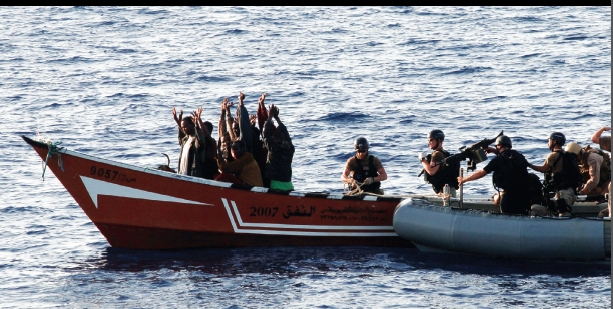
Despite what others say about piracy in West Africa, Chris Trelawny, the senior deputy director responsible for maritime security and facilitation at the International Maritime Organisation (IMO), the UN specialised agency (writing here in his personal capacity and not that of the IMO), thinks political leaders should change their mindsets and focus on the opportunities afforded by the maritime sector and not get unduly distracted by problems such as piracy and armed robbery against ships.
Reports in the world press would have us believe that piracy and armed robbery against ships in the Gulf of Guinea have reached epidemic proportions. This perceived threat to the supply of oil from the region, the adoption of United Nations Security Council resolutions 2018(2011) and 2039(2012) and the recent focus on piracy and armed robbery by the Economic Community of Central African States (ECCAS), the Economic Community of West African States (ECOWAS) and the Gulf of Guinea Commission (GGC), to name but a few, have added to the impression that the threat from these criminals has suddenly started to spiral out of control.
But is this really true? Even if it is, is piracy actually the problem or is it a diversion from bigger issues? If the problem is not piracy, then what are the real problems? And, more importantly, how do we fix them?
Before we go any further, it is important to clarify what the terms “piracy” and “armed robbery against ships” actually mean. The legal definitions are given in the box opposite. However, essentially both are crimes committed by persons in one vessel against persons and property in another vessel for the purpose of personal gain.
The main difference between them is that piracy takes place outside of a state’s jurisdiction, i.e. outside of the coastal state’s territorial waters (12 nautical miles) whereas armed robbery against ships takes place within a coastal state’s jurisdiction, in territorial waters. Although to the victim the difference may seem irrelevant, the rights and obligations of states to intervene and establish jurisdiction are critical factors in the response, or lack of response, to these crimes. Put simply, piracy is a universal crime and all states have an obligation to intervene. Inside territorial waters, it is the coastal state’s responsibility.
The IMO
The International Maritime Organisation (IMO) is the specialised agency of the UN responsible for all aspects of maritime safety, maritime security (including countering piracy), facilitation of international maritime transport, and protection of the marine environment. As such, the IMO receives reports of reported and attempted attacks by pirates and armed robbers and publishes them via its Global Integrated Shipping Information System (GISIS) (http://gisis.imo.org). Whereas nobody would pretend that the statistics are totally accurate (there is known to be under-reporting of less serious attacks for a variety of reasons), they are useful indicators of general trends.
A study of the statistics reveals some interesting facts. For example, the number of acts of piracy and armed robbery against ships in West Africa reported to the IMO covering the period 1 January to 31 December 2012 was 60, a drop of 8% compared to 65 reported incidents in 2011. Of the 60 incidents reported in 2012, 37 were attacks on tankers (16 chemical tankers, 11 product tankers, 5 oil tankers and 5 tankers, see Tables 1 and 2).
Of the 554 attacks and attempted attacks in West Africa that have been reported to IMO over the past 10 years, just under 20% took place in international waters. It therefore follows that over 80% of these crimes took place within national jurisdictions, and even though some of the coastal states of West Africa lack maritime law enforcement capability, there is no void of authority, like that in Somalia. So what is not being done?
Piracy and armed robbery against ships are land-based problems. Although the offences take place at sea, the criminals operate from bases ashore and must return to shore to sell their ill-gotten gains. To a certain extent the problem can be deterred or contained through action at sea but the only sustainable solutions are good policing and the rule of law ashore. It therefore follows that the failure to address maritime crime at sea is symptomatic of wider problems on land.
Incidents of piracy and armed robbery in the Gulf of Guinea fit broadly into one of three categories. The first is the low-grade theft of ship’s stores, crew possessions and money – essentially maritime mugging. Sometimes very violent, this type of criminal activity is most often under-reported as the values involved
are often below insurance claim minima, delaying the ship pending investigation of the offence is costly, and there is a perception that having local police on board may lead to further losses. The second, and from a financial viewpoint the most significant category, is the theft of oil and hydrocarbons, often during ship-to-ship transfer operations. (As these attacks tend to occur further offshore, the third category of pirate attacks are attacks on other ships to get food, fuel and other materials as logistic support for the vessels conducting the oil theft).
The cost of oil and hydrocarbon theft to legitimate exchequers is enormous – the cost to Nigeria alone is estimated at some $6bn per year – money which if invested in nurturing legitimate business ashore could significantly improve the economic condition of many people.
The effect of these crimes on marine insurance rates is also damaging to coastal states’ already fragile, under-developed economies. Some of the pirate attacks include the taking of ships containing
oil, which are then taken to the coast and offloaded for processing in refineries.
The oil saga
The whole issue of oil and hydrocarbon theft poses a series of uncomfortable questions, the answers to which are probably more significant than the piracy and armed robbery itself.
How much collusion is there between poorly paid crew members on the feeder ships and the pirates? Where do these ships go to be offloaded? Who doesn’t notice an ocean-going vessel offloading thousands of tonnes of oil at an illegal jetty? Who processes these huge quantities of stolen oil? Who doesn’t ask the right questions?
Although piracy and armed robbery against ships are important issues, they are largely the symptoms of organised crime, institutional corruption and lack of effective law enforcement ashore. It would be a mistake to focus on countering piracy and armed robbery in isolation – what is needed is comprehensive action to increase maritime security and improve maritime law enforcement in the widest sense. The most urgent priority must therefore be to address the governance and rule of law issues on land rather than being sidetracked into taking superficial actions at sea. Although it is tempting to point at the reduction in the pirates’ success rate in the waters off Somalia, as a justification for increased action by naval forces and the employment of privately contracted armed security personnel on board merchant ships in the Gulf of Guinea, even the briefest analysis should dispel this myth. On the high seas, the law of the flag state applies. However, as detailed above, 80% of incidents in West Africa happen within coastal states’ jurisdiction. This means that the carriage of firearms, the procedures for embarkation and disembarkation of security personnel, their weapons and equipment, and the rules for the use of force are all subject to the various legal regimes of the coastal states concerned. In most cases the relevant coastal state laws are either unknown to the international community or non-existent.
Given that many states in the region have recently emerged from civil conflict or have their own security concerns, it is unlikely that the presence of foreign warships or merchant ships carrying what some may see as armed foreign mercenaries within territorial waters will be welcomed. Furthermore, if there is indeed institutional corruption and local officials are involved (by commission or omission) in maritime crime, coupled with a lack of transparency on national laws, the likelihood of armed security personnel getting into trouble is significantly heightened. So what should be done?
The UN’s Security Council, through Resolutions 2018 (2011) and 2039 (2012), has recognised the need for adopting “a comprehensive approach led by the countries of the region to counter the threat of piracy and armed robbery at sea in the Gulf of Guinea and their underlying causes”; and the need to build on “existing national, regional and extra-regional initiatives to enhance maritime safety and security in the Gulf of Guinea”.
Piracy summit
The forthcoming Summit of Gulf of Guinea Heads of State, envisaged in Resolutions 2018 and 2039, provides a welcome opportunity for African states to develop regional maritime security in its widest sense.
It is worth noting that the UN Security Council resolutions concerning the situation in Somalia are enacted under Chapter VII of the Charter of the UN, with a focus on piracy as a threat to international peace and security in the region. However, Resolutions 2018 and 2039 are focused on promoting the maintenance of peace and stability in general in the Gulf of Guinea region. This is an important distinction as it calls for a different response from that employed against Somalia-based pirates operating in the international waters of the Gulf of Aden and the western Indian Ocean.
There are a number of non-African initiatives too. These include those of the EU, France, the UK and the US (including AFRICOM and the Africa Partnership Station). Clearly there is no shortage of ideas or policies, but do these seek to address the real problems or do they just focus on alleviating some of the symptoms, specifically piracy and armed robbery against ships? And, more importantly, is there regional state buy-in? Do the states in the region actually have the political will to implement maritime and maritime security strategies?
It should not be forgotten that states in the region have committed themselves through accession to various international conventions, to perform what are sometimes referred to as “coast guard functions”. These include the development of search and rescue capabilities; the prevention of pollution and protection of the marine environment; maritime and energy supply security; and countering piracy and armed robbery against ships, illegal migration, and the trafficking of drugs, weapons and people. It would be fair to say that a failure to implement some of these coast guard functions could have far more serious consequences than a failure to address piracy and armed robbery against ships.
For example, illegal fishing off West and Central Africa is currently at unsustainable levels. Given that many states in the region are dependent on fish for over 60% of their edible protein, the strategic implications of the failure to protect and sustain this vital resource should be clear.
Even in the short term, according to the Environmental Justice Foundation, “global losses due to illegal, unreported and unregulated (IUU) or ‘pirate fishing’ are estimated to be between $10bn and $23.5bn per year. West African waters are estimated to have the highest levels of IUU fishing in the world, representing up to 37% of the region’s catch. Along with the economic losses, pirate fishing in West Africa severely compromises the food security and livelihoods of coastal communities.” Why are these significant losses to the economy and threats to food security not being addressed?
Proper implementation of these coast guard functions could play a major role in coastal states’ abilities to develop their maritime sectors and to reap the benefits of intra-African trade by sea. The development and maintenance of exclusive economic zones, including growing viable national fishing industries, will contribute to sustainable development, consistent with the UN’s Millennium Development Goals. It is therefore important for political leaders to change their mindsets and to focus on the opportunities afforded by the maritime sector and not get unduly distracted by problems such as piracy and armed robbery against ships.
‘Sea blindness’
Addressing “sea blindness” in many African states, that is, the lack of policies with respect to the opportunities offered by a developed maritime sector, must be moved up the political agenda as African governments need to focus on the sea as well as on land. The development of the maritime sector should be a strategic national interest, not a minor departmental interest. The first priorities should be for states to develop their national maritime strategies (how they will develop and benefit from their exclusive economic zones); their national and regional maritime security strategies; their national legal frameworks; and their organisational structures.
Specific actions by governments could include:
• Conducting a review of national maritime and criminal legislation, its implementation and the integrity of those implementing it, in order to ensure that it is fit for purpose.
• Strengthening inter-agency co-operation in both a national and regional basis, including better use of information technology and enhanced maritime situational awareness.
• Developing African ports, domestic shipping and maritime industries so as to enhance intra-African trade.
• Attracting investment in the African maritime transport sector.
• Promoting the study of maritime subjects and, in particular, maritime technology, in universities in Africa.
These processes should involve all relevant agencies: navy, coast guards, gendarmerie maritime, police, intelligence, port and maritime authorities, judiciary, finance, industry, academia, etc. These should address holitically all maritime safety and security threats, including threats to energy production and supply; combatting illegal fishing, illegal dumping; trafficking of people, drugs and weapons; and of course piracy and armed robbery against ships.
An inter-agency approach, involving a range of agencies and collective responsibility, accountabiilty and shared benefits may, of itself, serve to reduce corruption and mismanagement. The IMO has been working in West and Central Africa since 2006 promoting the concept of an “integrated coast guard function network”, i.e. encouraging a joined-up, multi-agency approach to maritime law enforcement including countering trafficking and border control, maritime safety, security and protection of the maritime environment.
Fifteen out of 20 coastal member states of MOWCA have already signed a memorandum of understanding (MoU) developed in 2008, which lays out a strategy for enhancing maritime security. Although the MoU is an agreement between ministers of transport, it is a credible blueprint of a wider diplomatic agreement on maritime security between the states in the Gulf of Guinea and throughout the wider region.
The enhancement of maritime security will be a building block for the greater stability on land. Ignoring the work already done in developing the MOWCA MoU, simply because it has been signed by the ministers of transport (and not a “higher” department) would be a mistake. We should not waste time repeating what has already been said or achieved. We simply do not have time for that.
Conclusion
Piracy and armed robbery against ships is just one of the maritime challenges faced by African coastal states. More significans, however, are the lost opportunities resulting from a failure to develop the maritme sector as a strategic national asset. Concerted action by governments to develop national maritime strategies protected by national and regional maritime security strategies and good governance will lead to increased prosperity and stability throughout the region and a reduction in maritime crime.
Focusing on one symptom alone would be counter-productive as it could delay the action necessary to develop a sustainable maritime sector in West and Central Africa.








