
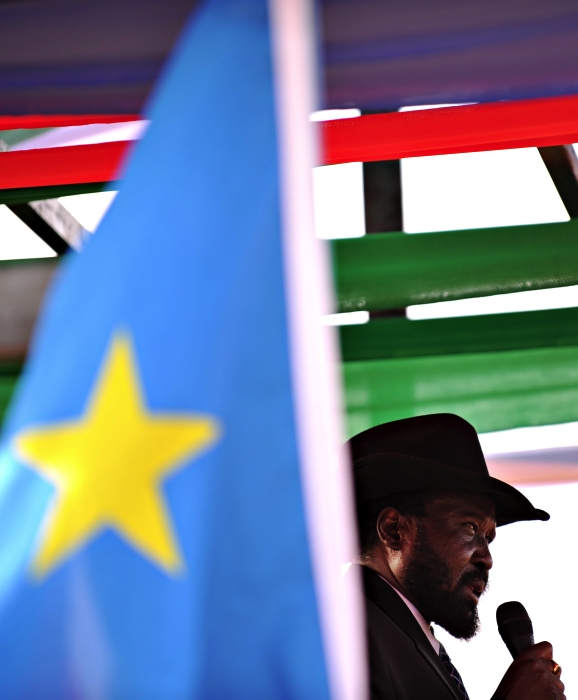
The AU has called for South Sudan and its northern neighbour Sudan to withdraw their forces from the disputed border areas and settle their arguments over oil, citizenship and boundary issues within three months. But, as Washington Shirai reports, little progress has been made.
WHEN THE SOUTHERN SUDAN PEOPLE’S Liberation Movement government in Juba, South Sudan and the National Congress Party government in Khartoum broke off their negotiations in Addis Ababa early last month (June), the two sides had failed to find an accord on a proposed de-militarised buffer zone. The two countries have been at loggerheads since April when, following tit-for-tat armed clashes as well as both sporadic artillery barrages and Sudan’s air attacks, South Sudan both occupied Sudan’s Heiglig oil field and shut down Khartoum’s vital oil pipeline. The pipeline had been shipping 300,000 barrels of crude oil each day to Port Sudan in the north, the transit fees underpinning Sudan’s economy.
South Sudan is highly reliant on oil revenues. Oil constitutes 98% of Juba’s revenues, but the South Sudan government claims that the Khartoum government has failed to honour payment agreements for the black gold.
Held under the auspices of the AU High Level Implementation Panel on Sudan (AUHIP), negotiations in Ethiopia were led by former South African president Thabo Mbeki and prioritised resolving the issue of oil fees. The talks followed the UN Security Council’s Chapter VII resolution to end the fighting, return to peace talks and permit humanitarian assistance to reach those affected by the conflict on both sides of the border.
Yet the oil pipeline dispute shows no signs of being resolved. South Sudan’s Foreign Minister, Nhial Deng Nhial is on record as saying that his government “was ready to pump no oil for two years” while it tried to negotiate “a fair tariff” with Khartoum to transport it. Industry experts say that even if an agreement were reached, it would take many months of maintenance work to ramp up operations before the oil could start to flow again.
South Sudan is said to be trying to reach agreement with Ethiopia and Djibouti to build a pipeline to the Red Sea – and another pipeline to Kenya’s new port at Lamu on the Indian Ocean is also being pondered. The problem is, however, that these projects would take many years to complete and investors would undoubtedly be nervous of backing a major infrastructure programme in a region so prone to conflict.
An influx of returnees
Adding to the problems faced by both sides in this simmering dispute is the number of displaced peoples in the two countries. In Sudan, insurgency in both South Kordofan and Blue Nile states has led to 140,000 people fleeing their homes.
The UN’s High Commission for Refugees (UNHCR) report that they have begun aid airlifts for refugees in South Sudan’s Upper Nile state. The flights are to provide supplies for 50,000 refugees who have fled conflict and related food shortages in Sudan’s Blue Nile state. Over the last year, the UNHCR says, almost 200,000 Sudanese have fled to South Sudan and Ethiopia.
South Sudan is also preparing for an influx of half a million ethnic South Sudanese people returning from the north, many of whom have spent their entire lives in Sudan. This follows the Khartoum government’s ominous instructions to South Sudanese living in Sudan to “regularise their residency papers”.
These returnees will face an even more challenging economic climate in South Sudan as inflation has skyrocketed in recent months. While Sudan’s inflation rate had reportedly run at 21% in the first quarter of the year, in South Sudan it would seem to be much higher. The cost of staples such as sugar and maize has almost trebled this year.
By no means the only country in the East Africa region to suffer from rising food prices, a South Sudan minister has nevertheless claimed that the increases in food prices is the work of profiteers.
As well as the “returnees” from Sudan, Southern Sudanese are also being deported to Juba by the Israeli government. A court in Israel has determined that Southern Sudanese refugees are no longer at risk in their homeland, giving the green light to a repatriation process.
The first batch of 700 South Sudanese returned to Juba from Israel last month as part of Israel’s right-wing populist policy to deport Africans and “protect the state’s Jewish identity”. Each were given $1,250 to start their new life. Pandering to a common Israeli sentiment that African migrants should now go home, Tel Aviv (and the South Sudan government) describe the process as one of “voluntary repatriation”, but some of those deported said they were given little choice.
The South Sudan Minister of Information and Broadcasting, Barnaba Marial Benjamin, denied reports that South Sudanese in Israel are being put in prison unless they agree to be repatriated. “No South Sudanese have been arrested,” Benjamin insisted. “Many people are claiming to be South Sudanese when they are not … the South Sudanese are not a target,” he added.
First birthday
However, as Africa’s youngest country approaches its first birthday celebrations, it is clear that the government of President Silva Kiir has many challenges to face. Yet, not all the news is negative. Marial has said that the government has enough foreign exchange for commodities and essential needs to satisfy public demand.
The minister also confirmed that the South Sudan Central Bank would be issuing letters of credit for commercial banks to be better placed to offer business loans.
Furthermore, Salva Kiir returned from a visit to Beijing with an agreement from the Chinese to provide $8bn in loans. That will ease the economic situation for a time, but clearly, as the World Bank recently commented (talking of its deep concern for the two countries): “Given the desperate living situation being faced by people in both South Sudan and Sudan, the World Bank’s analysis unambiguously shows that it is in the interests of both countries to resume talks urgently.”








