Kenya goes to the polls to elect a new president and new parliamentarians on 4 March. Interestingly, the race is turning out to be a battle of the sons of Kenya’s ex-political kingpins. Wanjohi Kabukuru reports from Nairobi.
President Mwai Kibaki, Kenya’s third president since independence in 1963, has issued his final adieu to Kenyan politics and laid the ground for his succession. After giving his last speech in Parliament on 19 December 2012, celebrating his 50 years in active politics, Kibaki set up an inter-ministerial committee to oversee the handing over of power as stipulated by the constitution. This is to avoid a repeat of the disorder that characterised his rise to power in December 2002.
As expected, the campaign to succeed him is already at fever pitch. The candidates are scouring the countryside and the main cities, seeking to secure the votes of the country’s 14.3 million voters.
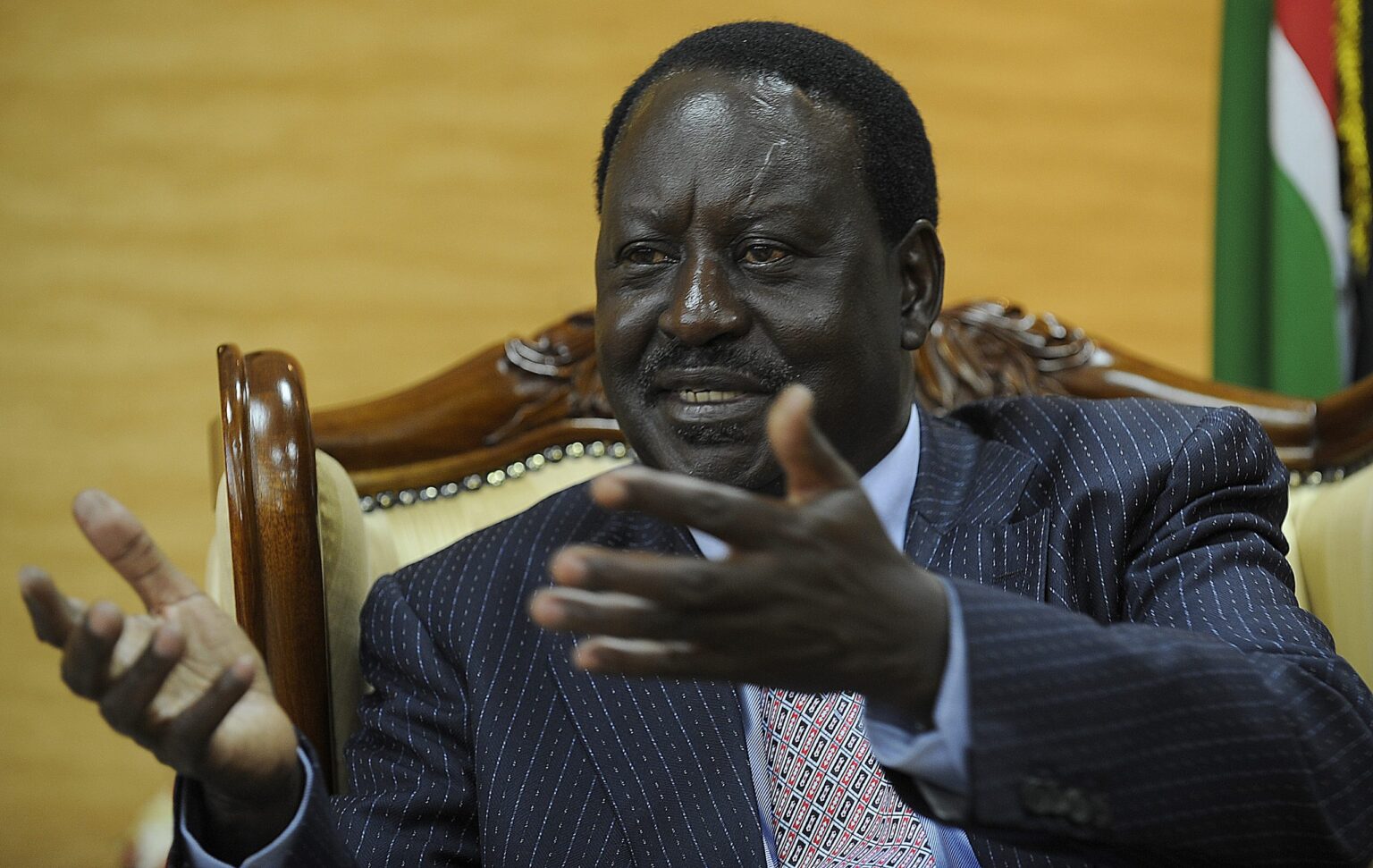
While there are several candidates, three of them are in the lead for the main prize. The three are: Prime Minister Raila Odinga, former deputy premier and finance minister Uhuru Kenyatta, and former local government minister Musalia Mudavadi.
There are now three established facts about Kenya’s fourth president. One is that the next president will be a man. Two, he will come from one of the main coalitions, and three, he will be a son of a former prominent Kenyan. In the race to succeed Kibaki, there are three main coalitions led by sons of former kingpins in Kenyan politics.
This will be Raila Odinga’s third attempt at the presidency. He is the son of the former vice-president, Jaramogi Oginga Odinga, who went on to become the face of the Kenyan opposition for nearly 40 years. The senior Odinga unsuccessfully vied for the presidency in 1992. He died two years later, and passed on the baton to his favourite son, Raila, who in 1997 also ran for the presidency but failed to win.
The Odinga family has been a permanent feature in Kenyan politics since independence. Both father and son were detained at different times by post-independence Kenyan governments for their opposition activities. The 1997 presidential election saw Raila coming third on the ticket of his National Development Party (NDP), which was later assimilated into the then ruling party KANU. Raila later quit KANU in 2002 and joined President Kibaki’s National Rainbow Coalition (NARC).
But after a tumultuous relationship, Raila quit NARC in a huff and set up the Orange Democratic Movement (ODM), which has since become one of Kenya’s most vibrant parties. In 2007, the ODM performed well above expectations, and in fact claimed that Raila had won the presidency instead of Kibaki. The election dispute led to several weeks of violence that killed over 1,300 people.
With Kibaki’s departure, many expect Odinga to be the automatic heir-apparent owing to his charisma and political acumen. But this is not the case. His once formidable ODM party has been fractured and Odinga’s anticipated “smooth sail” to State House is now a headache.
For his 2013 bid, Raila is leading the Coalition for Reforms and Democracy (CORD), which brings together the ODM, the Wiper Democratic Party (WDP) and Ford Kenya. They are campaigning on a platform of reforms. Raila’s running mate is the former vice-president and longtime political adversary Stephen Kalonzo Musyoka.
There are other smaller parties in CORD, which, according to the opinion polls, is likely to win the 4 March elections. But will it really be third time lucky for the 68-year-old Raila, as it was for Kibaki who secured the presidency on his third attempt?
Jubilee Alliance
Raila’s biggest challenge is the Jubilee Alliance, which is made up of newly formed political parties such as The National Alliance (TNA), United Republican Party (URP), and other smaller parties.
While this alliance has been dubbed by critics and opponents as the “coalition of the accused”, owing to the TNA leader Uhuru Kenyatta and URP leader William Ruto’s pending cases at the International Criminal Court (ICC), it is yet the team to watch. Led by Uhuru Kenyatta, the son of Kenya’s first president Jomo Kenyatta, the Jubilee Alliance not only prides itself on being the “digital generation”, due to its bevy of youthful leaders, it also claims that “it has the numbers” on its side. William Ruto, Kenyatta’s running mate, coined the slogan, “we have the numbers”.
Ruto’s slogan is no empty threat. The alliance really thinks it is going to win the elections, based on its calculations of the registration of voters nationally. Because there is a long-established voting pattern in the country based on ethnicity, the Jubilee Alliance thinks “the numbers” are on its side. But recently released opinion polls show that Raila will win by 51%. This, however, has been rubbished by the Jubilee Alliance, which wondered where Raila would get the votes from, after key vote-winning leaders decamped from his party and joined the Jubilee Alliance.
According to Kenya’s new constitution promulgated in 2010, a presidential candidate must garner more than 50% of the votes in not less than 24 counties, to win the race. It is this constitutional clause and Kenya’s long-established voting pattern that have given the Jubilee Alliance the confidence to claim that they have “the numbers” on their side.
In Jubilee’s arithmetic, TNA controls 15 counties and the URP 13, giving them 28 counties in the bag. A Jubilee in-house poll claims the Alliance will win 52% of the vote.
The third force
Clearly the “third force” in the race is Wycliffe Mudavadi’s Amani Coalition. Before crafting the Amani (Swahili for peace) Coalition, the former deputy premier had teamed up with the Jubilee coalition on the premise that he would be made Jubilee’s presidential candidate. A deal had been struck and signed between Mudavadi and Kenyatta to this effect.
However, this arrangement collapsed when Kenyatta visited the grassroots and his supporters told him to disown the deal.
With the deal up in smoke, Mudavadi’s United Democratic Front (UDF) sought KANU’s Gideon Moi, son of the former President Daniel arap Moi, and Eugene Wamalwa of new Ford Kenya. The trio then put together the Amani Coalition, effectively making it a “third force” in the Kibaki succession race.
The entry of Mudavadi into the race has added a new dimension to the poll. He is seen as a spoiler, especially to what had been wrapped up as CORD’s “vote basket” of Western Kenya, which boasts over 1.4 million voters. A first-time presidential aspirant, Mudavadi, a former deputy to Raila, is seeking to consolidate his Western Kenya vote in order to use it as a negotiating tool for power, especially in the case of a run-off.
The wannabes
Like all Kenyan general elections, there never lacks pretenders to the throne. Leading this pack is the former justice and constitutional minister, Martha Karua and Peter Kenneth, who are standing on different party platforms. While the pair has traversed the entire republic seeking votes, they have no chance of winning the forthcoming polls.