South Africa election: Has the ANC lost its mojo. As elections loom near in South Africa, in April 2014, scandals and corruption cases appear to be eating dangerously at the ruling ANC’s vote. The party is still expected to win but, according to pollsters, it will do so with its vote severely constrained and much blood on its face. Pusch Commey reports from Johannesburg.
The April 2014 elections will perhaps become a defining moment in the history of South Africa’s nascent 20-year-old democracy. And they come on the heels of the recent passing of the midwife – Nelson Mandela. In a portent of things to come, the president of the ruling African National Congress (ANC) and presidential candidate, Jacob Zuma, was spontaneously booed at Mandela’s memorial service in Johannesburg on 10 December 2013. What makes it hurt is the fact that it was done live on global TV, and in the full glare of several fellow presidents of the world.
With parliamentary and presidential elections looming in April 2014, and with President Zuma as the face of the ANC’s campaign, it is widely predicted that the ruling party will set a record in its loss of support. And the blame has been squarely placed on the head of Jacob Zuma. But what has he done to deserve all this?
Before rising to the presidency, he was in and out of court over allegations of corruption and rape. He was acquitted of rape after a trial. The corruption charges were withdrawn when he delayed the trial with legal manoeuvres until he won the presidency of the ANC, the most powerful position in South African politics.
He then leveraged his powers in 2008 to oust the sitting president of the country, Thabo Mbeki, seven months before the end of Mbeki’s presidency. There is speculation that he subsequently pressed the acting head of the National Prosecution Authority (NPA) to drop the corruption charges. That man, Moketedi Mpshe, later resigned from the NPA and was appointed as a judge.
The shabby treatment of Mbeki led to the formation of a rival party, Congress of the People (COPE), which won 7% of the vote in the 2009 election that inevitably propelled Zuma to the presidency of the country.

With friends like these
As president, Zuma has been plagued by scandal upon scandal. His links with an Indian family domiciled in South Africa have come under scrutiny. The Guptas are friends and business associates of Zuma and his family, and are alleged to be bankrolling the president for government favours and contracts in return. This came to a head last year in what has become known as Guptagate.
In what looked like a soap opera from a far-flung banana republic, friends and associates of the Gupta family arrived on chartered flights into South Africa to attend the wedding celebrations of a daughter of the Guptas. They were cleared to land their planes at the Waterkloof military airbase, allegedly with the permission of “Number One”, the president. They did not go through any immigration and customs check. To aggravate matters, they were escorted by a convoy of police vehicles to the wedding venue at the Sun City resort. In the full-blown scandal that emerged, the president denied any authorisation or knowledge of the landing. Thus, some small sardines in the chain of the authorisation process were blamed for the fallout and given the chop. The official explanation was that certain people, acting in their own interest, had been name-dropping Zuma, as “number one”, to flout rules.
The Guptas, apart from several business interests with links to government power, are proprietors of a pro-ANC newspaper, The New Age, as well as a new satellite TV station, ANNZ. Both are massively supported by advertisements from government departments and quasi-government institutions.
Since 2009, when President Zuma has been in office, there have been a record number of strikes and service delivery protests in municipalities. The Marikana massacre on 16 August 2012, when 34 miners, striking for higher wages, were mowed down by the South African police at a platinum mine near the town of Rustenberg, has become etched in memory.
Elsewhere, some of Zuma’s ministers and many top government officials have been fingered in corruption scandals. Also, politically connected individuals have landed massive government tenders and deals, while most do not have the capacity or the ability to deliver, except to sub-contract at a discount. This has given rise to what South Africans now call “tenderpreneurs”. They have multiplied like flies, as money becomes the primary contestation in the Rainbow Nation.
In the Gauteng Province, where Africa’s richest city, Johannesburg, resides, the middle class is up in arms over electronic tolls (e-tolls) imposed on the use of major roads, without proper consultation. Seen by many as unfair taxation, their implementation since December 2013 is causing popular anger.
On top of it all, Zuma has done himself no favours with his usual gaffes, one of which came in a lecture in late 2013 when he admonished South Africans not to think like Africans. He subsequently apologised for the slight.
But what threatens to be the tipping point is Nkandlagate (see NA Feb 2013). At the time of going to press, the nation was waiting with bated breath for the release of a final report by the public protector, Thuli Madonsela, after an investigation by her office. An unlawful leak of a provisional report and publication by the Mail and Guardian weekly newspaper in December, partly fingered the president for unjustified enrichment to the tune of 20 million rand and recommended a refund.

Controversial homestead
Nkandla is a rural area in the province of Kwazulu-Natal where the president and his family have a sprawling homestead. It is alleged that the government appropriated or misappropriated 205 million rand of taxpayers’ money to upgrade the homestead, complete with new buildings, a swimming pool worth 2 million rand, an amphitheatre, a football pitch, a bunker, a helipad, fencing, a cattle kraal worth half a million rand, and a tuck shop for the first of Zuma’s four wives also worth half a million rand (exchange rate: about 10 rand to the US dollar).
A government and party investigation has exonerated the president. According to the investigation, the swimming pool was a fire pool for the reservation of water to put out potential fires. The amphitheatre was a retaining wall. The private homestead was a national key point, and thus justified all the expenditure for the security of the president. In their narrative, the president was unaware of the nature and cost of the upgrade.
Government ministers and party functionaries have since launched court actions and media attacks on the one person whom, ironically, the public view as a person of great integrity, Thuli Madonsela. Her investigation into government graft (which has included the Nkandla homestead) has deeply embarrassed the party and the government, and has led to dismissals of ministers. Now her probe into Number One’s affairs has caused a firestorm in an election year.
What makes Nkandla special is the fact that it has become a monument. It does not have legs and cannot walk away from photographs and the prying eyes of Google Earth. In December last year at a press conference, the minister of intelligence threatened the media that the taking and publication of Nkandla photos constituted a criminal offence since it had been declared a national key point. The following day, pictures of the homestead were all over the newspapers and social media.
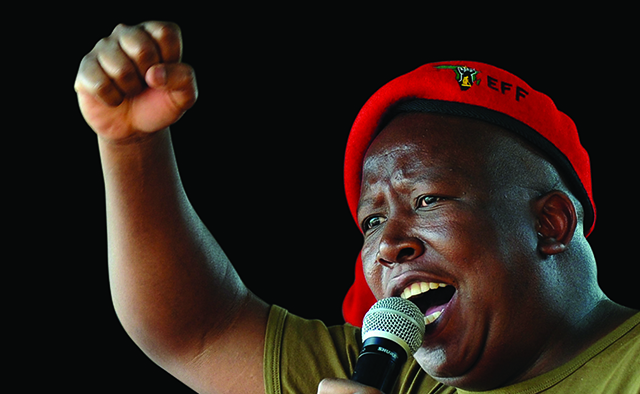
It has been called a “museum of corruption” by Zuma’s nemesis, Julius Malema, whose new party, the Economic Freedom Fighters, are making inroads into the ANC’s electoral base, brandishing their red berets and economic sound bites. In a humorous broadside, Malema has complained that he does not understand why the president wants a swimming pool since his whole family cannot swim.
Malema went on to donate an EFF constructed house to a poor neighbour of the president’s at Nkandla on the day the ANC was launching its election manifesto in early January.
Besides the saga of Nkandla, it is an irony of fate that the two central characters who propelled Zuma to victory over Mbeki for the ANC presidency in 2007, and the presidency of the country in 2009, are now his arch-enemies. Malema was then the president of the ANC Youth League, and Zwelinzima Vavi is still the secretary general of the country’s powerful trade union, COSATU, an indispensable historic partner of the ANC.
Both Vavi and Malema have brazenly taken on Zuma on a number of issues in the course of his presidency, making him look weak. Malema was expelled from the ANC. Vavi has come under siege, leading to a move to topple him from his position.
A sex scandal in which Vavi was involved (he has admitted to having had an affair with an employee of COSATU) exploded in his face. The secret affair was possibly exposed by his adversaries. In what mirrors Zuma’s previous rape woes during the Mbeki era, an initial allegation of rape by the employee did not take root, when she backed down. Disciplinary action has been taken against Vavi.
Cracks showing
Now there are cracks in the unity of the ANC and its alliance partners. The most powerful of Cosatu affiliates, the 320,000-strong National Union of Metalworkers (NUMSA), who are Vavi supporters, has resolved (at its congress on 13 December 2013) not to support the ANC at the April 2014 elections.
As such, over 8 million rand of NUMSA contributions to the ANC election machinery will be gone with the wind. However, the bigger danger is the message they communicate to the electorate during the elections, as well as the advent of a precedent-setting schism that was once unthinkable.
A new trade union, the Association of Mineworkers and Construction Union (AMCU), has succeeded in dislodging another ANC-aligned COSATU affiliate NUM (the National Union of Mineworkers), at the nation’s platinum mines. In all of this the chief agent provocateur, Julius Malema, is forming alliances and punching hard at the ribs of the ANC. The constant refrain is that the ANC no longer represents the interests of the poor.
In the other corner, wringing their hands with glee, are the traditional opposition parties and 18 other new political parties. The result of a credible survey by the political polling agency, IPSOS, shows that the ANC’s support has dropped to an all-time low, at 53% in November 2013 as against 63% in November 2008.
The poll also showed that the largest white-led opposition party, the Democratic Alliance, has increased its support to 18% from 16%. The Economic Freedom Fighters are third, with 4%. Agang SA, led by the respected freedom struggle figure Mamphele Rhamphele, and the African Christian Democratic Party are at 1% each. In 1994, the ANC got 62.6% of the vote in the elections. This increased to 66.4% in 1999, and 69.7% in 2004.
But with all the scandals and the array of forces against the ANC’s electoral fortunes, what does the future hold?
First and foremost, the elephant is fighting back! The ANC had an impressive launch of their election campaign on 11 January 2014 where their manifesto was unveiled. It was well attended and done with great fanfare.
President Zuma unveiled a manifesto in which he promised, among other things, six million job opportunities (not jobs) in the next five years. A state tender board was to be established to deal with tender issues.
On land reform, he reiterated a departure from the willing seller willing buyer principle, though a few days earlier the government had paid a billion rand in settlement of land claims by a local black community against the massive white-owned Mara Mara game reserve. The claim was first lodged in 1999. Expropriation of land is now on the cards, and the deadline for the lodging of further land claims has been re-opened and extended to 2018. Zuma has asked for 75% of the votes in the coming elections to enable him to change the national constitution to resolve outstanding issues held hostage by the constitution. But will this be more of the same recycled unfulfilled promises at election time?
If there are signs of panic, it is reflected in the statement of the deputy president of the ANC, the veteran billionaire businessman and politician, Cyril Ramaphosa, who on a campaign trail, urged blacks to vote for the ANC, otherwise the Boers (white Afrikaners) will come back with apartheid.
Judging from the manifesto launch, it seems the ANC will be banking on Mandela’s ghost to rescue it from decline. They have put into play the great man’s images all over town. The flip side is the power of contrast. At the Mandela memorial when the populace at the stadium looked in the mirror and saw Mandela’s ANC versus Zuma’s ANC, the picture was not pretty – and they booed Zuma. It will be part of the risk the ANC has to take. The other big weapon in the ANC arsenal is the power of patronage, as well as access to state resources for electoral purposes. Already there have been increases in social grants in a country where one third of the population is on welfare (16 million people).

Julius Malema of the EFF has a strong hold on the youth vote for the upcoming election
The achievements
So what has been the achievement of the ANC government, since 1994 when it first came to power? Objectively, it has not been all bad news as detractors would want us to believe. A Goldman Sachs report in November 2013 pointed to significant improvements in the lives of South Africans since 1994.
The GDP of the country has increased two-and-half times, from 143.7 billion rand to 402.2 billion rand. There has been a significant improvement in the delivery of water, electricity, sanitation, and literacy.
South Africa is still Africa’s biggest economy, and the continent’s richest country by GDP. Its systems and institutions run reasonably well. Its infrastructure is world- class, and if you arrive in its big cities you could be forgiven for thinking that you are in some American city.
For example, Cape Town was recently voted by The New York Times as the number one destination to visit in 2014, trumping all the fine cities across the world. The number of South Africa’s dollar millionaires is increasing in leaps and bounds annually. The press is robust and though some see it as under threat, its freedom must be envied by many countries.
What is worrying is the county’s current account deficit (an overdraft) that has ballooned to $25bn. It was $6bn until 2007. Another worry is unemployment at an official 25%, with 70% of youths (aged between 18 and 34) currently unemployed. The voting intentions of these youths, who have no emotional connection to liberation politics, and whose main concern is economics, should worry the ANC – especially when a youthful Julius Malema is targeting that group with an economic message juxtaposed with a narrative of government corruption and the sins of fat cats. And then there are the unknown factors, what politicians fear most – events. A forewarning was a violent service delivery protest over the water supply near the town of Brits at the beginning of the new year. The police shot three people dead. It is the kind of scenario that the ANC government will be keen to avoid in an election year.
But, irrespective of all its troubles, it is predicted that the ANC will still win over 50% of the votes in April, and return Zuma to power.
But if a populace weary of promises gets the feeling that this is the right time to extract benefits from a government desperate for their votes, then there will be plenty of trouble coming before April. And the world should brace itself for a seismic shift of the known and unknown in South African politics.