
It is two years since the “Tunisian Uprising” that not only changed the shape of the country, but that of North Africa at large. Kate Eshelby recently visited the country and here is what she saw.
A huge blank space looms above. “Pictures of Ben Ali used to be everywhere,” Boubaker, my guide, says. Now they are all torn down. Tunisia, the fuse of the Arab spring; with the popular revolution which forced President Ben Ali to flee into exile in January last year, it has recently celebrated an historical moment – democracy for the first time. Before, tourists were followed by secret police. Today the country is safe and everyone is free to talk openly.
I have come with my husband and seven-month-old son to witness a changed country, and enjoy Tunisia’s gems away from the tourist hubs. Tunisia has marketed itself as a package holiday destination since the 70s, with purpose-built resorts. But beyond these the country offers a rich culture; which can be enjoyed while staying in aristocratic homes known as dars, rivals to Morocco’s riads. “We are now trying to steer away from mass market tourism,” Abelkader, owner of the Tunisia Direct travel agency, explains.
In Tunisia’s capital, Tunis, we are staying at Dar El Medina, an exquisitely converted 19th-century family house in the heart of the Medina. Flinging open the shuttered door of our room I am instantly under a hyacinth-blue sky in a central courtyard. Our room has high wooden decorative ceilings, antique chandeliers, marble inlaid walls and earth-red kilims.
From here, we decide to follow the Medina’s labyrinth of narrow cobbled streets (UNESCO world heritage listed) past elaborate yellow and blue doors; ancient and huge, they are studded with traditional motifs of crescents, minarets and stars. We wander through a cascade of arches: marvelling at the keyhole lattice windows, filigree balconies and wooden mashrabiya.
Part of the Medina is the maze-like souk, where men smoke hubbly-bubblys and exotic products are sold. We stumble upon one enclave selling nothing but chechias, wine-red traditional hats, like the Turkish fez. Piles of them sit on moulders, with men busily shaping them. Tunisia has many influences from Turkey, but also from Morocco and Andalucía. It is an eclectic mix of the Mediterranean and the Middle East.
The Medina wavers out to Bab Bhar, or “Sea Gate”, part of the old city walls, where the former British embassy stands with its colonial tiled façade. In front, steam dances from carts selling hot food and men sit outside cafés drinking thick Turkish coffee. Here trams and old rusting cars trundle along avenue Habib Bourguiba, Tunis’s main street – with its old-fashioned street lamps.
We explore several other elegant mansions. Ed Dar antique shop, owned by three characterful brothers, has magnificent pieces for sale throughout the rooms of what is essentially a grand old family home, like an Aladdin’s cave: antique French cologne bottles, mother-of-pearl inlaid chairs, hand-painted armoires and marionettes.
Another is Dar El Jeld; a lavish 18th-century house, now a renowned restaurant. We dine here under an ornate ceiling among traditional tiled walls, grand paintings and marble columns. I eat salade mechouia, fresh fish with spices and Briq a l’Oeuf (a Tunisian delicacy) – when cooked perfectly, the egg melts in your mouth.
Next we head to Djerba, a small island off Tunisia’s east coast, nestled in the Mediterranean Sea.
Here whitewashed houses mingle with medieval forts, rose- pink flamingos paddle in lagoons, long beaches stretch out and farmers perch on stepladders picking olives.
Our home for the next couple of days is Hotel Dar Dhiafa, another distinguished old house down a quiet lane: a hidden oasis with Moorish arches leading to walled courtyards, one cloistering a secluded pool. The rooms have beds romantically concealed in domed niches and the butter-yellow walls are traditional Tadelakt. Alcoves stacked with cushions and low-lying tables fill the bar, all candlelit in the evenings.
We spend several days wandering along wild beaches, with no one else in sight except a few fishermen mending their nets. The island’s largest town, Houmt Souq, is brimming with fondouks: bygone inns where merchants once stayed with their camel caravans while crossing the Sahara.
The atmospheric fishing port is choc-a-bloc with big pirate-like ships – used for tourist day trips – among rusting fishing boats. Big clowders of cats play amid the nets and there are piles of terracotta pots laced together with rope. “They catch octopus, using a centuries-old method,” Boubaker says.
Early one morning we leave Djerba by ferry, and drive up into the mountains, heading for the Sahara desert. We stop at Metameur, where long morning shadows lean across a spacious courtyard. All around are nougat-coloured stone ksour (fortified granaries built throughout Tunisia’s South) soaked in light.
Each ghorfa or room is curved and barrel-vaulted, with jagged steps clinging to the outside walls leading up to a warren of hobbit-like doors. We then pass hill-top villages, among a lunar landscape, with olives drying on flat-roofed stone houses, men on donkeys and Berber women collecting water from the well. Finally we pull up at Hotel Sidi Driss in the village of Matmata – the home of Star Wars’ Luke Skywalker – and where much of the intergalactic film-set still remains.
We eat lunch where Luke sat, in his troglodtye dwelling – these unusual houses, dug into the ground, around which a warren of cave rooms lead off, are abundant here, and alien enough to represent his planet home Tatooine. We visit the troglodyte home of one old lady, dressed traditionally with Berber buckles holding material like a pinafore and a clashing brightly patterned headscarf. She sits watching TV – a strange contrast to her otherworldly home. Nearby is her bed made from palm branches, whitewashed with gypsum.
That night we sleep at Ksar Ghilane, an oasis in the Sahara desert, where the surrounding golden sand dunes – soaring theatrically in endless waves – were used in another film, The English Patient. Our bed is at the luxurious Yadis Camp; large white tents sit spread-eagled like jelly fish – at night they are spectacularly illuminated against the surrounding wilderness, with lanterns lighting up the sandy paths and fairy lights snaking up the palm trees.
We spend our days picnicking in the dunes, riding camels to ancient forts and careering over perfect, untouched sand in quad bikes. Behind the camp steam rises from a natural, hot water spring. It is here the quad bikes can be hired from quasi-Tuareg turbaned men wearing black leather jackets while Zorro-like men gallop out of the dunes on colourful pageant horses.
But creep away from this hub into the lush green space of the surrounding palmeraie – and there is only the silence of trees and boundless dunes. When it’s time to leave the desert we drive out past nomads, their brown goat’s hair tents on the stony hillsides, where they graze their animals.
We stop at one and a turbaned shepherd shows typical Tunisian hospitality, filling our pockets with dates as we wave goodbye. We then pass chotts, or dry salt lakes – their crystals shimmering red in the setting sun.
We visit Boubaker’s home in Chenini: this Biblical-like Berber village appears as if it has been carved out of the steep mountain it clutches. Men wander around wearing traditional brown djellaba cloaks, with hobbit-like pointed hoods. The ksour resemble honeycomb as they climb up the cliff face, glowing the colour of caramelised sugar in the late afternoon sun. Among them a solitary domed mosque shines bright white.
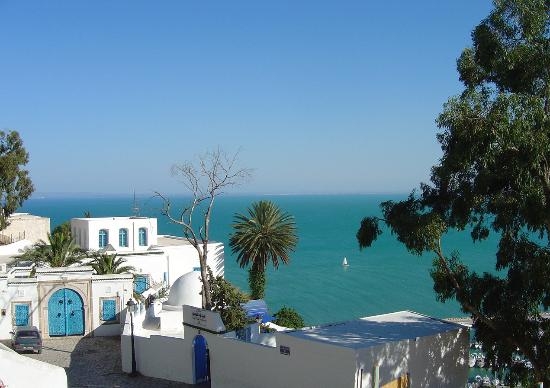
Our final days are spent in Sidi Bou Said, a chichi blue-and-white painted cliff-top village, just 18km from Tunis – and yet leafy and green. Here we stay at the exquisite Dar Said hotel, the former home of a wealthy family. I close my eyes and take a deep breath. Jasmine. The scent wanders in the courtyard and our bedroom looks out to an aquamarine sea and lush garden. Orange trees punch the sky and the sea chucks light on to the village.
I can see why the artist Paul Klee, when he came here and saw the quality of light, said, “No longer do I have to chase after it, I know that it has hold of me forever.” I just hope that the light democracy has brought to the country keeps shining.








