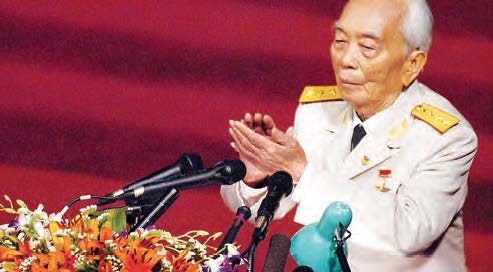
Following the recent death of the Vietnamese war hero General Giap (pictured), thinking about his tactics, strategy, and the costs of long-term objectives, is particularly useful in the light of the increasingly brutal acts of jihadists in their wars in Africa.
Giap beat the Japanese, French, and Americans, changing the modern world. His achievements have again been celebrated following his recent death. Questions were also raised on how successful a general he was, given the huge costs involved in his victories. As the defeated General Westmoreland, his American adversary churlishly noted: “Any American…losing men like that would hardly have lasted more than a few weeks.” Westmoreland ignores the reality that against a technologically superior military, Giap played to his advantages, adopting effective asymmetrical warfare. It was when he went toe to toe conventionally that he lost huge numbers. The Tet offensive in 1968, although a military disaster, turned into a long-term strategic victory for Giap. Americans finally recognised that to win, they would need to kill on a truly epic scale and sustain unacceptably high losses.
The Americans, given their technological superiority, could have defeated the Vietnamese but their public could not support the costs, with many seeing the war as illegitimate, with no clear impact on US vital interest. US soft power was eroded, the world increasingly seeing an imperialist power rather than the “freedom-loving democracy” of propaganda.
Meanwhile, with war aims limited to their country and a population willing to endure huge losses for national liberation, Vietnam was supported by the non-aligned movement and powerful regional backers (China/USSR) who re-supplied them.
The tactics of “terror” have worked in the past. Using terror as part of a conventional war in Afghanistan, jihadists and Islamists, with the support of the US, achieved victory over the USSR. It also worked in a totally non-conventional war, leading eventually to power-sharing in Northern Ireland, and to a lesser degree, to freedom in Algeria, and South Africa.
So it’s important to link the objectives and strategies of three of the jihadist movements active in Africa that have deployed terrorism as a tactic, but are also increasingly deploying nihilistic and barbaric methods – murdering unarmed civilians.
The three – Al-Qaeda across Africa, al Shabaab in Somalia, and Boko Haram in Nigeria, have laid out their war aims. First, in August 1996 in bin Laden’s “declaration of War against the US”, Al-Qaeda’s principle war aims were to eliminate US influence in Muslim nations, especially Saudi Arabia; destroy Israel, and unite Muslims in a caliphate. A later 1998 fatwa urged holy war against Americans and Jews, including civilians. Al-Shabaab’s war aim is to overthrow the foreign-imposed government of Somalia, expel foreign armies and create an Islamic caliphate governed by sharia. Equally, the imposition of a caliphate and sharia is also the demand of Boko Haram.
Al-Qaeda’s overarching and impossible war aims will be defeated in the long run, despite some so-called tactical shortterm victories. Meanwhile, in multi-religious states south of the Sahara, such as Nigeria, a caliphate would be impossible to achieve, unless the country breaks up. Perhaps this war aim is possible in Somalia, but neighbouring African countries, especially those with Somali populations, such as Kenya and Ethiopia, would feel threatened, explaining their recent invasion.
All three jihadists forces have similar short-term tactics – provoke fear and chaos, leading to overreaction, bleeding the economy, and more division, especially in making Kenyan Somalians and other Muslims to be targeted as a fifth column.
In fighting this war the key is not to overact as the US has since 9/11, seeing any manifestation as challenging their (in)ability to control the world. We should take a long-term view – see these terror explosions as a kind of frenzy that taps into local grievances with no long-term strategic depth or sustenance. Like the Vietnamese, we will have to endure huge pain and some losses, but we must remain resolute.