
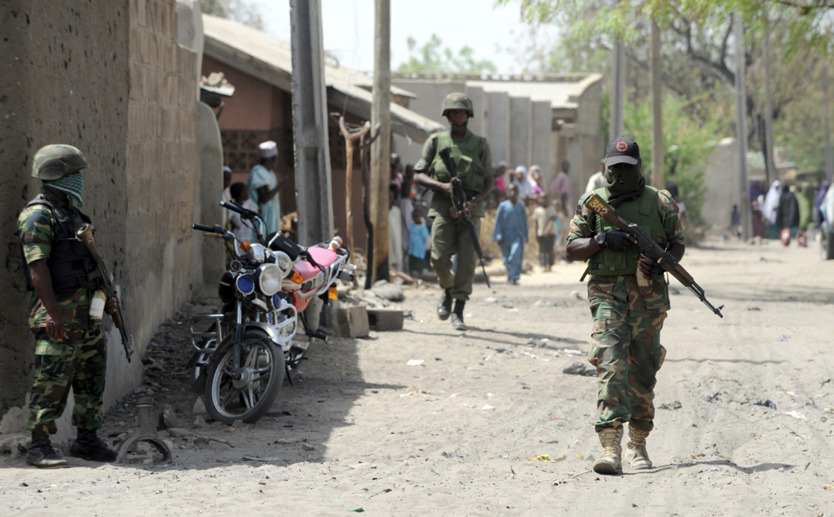
Africa’s most populous country appears to be experiencing both its best and worst times – being crowned as Africa’s largest economy, amidst a mounting brutal terrorist insurgency which is entering its sixth year, with no signs of letting up. As Tolu Ogunlesi critically analyses Africa’s new biggest economy, Nigeria will now be under even more pressure to resolve this paradox.
On a Tuesday morning early in February a group of investors gathered at the new InterContinental Hotel in Lagos, for Renaissance Capital’s Investment Conference. Among the event’s highlights were the duo of Bob Diamond, ex-CEO of Barclays Bank, and Ashish Thakkar, a 32-year-old Indian-Ugandan billionaire. At that time there was speculation that the two men were seriously looking at investment opportunities in Nigeria, through their new joint investment vehicle, Atlas Mara. In April confirmation arrived, with the news of Atlas Mara’s acquisition of a sizable stake in Nigeria’s Union Bank.
Two months after the Renaissance Capital conference, in the InterContinental Hotel hall, another investment meeting – this time a 2-day Nigeria Summit – was held by the Economist magazine. The second day of that Summit coincided with an investment conference by the Africa Finance Corporation (AFC), highlighting the possibilities of investing in infrastructure in Nigeria.
Seven hundred kilometres north of Lagos, in Abuja, the seat of government, preparations are on for Nigeria’s hosting, in May, of the World Economic Forum on Africa, seen by the government as “an unprecedented opportunity for Nigeria to showcase its vast economic opportunities to the world.” It’s the first time Nigeria will be hosting the event; South Africa has hosted it seventeen times out of twenty-four.
Welcome to Nigeria Rising – the slowly but steadily changing story of Africa’s most populous country, rich in oil and gas, hobbled for years by bad governance, but now emerging as an investor’s delight; welcoming a never-ending stream of individuals and businesses drawn by its promises of unprecedented financial return.
The influx of opportunity-seekers is reflected in the boom in Lagos’ hotel business. In the last decade, the number of upmarket hotel rooms in Lagos has tripled, according to W. Hospitality Group, a consultancy. And yet there’s still plenty of room for growth.
The numbers that support the Nigeria Rising theme are bold – the most dramatic being the emergence of Nigeria, in April, as Africa’s largest economy. In the last three years, more than $20 billion has flowed into the country in direct foreign investment; making it the second largest recipient of FDI on the continent, after South Africa. By the end of 2013, foreign investors held $5.4 billion in Nigerian bonds, up almost five-fold from 2012. The Nigerian Stock Exchange, headquartered in Lagos, has recovered remarkably well from the 2008 global economic slump; its 2013 results earning it a place among the ten best-performing stock markets in the world.
And a wave of reforms in the last decade are slowly opening up opportunities long locked away by government ineptitude and corruption, translating into scenarios like the one that has seen Nigeria emerge from being the world’s second
biggest importer of cement, to a net exporter, in less than a decade. The foreign attention appears to be driving local players to prove themselves. Most of the $3.3 billion that investors spent purchasing more than a dozen government-owned power plants in 2013 came from local banks; now much bigger than they used to be after a round of government-enforced mergers and recapitalisation that started in 2004. And there’s also now a Sovereign Wealth Fund (launched in 2011, with $1 billion) that is keen to invest its funds locally.
All that glitters…
However, travel another 500 kilometres north from Abuja, to Borno State, and the story changes remarkably, for the worse. Here hope and optimism are endangered species. Poverty pales into insignificance beside the presence of Boko Haram, an Islamist terrorist group that has laid siege to Nigeria’s north-eastern corner since 2009.
The group, believed to exist in as many as six factions, all operating independently, says it wants to establish Sharia rule across Nigeria. Its actions however reveal a group that seems bent on causing maximum havoc, by whatever means possible.
The heavily-armed militants – now strongly believed to be linked to Al-Qaeda – have established bases in the region’s remote mountains and forest, on and around Nigeria’s borders with Chad, Niger and Cameroon, from where they keep up a barrage of deadly attacks on north-eastern Nigeria and beyond.
Not even Abuja, the seat of power, has been spared Boko Haram’s bloody fury. A series of high-profile attacks between 2010 and 2012 hit the United Nations Headquarters in Nigeria, the Nigeria Police Force Headquarters, and two newspaper offices. After a year-long lull the terrorists again managed to strike a busy bus park on the city’s outskirts in April, killing 71 people, wounding hundreds. Nigerians are now used to wondering – where next?
Of Nigeria’s problems – and there are many – Boko Haram is the most alarming. Lai Mohammed, spokesperson of the main opposition party the All Progressives Congress (APC) describes it as the “most serious threat” to Nigeria since a 30-month civil war that ended more than forty years ago. Indeed, Boko Haram manages to dampen the Nigeria Rising story, again and again. The Nyanya bus park bombing immediately cast doubt on Nigeria’s suitability for the WEF, prompting the government to hurriedly issue a statement assuring that it would mobilise 6,000 soldiers and policemen for the 3-day conference.
Analysts link the emergence of Boko Haram to the dire economic conditions in the North East of Nigeria. Poverty rates there are double that in the South West and it is is believed this and other social deprivations have combined to create the conditions for Boko Haram to thrive.
Whatever the reasons for the emergence of Boko Haram might be, its impact is not in doubt. Thousands lie dead – this year alone, 1,500 victims, according to Amnesty International. The UN says 300,000 people have been displaced since May 2013. The threat of extremist groups is not Nigeria’s only security concern. Travel advisories to Nigeria also regularly warn of the likelihood of kidnappings.
“Kidnappings remain a security concern throughout the country,” the US Diplomatic Mission warned in its most recent travel advisory, in January 2014. Offshore, on the Atlantic coast, the situation is as dire. “Pirates operating off the Gulf of Guinea are developing a fearsome reputation for violence and kidnapping key crew members,” noted IHS, a maritime data consultancy, in its 2014 piracy forecast.
The size of opportunity
Nigeria’s potential is rooted in this fact: a fast-growing population that it has spent the last fifty years not exactly taking care of.
At its current rates of growth, one of the highest in the world, the United Nations predicts that by 2050 Nigeria will have overtaken Pakistan, Brazil and the United States to become the world’s third most populous country, after India and China – with 400 million people.
Official estimates indicate that Nigeria has a deficit of 17 million new homes. The country is also currently producing only 5,000MW of electricity for its 170 million residents, while South Africa (50 million) and Brazil (200 million) churn out 50,000MW and 120,000MW respectively. Individuals and businesses have to generate their own electricity from petrol and diesel, at a cost several times what they would pay for grid electricity, were it available.
In the transportation sector, things are just as bad. The railway line that spans the 1,200km between Lagos and Kano, Nigeria’s two most populous cities, and built by the British a century ago, was only just resurrected in 2012, after several years of disuse. Even then, it still takes more than 24 hours to make the journey, thrice the time of a similar journey in China.
Across Nigeria highways are in desperate need of upgrades. The country’s busiest, the one that connects Lagos to the rest of the country, is a 150-kilometre obstacle course – laden with potholes, swollen bits of tarmac, narrowed lanes and wrecks from accidents. Functional airports are in short supply across the country, as are intra-city rail networks. What Nigeria therefore offers investors is an infrastructure-hungry population. There is a huge catching-up game to be done, and then after that a keeping-up-with-a-fast-growing-population game. The big investment challenge therefore facing Nigeria is the provision of roads and trains and electricity and broadband and food and housing and insurance, not just for today’s 170 million, but for tomorrow’s 400 million. The 1 billion naira ($60 million) that Agriculture Minister Akin Adesina says is being spent daily importing rice – Nigeria is the world’s largest rice importer – could easily stay at home, if only the country got serious with local production.
It will take a miracle to surmount these challenges, considering that it is the same conditions that have created this dysfunction that conspire to frustrate all solutions. But even Nigeria has in recent years demonstrated that it can provide solutions to its problems. The country has gone from less than half a million telephone lines at the turn of the century, to more than 120 million today, and earned itself a reputation as one of the most lucrative mobile phone markets in the world. Pension reforms a decade ago have helped create a new, mandatory, “fully-funded” pension scheme containing in excess of $22 billion (now growing at $3 billion annually) in privately managed funds.
Observers will continue to wonder if Nigeria’s governments can work up the political will to make change happen in the most critical areas. Nigeria is regarded as one of the most corrupt countries in the world, a place where vested interests of every kind thrive. The hundreds of millions of dollars in unfulfilled government contracts awarded annually to fix Nigeria’s roads and power plants and oil refineries end up in the pockets of individuals and companies who will do everything to ensure that the contracts keep flowing.
It is for this reason that privatisation lies at the heart of Nigeria’s economic reforms: replacing a rent-seeking government-run model with a private sector-driven one. The private sector, because it has been set up to generate profit, is interested in getting infrastructure delivered as cheaply and quickly as possible, says Andrew Alli, CEO of the Africa Finance Corporation. “This is quite different from where the government is spending money on infrastructure, where you have civil servants who are essentially spending other people’s money and the incentives are very different.”
Eyo Ekpo, who oversees the Market Competition and Rates department at Nigeria’s electricity regulator, says: “It is becoming clearer to us that the right place for government is to regulate the [power] sector in a responsible and responsive manner.”
In other words, government should, instead of seeking to generate and distribute electricity, as it has tried and failed to do for decades in Nigeria, instead focus on ensuring that it sets level playing fields for investors, guarantees investments and property rights, slashes red tape, and protects consumers from being exploited.
Nigeria’s current ranking of 147th of 189 countries on the World Bank’s Ease of Doing Business Index may be a pointer to just how much the government’s dysfunctional ways – failed infrastructure, multiple taxation, a legal system that does not inspire confidence that wrongs will be speedily and justly redressed – affect the business landscape. Eko Hotel, the biggest in Lagos, says it spends a tenth of its operating expenses just keeping the lights on by itself. The Nigerian arm of telecoms company MTN says it spent 12 per cent of its operating costs – amounting to more than $200 million – buying diesel to power its 10,000 base stations, in 2013. According to Communications Minister Omobola Johnson, 70 per cent of every naira spent by investors on telecoms infrastructure goes on government taxes and levies.
Africa’s new giant
Combining effective government regulation with the natural efficiency of the private sector is the key to unlocking Nigeria’s immense potential, analysts say. The last decade has seen an increase – hyped, some believe – in the size of the Nigerian middle class, the segment of the population that holds the most interest for businesses focused on retail opportunities.
Nigeria is one of the Top 5 markets for French cement-maker Lafarge, says Guillaume Roux, Executive Vice President. Roux says he now spends the “majority” of his time in Nigeria, “despite having global responsibility.”
In 2007 Nigeria overtook Ireland to become Guinness’ second-largest market in the world, for its Stout brand, after Great Britain. Nigeria is also the biggest market for the London-based global consumer goods brand, PZ Cussons.
“Nigeria is very, very important. You’ve got a vibrant and growing middle class, a big consumer population, a young population that will be consuming more and more,” emerging and frontier markets investor Mark Mobius told Bloomberg in January. Mobius has put his money where his mouth is; the $2.3 billion Templeton Frontier Markets Fund has about a tenth of its holdings in Nigeria. Getting electricity right could push Nigeria’s economic growth rates – already
consistently one of the highest in the world – into double digits, economists have said. A double-digit growth rate “would double the size of [Nigeria’s] economy in six or seven years,” says Jim O’Neill, the ex-Goldman Sachs economist famous for coining the ‘BRIC’ epithet.
That, going by newly revised GDP numbers, suggests a trillion-dollar economy by the beginning of the next decade.
Facing the future
Being confirmed as the biggest economy in Africa is rightly being celebrated in the country. But, unless it wins the World Cup, the two other important events on the country’s calendar in the next months will be the ongoing Constitutional Conference, and campaigns leading up to the presidential elections due early in 2015.
Those elections will be the fourth since the military handed over to a civilian government in 1999. Nigeria’s elections have always been hotly contested, generally marked by high levels of rigging, and violence is not infrequent. A series of bloody riots in the Western region during the 1964 elections helped trigger the military coup
that brought an end to the First Republic. Most recently was the violence that followed the 2011 elections, in which tens of people died in Northern Nigeria.
The fears about the 2015 elections are heightened by the antics of Boko Haram. The governors of the three states most affected by
Boko Haram are from the opposition party. If the federal government’s state of emergency persists, and somehow precludes the opportunity for elections to be held in those states, the APC will be the losers. At the moment none of the parties has announced its candidates, but it is assumed that President Jonathan will take the People’s Democratic Party (PDP) ticket without a struggle, especially as most of those likely to challenge him left the ruling party for the APC in a much talked about mass defection in 2013. The APC will have a much more colourful struggle for its presidential ticket, in an election year widely viewed as the opposition’s closest shot at displacing the PDP, which has held federal power since 1999.
For now the focus appears to be on a National Conference that President Jonathan inaugurated in March, with a vague mandate to “engage in intense introspection about the political and socio-economic challenges confronting our nation and to chart the best and most acceptable way for the resolution of such challenges in the collective interest of all the constituent parts of our fatherland.”
It is hoped that the outcome of the Conference will help strengthen the Constitution handed over by the departing military dictatorship in 1999, and give a stronger sense of belonging to Nigeria’s hundreds of ethnic nationalities, caught up as they are in a never-ending game of suspicion and recrimination. However the National Conference plays out, the biggest challenge facing Nigeria’s leadership – apart from taming Boko Haram – will be demonstrating that it can undermine the country’s reputation for unpredictability; its penchant for, as the title of a 2011 book by a former American Ambassador to Nigeria John Campbell put it, “dancing on the brink”.
For now, the air of uncertainty surrounding the 2015 elections means that many investors will be choosing to watch warily from the sidelines, unsure if 2015 will be the tipping point into complete disarray.
Even then there are those who will choose to err on the side of their ambitions, realising that reports of Nigeria’s demise are often exaggerated. In the run-up to the 2011 presidential elections, as fears of unrest heightened, Mark Mobius was quoted as saying: “Of course there will be volatility as a result of the elections, but from a longer range point of view we are quite bullish.”
It does seem likely that four years on, those sentiments – combining heady amounts of risk and of optimism – will still be in place, strong as ever.
However, both gloom and bloom are tied to the same fact: Nigeria’s population – which can produce one of the largest pools of talent and middle-class on earth. But if Nigeria fell apart, no country or aid organisation would be able to manage a potential burden of tens of millions of refugees. And Boko Haram is merely the most alarming of a litany of issues.
To realise its potential its government will have to show the world they are capable of rising boldly to the terrorist threat, as well as breaking the jinx that makes Nigeria seem like a country that achieves in spite of, and not because of, its leadership.
What will it be – a Nigeria rising to fulfill its great potential in the global economy, or one that will, not for the first time since Independence in 1960, trundle down the path of broken promise?








