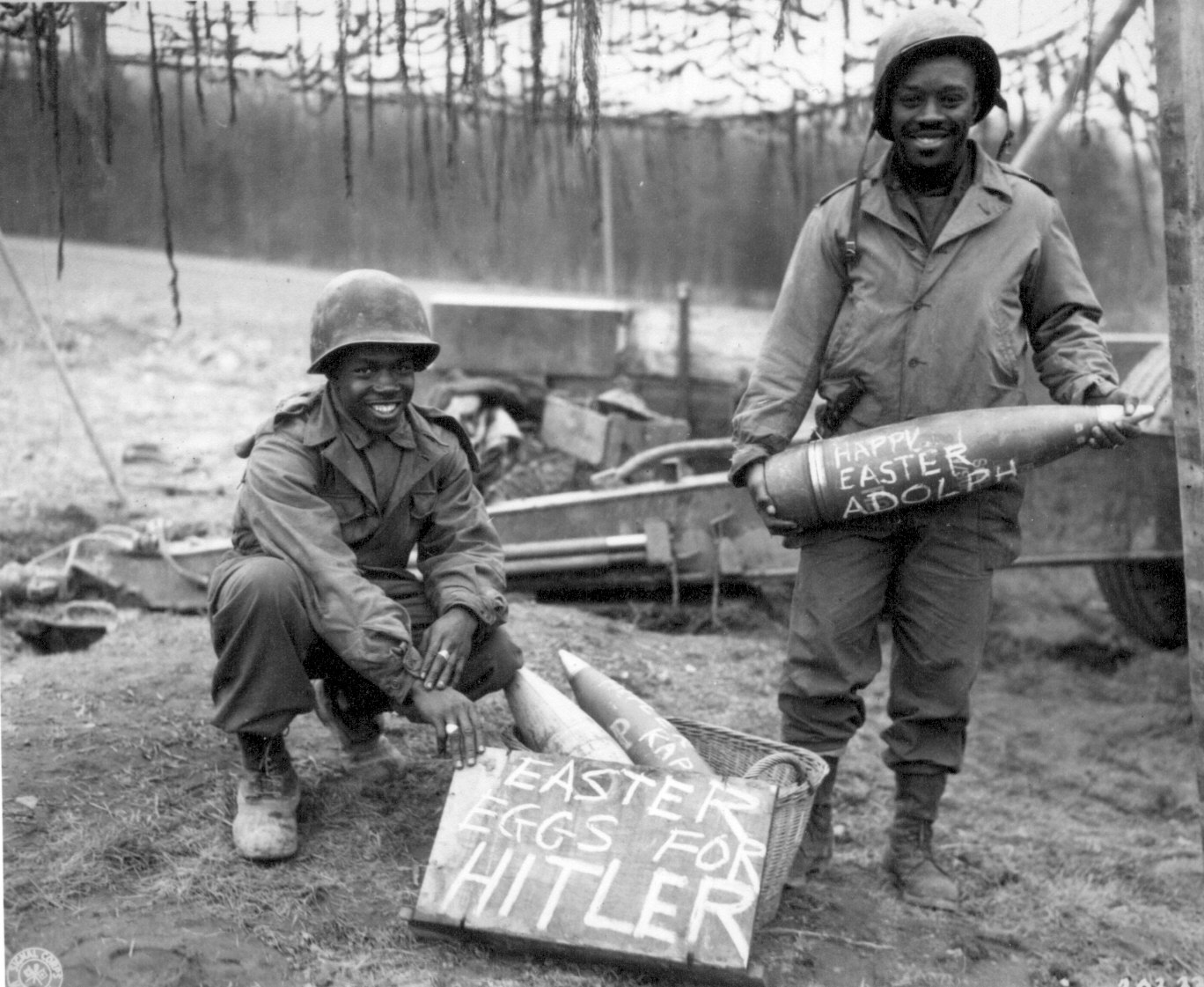
During the Second World War (1939-1945) many young men from Asiakwa, my home town, “ran away” to join the army. They didn’t actually “run away” to join the army. Because they would have been “caught” and taken into the army anyway, if they had not gone to join it “voluntarily”. What the British did was that they told the village chiefs that if they didn’t help the British to defeat Hitler, the Germans would over-run Ghana. And abolish chieftaincy in the country!
That would mean that instead of each village being governed by a chief (ohene) who was put on the stool through traditional processes that had lasted for hundreds of years, the Germans would simply look for someone in the village who they thought would implement German policy most effectively and install him as the burgomeister of the village. A Paramount Chief (Omanhen) might become an Uberburgomeister, if he was lucky.
The British also made it known through films and other forms of propaganda that black people in Germany were used for experiments (just like monkeys were) and that those who were not used in that way were sterilised, so that their numbers would be reduced. In other words, the Germans were total brutes, as far as black people were concerned.
Ghanaian chiefs bought into this propaganda wholeheartedly. The Paramount Chief of my own state, Akyem Abuakwa, Nana Sir Ofori Atta (imagine a black African chief being created a “Knight Commander of the British Empire” by the same British who had exiled King Seretse Khama of Bechuanaland, now Bostwana, for marrying a white woman!) was one of the chiefs who did not want the Germans near his state.
Nana Sir Ofori Atta enthusiastically organised his people to make financial contributions to the British war effort, by instructing the schools in his state to send their pupils into the bush before classes each morning, to collect palm kernels, which were to be donated to the British for manufacturing soap and margarine for their troops, who were fighting the Germans.
This was typical of our Anglophile King – he fought with the British against Asante in the Yaa Asantewaa War (1900) and was awarded the rank of sergeant in the British army. And in WWI (1914-1918) he organised a fundraising campaign for the British war effort, which succeeded in raising enough money – a whopping £300,000 sterling in those days! – to buy a warplane, called “Akim”, for the Royal Air Force.
Now, such chiefs had been provided with a “native police” force whose members would arrest any able-bodied young men who refused to join the British army. Such “kosaankobifuor” (war “refuseniks”) would be taken to Accra to be forcibly enlisted. So, those young men in our villages who knew what was good for them did not wait to be arrested but went and joined the army “of their own volition”, if it could be called that. At least such a step would ensure that they were not maltreated on being enrolled in the army.
Kwame Adu was one of those who were forced to “volunteer”. Like many others from Asiakwa (they apparently obtained good advice from earlier “volunteers”!) he chose to become a driver. At least learning to drive would give him one skill that would last for life, and also, save one from the worst fate to befall a soldier – being forced to become a “carrier” of munitions and stores, during campaigns.
When Kwame Adu was discharged from the army, he went to Kumasi to ply his trade as a driver. Eventually, he persuaded his uncle to “cut out” all the cocoa on his farm (the healthy as well as the diseased cocoa trees were all cut down, under a system called “all die”, through which the compensation money was corruptly split between the farm owners and the agricultural officers, under the very noses of their British supervisors!) and use the compensation money to buy him a car. A brand new Austin A40. White. With red leather seats.
I fell in love with the car the first time I set eyes on it. But how was I to get Kwame Adu to take me on as his driver’s mate? The man was known to everyone as an old skinflint who worshipped his car. He wouldn’t let anyone get near it, surely? Especially a young “hot-head” who would like to actually get into the driving seat?
I decided to adopt a direct approach. Kwame Adu lived near the house of one of my aunts. And I used to go and lie in wait for him there, and secretly watch his movements. I knew he came home at about 10.30am each day to eat fufu. Most people ate fufu in the afternoons and evenings. But Kwame Adu liked his in the mornings. If he came home at 3.00am because someone had hired him in a town or village that was far away, he would eat his fufu before he went to bed! And he would eat it again at 10.30am – as usual.
I observed that it took him about 45 minutes to an hour to finish his meal. So, one day, when he had parked the car in the road near his house and was busy eating, I borrowed a bucket of water and some rags from my aunt’s house, and went to work to clean the car. It was particularly dirty that day, for rain had created mud on the roads, and there were ugly yellowish mud-stains all over the car’s white bodywork.
Now, because of his military training, Kwame Adu didn’t like to drive in a dirty car, and after he had finished his meal, I saw him emerge from his house, carrying a bucket of water and a duster. Then he took one look at the car. The broadest smile I have ever seen on anyone’s face broke out on his lips. At the same moment, I popped up from behind the car and gave the windscreen an expert going-over, with a dry piece of cloth.
Without much ado, Kwame Adu asked me, “Would you like to go to Kyebi with me?”
I said, “Yes sir!” And I became his driver’s mate from then on. Our relationship became cemented when he began to send me to go and call on one of my father’s own nieces for him. Apparently, their affair had been going on for some time, but had been kept completely secret because Kwame Adu already had a wife. But the fact that I lived in the same house with the lady was too tempting for him, inasmuch as he realised it would save him from engaging in subterfuge after subterfuge, just to get to her.
From now on, all he needed to do was to say to me, “Go and tell Amma that I am going to Tafo and when I get back, I shall not be going anywhere else”. I would simply relay the message, and the rest was none of my business.
Now, I wanted very much to drive the Austin, instead of just sitting at the front and collecting passengers’ belongings and putting them in the boot. So I told Kwame Adu about the experience I had gained driving Kwame Toh’s Bedford one-and-a-half ton truck.
That did not earn me a drive. So I told him about the Ford Pilot that belonged to the cocoa rehabilitation department. I even embellished the story with some of the things about the Burma campaign, in the Second World War, that my master, the ex-serviceman, Kwaku Robert, had related to me. Kwame Adu was still not impressed. Not even the fact that Kwaku Robert’s master was a white major in the army called George Watson, moved him to recognise that perhaps I knew something about the world.
It was becoming very boring with Kwame Adu. I washed the car every day. We took off with passengers for Bunso, Kyebi, Osino, Tafo and sometimes, even as far as Koforidua or Anyinam. But even when there was no single passenger in the car with us, Kwame Adu would never let me drive!
In fact, he began to frighten me! For sometimes, he would stop the car, go to a palm wine bar somewhere and tank up. Then he would begin to doze as he drove the car along. Whenever he dozed off and he snapped out of it, the first thing he did was to apply his brakes. Sometimes, quite hard. This would throw the car either to the right or to the left, depending on which front tyre had more air in it than the other! (I never once saw him check his tyre pressures, except when one tyre was noticeably low in pressure and looked as if it might be carrying puncture.)
Now, the Austin had a bad habit of hissing when it braked, and so whenever Kwame Adu braked, it said: “S—sss—ssss–ssss!” And it tried to enter a ditch!
More than once, I had to take over the steering and whip the car into the middle of the road before Kwame Adu stopped dozing and applied the brakes: “Ssss-sssss—ssss!”
Each time, I was a nervous wreck by the time we got home for the night. What was with this man? Why was he so mistrustful? He depended on me to save his car when he dozed off. Surely, he could see that I had saved the car? So why didn’t he let me drive it?
Eventually, he hit on a plan that was satisfactory to himself. But hardly what I desired.
(To be continued.)