
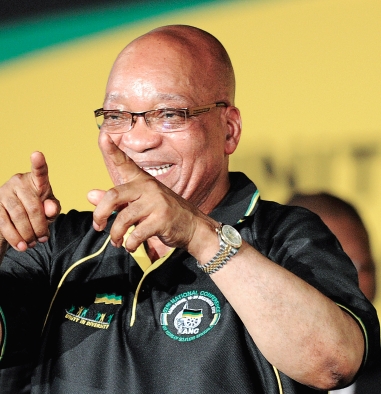
South Africa’s ruling party, the African National Congress (ANC), has stayed more or less intact for the better part of a 100 years. But can the party meet the challenges of the 21st century? asks Xolela Mangcu.
South Africa’s ANC rightly claims the mantle of the oldest liberation movement in the world. However, since coming to power the ANC has been marked by internecine leadership battles. It is not that difficult to figure out why these battles take place – it is the scramble for resources that, all too often, has plagued the African continent. In an article titled Climbing Jacob’s Ladder, the Rhodes University academic, Richard Pithouse, notes that “the scramble for resources” has been particularly acute under Jacob Zuma’s leadership. He writes:
“One of the key factors animating support for Zuma in the ANC is the brazen manner in which the party has become an instrument for private advancement from the top to the bottom of society.”
In the short space of 18 years, the ANC has put paid to the self-delusional concept of South African exceptionalism – the idea that we were beyond the corruption that has plagued other African countries since independence. The energy that was galvanised to oppose the apartheid regime is now turned towards eliminating rival comrades who might have pretensions to the nation’s till.
Pithouse also points out that in Kwa-Zulu Natal alone, 38 ANC members have been killed in the last two years and a senior party member was mowed down on the eve of the Mangaung elective conference in December. At that very same conference, the party leadership boasted about growth in its membership. The numbers are disputed by some sections of the party. Members of the Free State ANC successfully argued before the Constitutional Court that the provincial leadership manipulated the number of delegates in that province in favour of Zuma.
Similarly, there are questions about the manipulation of delegates from the North West province where the secretary of the party in that province was suspended on the eve of the Mangaung conference, so he could not raise an objection about the make-up of the provincial delegation on the conference floor. And then, there is the hard-to-believe 35% increase in the paid-up membership of the ANC in Zuma’s home province of KwaZulu Natal.
But even if we were to grant that the increase in membership is authentic, there is a paradox between that supposed growth and the decline in electoral support for the party from 70% in 2004 to 65.9% in 2009 and 61% in the 2011 local government elections.
It is now taken as a given that in South Africa’s parliamentary and presidential elections fixed for April 2014, the public will punish the ANC for electing Zuma. With each election turning out to be a bloodletting, fewer and fewer credible individuals and organisations are likely to campaign as vigorously for the ANC in 2014. Already, the influential Trevor Manuel, trade union leader Zwelinzima Vavi, and Kgalema Motlanthe, also a former trade union leader for 15 years, have declined nomination to the party’s National Executive Committee (NEC). This is not only a vote of no-confidence in the current leadership but also a loss of institutional wisdom for the party.
The decision to pick Cyril Ramaphosa as ANC deputy president has been described by Zuma’s spin doctors as an attempt to assuage the urban middle classes, the business and investor community. I am, however, not convinced that Ramaphosa will have any success in punting Zuma to the public without damaging his own reputation. He will most likely be kept in check by Zuma’s supporters should he raise his head above the parapet. Ramaphosa will thus find himself constrained between Zuma’s supporters and those he has antagonised by parachuting into the leadership at the behest of Zuma’s supporters. He has already had to denounce any ambition for higher office. Could this have been at the instruction of Zuma’s supporters? Quite likely.
Another possible danger for the ANC going into 2014 is that just as the coalition that supported Zuma in his bid to oust Mbeki fractured, Zuma’s coalition could also fracture. This will happen for a simple reason – there is always only so much patronage to go around.
Already there are many “walking wounded” members of Zuma’s coalition. They were not elected to the national executive committee – membership of which is crucial in connecting questionable businesspeople to crooked politicians in government who sit on the committee. There will be more losers as the new coalition consolidates itself in the new government, leading to a further fracturing of the ruling party into tiny but even more vicious factions. However, all is not lost for those who cannot make it to the NEC. There is also the sphere of local government, which has become a cesspool of sleaze as local warlords scramble for provincial and municipal office to dispense businesses to families and friends. Suffice to say without these official positions, which they owe to their influence in the party, many of these individuals are unemployable.
The race for political office literally becomes a life and death issue, which is what we are likely to see in the local government elections in 2015. And then there is the issue of an increasingly racialised, tribalised and provincialised ANC. I did a bean count of the racial make-up of the new NEC and found no more than three whites, two Indians, and three Coloureds out of a total of 92 members. This is a rather incredible development for a party founded on non-racialism. How on earth does the ANC hope to attract support from members of these groups if they are not reflected in its leadership structure? Or is the ANC comfortable in obtaining majority support in the African population? But such support may also not be forthcoming if the party continues to concentrate its energy and resources in KwaZulu Natal. According to Zuma’s former spin doctor, Ranjeni Munusamy: “The ANC of Zuma is the very antithesis of the ANC of generations past.”
Munusamy observes that the KwaZulu Natal ANC got almost everyone it wanted elected onto the ANC’s NEC. Indeed, about half of the members of the NEC come from this one province. The concentration on one province can only fuel resentment in the broader population, leading to alienation at the polls. And the splurge on a house worth R250m for Zuma – at the taxpayers’ expense and possibly illegally – is likely to be the main election issue. Even if Zuma should survive the opposition party’s efforts to have the case of corruption against him re-opened, the R250m house is not going away. The mansion has created resentment not only among the poor people in that region – they rejected the ANC in a recent by-election – but also in the African population at large. And so, not only do you have an increasingly racially and ethnically homogenous party but also an intellectually uniform one. This is an electoral gift to opposition parties in a country as diverse as South Africa. The ANC, to wit, is facing a severe crisis of leadership.
It could indeed be the case that, in the words of Antonio Gramsci, “the crisis consists precisely in the fact that old is dying and the new cannot be born; in this interregnum a great variety of morbid symptoms appear”. If the ANC cannot find a race and ethnic transcendent leadership and politics, those who do will most likely lead the country in the second decade of the 21st century.








