
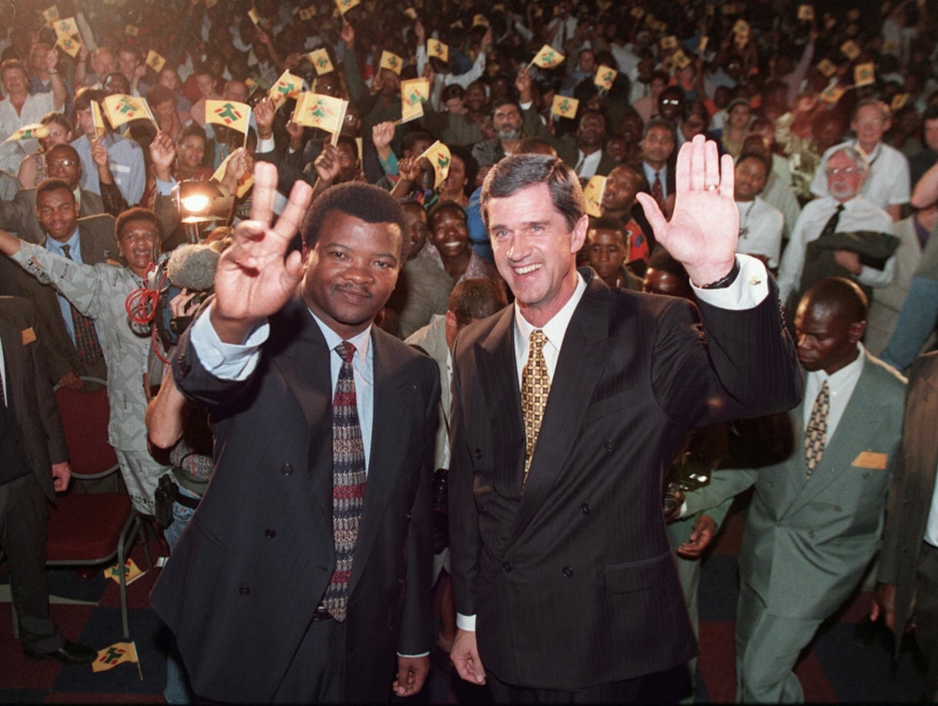
Udo W. Froese writes about the post-election situation in South Africa and says political alliances will take the stage ready to do battle in 2019.
South Africa’s forthcoming elections in May will be a mere earth-tremor in its preparations for the earthquake of the real political power strategies and struggles leading up to the elections in 2019. After the May elections, new political party alliances will be formed. The goal is a complete political transformation. The following is an unscientific but strategic pattern analysis, not popular within the country’s corporate media monopoly and with its armchair academic analysts.
Since 1999, the former Bantustan Transkei military leader, General Bantu Holomisa, has been preaching the formation of an opposition alliance to challenge the ruling ANC.
When the breakaway party, the Congress of the People (COPE), split into two after the fallout between COPE’s leaders, Mosiuoa Terror Lekota and Sam Shilowa, the new breakaway joined General Holomisa’s United Democratic Movement (UDM). Homolisa stated then: “This is just the first manifestation of a black dominated coalition.”
Under the late President Nelson Mandela, Holomisa served as a deputy minister of tourism. Soon he fell out with the ruling African National Congress (ANC). He then formed a new political party with the former apartheid minister of defence, Roelf Meyer. Meyer had served to the end of the apartheid era as minister of defence under President FW de Klerk. But, he soon opted out of the alliance with Holomisa.
The question that arises is: Is Gen. Holomisa the dark horse in the forthcoming elections? When will a new alliance between his UDM and COPE-2, AMCU, possibly a breakaway from NUMSA and Agang SA, be formed? It could be the reason for Holomisa having met with the Association of Mine and Construction Workers Union (AMCU) on numerous occasions.
Like Holomisa, the National Union of Metalworkers of South Africa’s (NUMSA) secretary general, Irvine Jim, also hails from the Eastern Cape. A host of small political parties on the fringe would join the new alliance Holomisa lobbies towards.
Agang SA’s Mamphela Ramphele has no hope at all of leading any black South African party of note, not to mention becoming the president of the country. She is just too erudite, with no foot on the ground, accused of being unable to complete anything she touches.
Ramphele serves on the board of the Rockefeller Foundation in the US. She was vice chancellor of the University of Cape Town. At one stage she also served as a director of the World Bank and on the board of one of the platinum mining companies, where she did nothing for the struggling mine workers.
As Ramphele shares the same donors as the Democratic Alliance (DA) leader, Helen Zille, she would serve her masters better in the Holomisa camp. Though the DA has similar plans for 2019, they differ. The fallout between Ramphele and Zille seems to be part of the yet-to-unfold strategy.
The difference between Holomisa and Ramphele is quite obvious. Despite having been a former Bantustan military leader, Holomisa remains hands-on and therefore, relevant to local politics. He is respected in the Eastern Cape and has earned his stars. Unlike the elitist Ramphele, boots-on-the-ground Holomisa is not just an airy-fairy token for many well-heeled international Western interest groups.
The DA would seem to go it alone until 2019. It would continue with its strategic efforts to weaken the ruling ANC. By its own admission, the DA plans to take over the Union Buildings in Pretoria as the new ruling party. However, it seems that the DA has also realised that it might not quite make it alone. Therefore, the new DA strategy seems to be to attempt a coalition agreement with the ANC by 2019.
A long-serving, senior member of COSATU’s leadership explained: “The DA and its backers seem to work on a group of COSATU affiliates. Those could include the South African Municipal Workers Union (SAMWU), the Food and Allied Workers Union (FAWU), the Chemical Workers Union (CWU), and regional representations of the South African Democratic Teachers Union (SADTU), excluding its headquarters.”
The senior member of COSATU’s Central Executive Committee (CEC) explained the above-mentioned point: “The opposition Democratic Alliance would need to build a large enoughpower base in preparation for a serious strategy of forming a coalition agreement with the ANC by 2019.”
The role and the timing of Julius Malema’s Economic Freedom Fighters (EFF) seem to depend on its current leader’s situation. The question mark over Malema’s political future and his leadership of the EFF will be addressed if a provisional sequestration order is finalised. Malema would see his political aspirations for a seat in Parliament evaporate, as being an unrehabilitated insolvent would prevent him from being a member of the National Assembly. Malema would just be dumped then, and Dali Mpofu would quickly take over leadership of the EFF.
Some 90% of the Marikana mine workers who lost 43 of their members to police bullets in 2013, hail from the Eastern Cape. Even the sangoma (a traditional priest), who addressed the crowds shortly before they clashed with the police, was from Pondoland in the Eastern Cape.
In the above context, it would seem that the timing could be right for the EFF to join the new coalition after the elections, if Holomisa works hard for it. New political parties would converge. They could vote in a bloc in Parliament.
The new executive of the emerging political alliance possibly led by Bantu Holomisa would show its hand. Would the disgraced, former COSATU general secretary, Zwelinzima Vavi become the shadow economic minister then? Would the likes of the AMCU head, Joseph Matunjwa, NUMSA secretary general Irvine Jim, Agang SA leader Mamphela Ramphele, and the possibly new head of the EFF, Dali Mpofu, be part of the new executive? If that was the case, could one assume that the AmaXhosa’s attempt to get back into national power would be realised?
The current political manoeuvring seems centred around South Africa’s platinum mining industry in its belt outside Rustenburg. Meanwhile, the national currency, the rand, is weakened. The strikers are used as cannon fodder, as their demands for a wage increase of R12,500 seem difficult to implement. It would give the owners of the platinum mining industry the ability to shut down. The platinum deposits in the Limpopo province seem to be more attractive than those around Rustenburg.
If the above pattern analysis proves to be a reality by 2019, it could be described as a “real power political scam”.








