
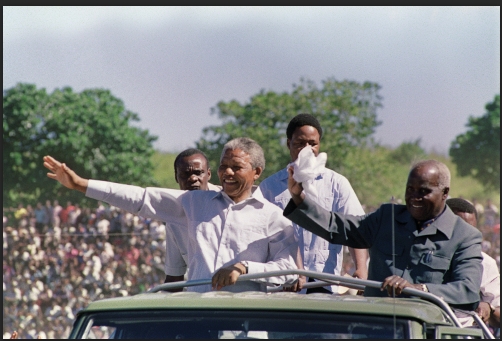
If not for the historic role Zambia played in the struggle against apartheid by giving the ANC sanctuary in the country, Nelson Mandela’s work and freedom would have been doubly difficult. It is no wonder that Zambia was the first country Mandela visited in February 1990 after his release from prison. From Lusaka, Reginald Ntomba recalls the details.
The story of the liberation of Southern Africa cannot be written without a mention of Zambia. Sharing borders with five countries (Angola, Namibia, Botswana, Zimbabwe, and Mozambique) that were yet to free themselves from the shackles of colonialism, Zambia found itself inextricably wedded to the liberation wars waged among its immediate neighbours and beyond – including South Africa.
In 2007, I was among a group of Africans and Germans that visited Namibia on an exchange programme. On a weekend, our Namibian colleague, Helena Amutenya, took us to her grandmother’s village on the outskirts of Windhoek. Upon introducing myself as Zambian, one of Helena’s cousins greeted me in Nyanja, one of the many languages spoken in Zambia. He told me he had stayed in Lusaka during the days of the struggle.
Earlier in the week, we had a discussion with a SWAPO parliamentarian. During question time, I introduced myself as a Zambian. Before I had even finished, he interjected: “Why did you people remove Kaunda, such a great statesman? He looked after us very well when we were fighting for our liberation from colonial rule.”
Who better to describe the role Zambia played in the African National Congress’ struggle for majority black rule and Nelson Mandela’s long walk to freedom, than the country’s post independence president Kenneth Kaunda:
“This is a deeply felt and personal loss for me,” he says, “Zambia was the home of the ANC for more than a decade. It was a home for all freedom-seeking Africans. As president of Zambia, it was a privilege and a pleasure to make sure that Oliver Tambo, Thabo Mbeki and the many South African exiles felt at home in Zambia.At the same time we kept pressure on the apartheid government and provided all means necessary to empower our brothers and sisters to fight for liberation. While he was in jail, one of the first actions I took when we attained our freedom on 24 October 24, 1964, was to meet with South African leader B. J. Vorster and his successors, right up to F. W. de Klerk, to persuade them to release Mandela and other unlawfully jailed freedom fighters.
“We explored all options, asking for African leaders, including Mandela, to be imprisoned in Zambia rather than their homeland. We asked the apartheid government to open up dialogue with the ANC. We intensified the struggle to liberate all of Africa on all fronts. Mandela thanked me for the role Zambia played under difficult circumstances – and for making persecuted Africans and exiles welcome in Zambia.
It was not necessary. “We have lost one of the greatest sons of Africa, and the world is poorer for it. When Mandela left South Africa for the first time after 27 years of incarceration, I was delighted and honoured that his first destination outside of South Africa was Zambia,” he said in a statement to various media on learning of Mandela’s death on 5 December. He added: “It is was a privilege to welcome home a brother I had last seen free in 1962 on his last trip outside of South Africa. At our subsequent meeting in Ethiopia, he and Oliver Tambo had come to brief us on the ANC’s plans to escalate the struggle for independence, where OR (as he was fondly called) was to lead the struggle from the international front, while Mandela was to lead the domestic struggle. When I saw him again on this joyous occasion in 1991 I told him that the people of Africa were waiting for him to take up the last mile of the struggle for Africa… I am glad I got to see him again on February 11, 2010, not knowing that it was to be our final goodbye.”
Kaunda was one of the high profile dignitaries at Nelson Mandela’s remembrance memorial, which strangely, current Zambian president Michael Sata, despite being the only head of state to declare a 7-day state of mourning for Mandela, in Zambia, did not himself attend.
Kaunda, however, stated further on the role Zambia played in South Africa’s independence struggle: “It was a duty we were happy to fulfill. An African brotherly responsibility. It’s what the struggle over colonialism demanded. We responded accordingly with a clear conscience. Mandela to me was more than a comrade. He was a brother. A brother in the common struggle for a liberated Africa. Today we are all free to create a better Africa on our terms because of his sacrifice.”
Many South Africans, especially those who were directly involved in the struggle for freedom (they lived and strategised out of the Zambian capital Lusaka for years, including current president Jacob Zuma, and former president Thabo Mbeki) consider Zambia to be their “second home”. This is a line you hear in many speeches by ANC officials and the now long-returned former exiled refugees. Lusaka was more than the headquarters of the ANC in exile.
It was in this city that the national broadcaster had a radio channel specifically dedicated to the liberation struggle. The channel propagated messages that helped galvanise the people back home to continue fighting for freedom.
In Zambezi Road in Lusaka’s Roma Township is house number 250 where Oliver Tambo stayed from 1967. A book has since been written about this house titled, A House in Zambia – Recollections of the ANC and Oxfam at 250 Zambezi Road, Lusaka, 1967-97.
According to the book, edited by Robin Palmer: “The cottage was built to provide accommodation for Oliver Tambo, acting president of the ANC, who was primarily based in Lusaka.
“The military headquarters moved there from Morogoro (Tanzania) in preparation for the launch in August 1967 of the Wankie campaign, an invasion of Southern Rhodesia in alliance with the Zimbabwe African People’s Union (ZAPU). Lusaka became the de facto headquarters of the ANC in 1967, though it did not formally move its headquarters from Morogoro until the early 1980s.”The book continues: “Tambo did not stay for long in the cottage, but it was later occupied by a succession of ANC people, including Archie Sibeko, trade unionist and Umkhonto weSizwe (MK) logistics operative, Ruth Mompati, and Andrew Masondo, a former maths lecturer at the University of Fort Hare and Robben Island prisoner, who became the political commissar of MK, and, after liberation, a general in the South African Defence Force. Cecilia, his wife, was Oliver Tambo’s private secretary for many years.”
Because Zambia provided a safe haven for the ANC, which was headquartered in Lusaka, the country was prone to military reprisals by South Africa’s defence forces, which sometimes came at a heavy human cost.
The effects on the country’s economy were also substantial. At one point there were 8 liberation movements, including the ANC, operating from the Liberation Centre in Lusaka.
One other memorable consequences was the influx of refugees into Zambia. Government-run refugee camps were set up on many border towns in Zambia, at which schools, health centres and other essential facilities had to be provided at a huge cost to the Zambian. The extent to which Zambia was brought to its knees by its continued policy of supporting liberation movements is widely acknowledged.
According to research by Jubilee Zambia in November 2000, Zambia‘s apartheid-caused debts amounted to $5.3bn, and the total apartheid-related costs were estimated to be in the region of $19bn.
“Zambia … paid substantial extra costs. First in 1973 when Rhodesia (then backed by apartheid South Africa) closed its border with Zambia and tried to blockade it. [Second], when Zambia kept its border closed in order to impose UN sanctions against Rhodesia, and [third] in the 1970s and 1980s when its rail links through Angola and Mozambique were cut. This isolation was a major reason for the construction of the Tazara railway to Dar-es-Salaam,” states a report by Africa Action.
In his book, End of the Kaunda Era (1994), John Mwanakatwe, Zambia’s first minister of education, recalls:
“Throughout the years from 1964 to 1985, the problem of decolonisation had a great impact on the political and economic fortunes of Zambia. It can be asserted that no other independent country in the Southern African sub-region experienced as much loss and suffering from liberation wars as Zambia.”
But in Kaunda’s words, it was all worth it: “I dedicated myself to the struggle for the people of Africa and fought against white domination and black domination and my dream for a free South Africa was at long last vindicated.”








