
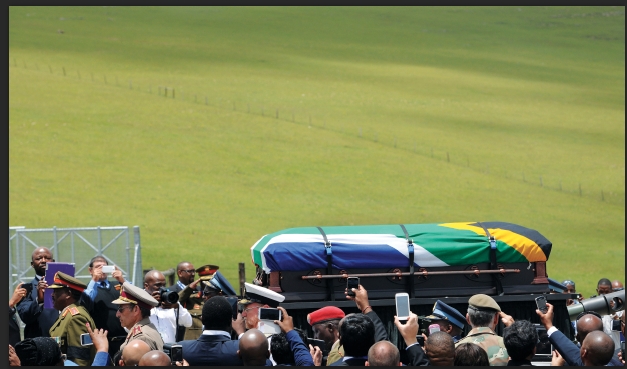
Nelson Mandela Funeral. Having inspired a better world, Nelson Mandela’s rest will be well deserved as he enters into conversation, not with himself, but this time with his ancestors and the world again. And the world cannot thank him enough for his magnificent leadership, writes Pusch Commey.
Mandela’s early formative years were in the rural hills of his birthplace Mvezo and subsequently at Qunu, where he is now buried and rests. It was amongst those hills, tending cattle, that Nelson Mandela honed his skills. The boys would engage in the traditional sport of stick fighting during the long hours. These were contests of strength, stamina, dexterity and tactical acumen. In the fields,Mandela absorbed the values of humanism. He recalls: “I learned that to humiliate another person is to make him suffer an unnecessarily cruel fate. Even as a boy, I defeated my opponents without dishonouring them.”
Such attitude served him well. Perhaps the finest illustration of the value of his African upbringing was during his presidency. In 1995, he invited Percy Yutar (1911-2002) for lunch. Yutar was the man who prosecuted him in the infamous Rivonia Trial of 1963. It was that trial that sent Mandela to prison for 27 years.
As an Armenian Jew, Yutar had himself suffered anti-Semitism and relative oppression at the hands of the powers that be – the Afrikaners. For that reason, he remained for a while a junior state prosecutor and was forbidden from joining the Attorney General’s office in Cape Town. Now as deputy attorney general of the Transvaal province, he was eager to please his bosses at the Palace of Justice in Pretoria. And indeed, in cross-examination and treatment of the defendants, he was relentlessly mean.
Mandela was convicted. Yutar insisted on the death penalty. Mandela declared that he was prepared to die for the ideal of equality and non-racialism. It was not to be. Judge President Quartus De Wet (1899-1980), found a technicality to deviate from the recommended sentence of death.
Some say he did not want to make Mandela a martyr. But the judge knew that Mandela did not deserve to die. He sentenced him to life imprisonment. The loophole was that Mandela had been charged with sabotage instead of high treason. The imponderable remains: What would have happened to Mandela and his legacy if he had been hanged?
But to Mandela, after his release from prison 27 years later, this was not the time for winners and losers. He understood Yutar. After a kosher lunch, he held his hands, fraternised like lawyers do after tough opposition, and said: “You were only doing your job”. Mandela was the ultimate peacemaker. And even the Bible says, “blessed are the peacemakers”. At his presidential inauguration in May 1994, his gaoler was invited as a VIP guest. He subsequently had tea with Betsie Verwoerd, the wife of the architect of apartheid, Hendrik Verwoerd.
In a world of political pettiness and factionalism, he captured the global imagination. And when he walked into a rugby stadium wearing the South African Springbok rugby jersey of the captain, at the Rugby World Cup in 1995 in Johannesburg, the conversion of his arch enemies was complete. They chanted “Nelson,
Nelson, Nelson”. The Afrikaners sang a black liberation song, Shosholoza. Says Thabo Mbeki, who was his deputy and who succeeded him as president in 1999: “Mandela’s death is the end of an era”.
President John Mahama of Ghana gives an appropriate African perspective: “The long walk to freedom was also Africa’s story. The indignation that once permeated our continent has been replaced by inspiration. The undercurrent of pessimism resulting from the onslaught of maladies – wars, coups, disease, poverty and oppression – has given way to a steadily increasing sense of possibility. It wasn’t just Nelson Mandela who was transformed during those years of his imprisonment. We all were. And Africa is all the better because of that.”
Mandela was an idealist, a romantic, and a pragmatist all rolled into one. And yet he simply wanted to be like everybody. He wanted no personal glorification, but to be judged by his ideals of freedom and justice – a timeless, universal ideal. He said: “I don’t think there is much history that can be said about me. I just want to be remembered as part of that collective.” In Africa the collective is paramount.
He also said: “What counts in life is not the mere fact that we have lived. It is what difference we have made to the lives of others that will determine the significance of the life we lead.” He had that elusive quality that is uncommon: an effusive generosity of spirit. He was father, lover, fighter, politician, peacemaker, everyman.
That is what made the majority of White South Africa come to his party. At his inauguration in May 1994, he was flanked by four white generals of the old order. He was sworn in by a white chief justice. And the white South African defence force put up a brilliant fly-past to salute him. The objective fact though, was that blacks had been prevented by apartheid from doing these jobs.
But most of White South Africa embraced the change he preached and practised; change from bigotry to reconciliation, unity and love. They believed. He saved them from a prison house and it was a fresh air of freedom. But whether it was justice is still being debated. And South Africa is work in progress. But in Mandela’s lexicon, African justice is restoration and rehabilitation, not retribution. And the world has just began to learn again.
One would have imagined that when Mandela embarked on his reconciliation project, immediately prior to the first multiracial elections in April 1994, the races were at each other’s throats in the streets, but that was not the case. Yes, there was tension and extreme violence perpetrated by various fringe formations, but whites and blacks walked the streets of Johannesburg without animosity. It is also to the immense credit of the black population, shaped by values that made them see beyond hatred and revenge. South Africa is a complex, beautiful and remarkable country.
In his latter years, his son-in-law, Dr Kwame Amuah, married to his eldest surviving child Dr Makaziwe, discussed with him the prospect of death. In response to Dr Amuah’s desire to write a book on the subject of death, Mandela said: “How do you write about death when you have not experienced it? Rather write about love, because it is something we all experience.”
Love was the compass that gave direction to his project and Dr Makaziwe, is in no doubt about what made her father. She narrates: “The name Mandela originated from our great grandfather Mandela, who was born in 1820. He was the son of King Ngubengcuka, the fourth monarch of the abaThembu, an ethnic group from the Eastern Cape. Mandela gave birth to Chief Mphakanyisa Henry Gadla Mandela who gave birth to our father Rolihlahla Mandela.”She adds with unguarded adorationabout her iconic father:
“It is indisputable that Nelson Mandela’s development, beliefs and convictions, as well as his principled stand on inclusivity and forgiveness were derived from sitting at the feet of his elders. It is what he learnt from African values that made him the world icon that he is today. It is that African philosophy of Ubuntu practised all over the continent which says, I am because you are. Not I think, therefore I am.”
Indeed, having inspired a better world, Mandela’s rest is well deserved. Now he has entered into conversation, not with himself, but his ancestors. And the world cannot thank him enough for his magnificent leadership.








