
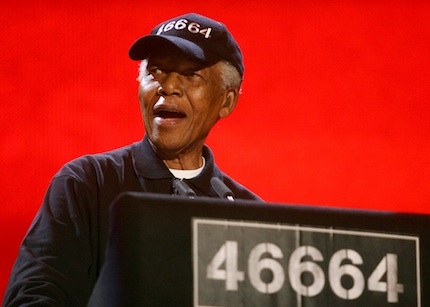
Mushkat Parker reminisces on the man South Africans simply, yet fondly, called “tata”. His power of forgiveness will be hard to emulate. But where did he stand on South Africa’s foreign and domestic policy? How will his staunch 46664 HIV/Aids campaign be moved forward?
With the passing of the ‘Father of the Beloved Country’ the underlying and recurring theme in Nelson Mandela’s philosophical DNA remains the power of forgiveness which he uncannily exuded by disarming even his most die-hard of detractors through the generosity of his spirit and deportment, firmly rejecting any notion of a Maoist ‘cult of personality’ or even sainthood, preferring to be a sinner who was trying to do something good.
When the softly-spoken African butler of the assassinated South African Prime Minister Dr Hendrik Verwoerd – who was generally recognized as the Apostle of Apartheid, was asked in 1966 what kind of man he was, the butler almost instinctively replied: “He was a kind but very wrong man.”
Fast forward some 28 years, and another South African leader, a certain Nelson Rolihlahla Mandela, the first elected President of a non-racial South Africa, on a visit to the notorious Robben Island Prison, where he was incarcerated for 18 of his 27 years in gaol, paid tribute to one of his jailers, Christo Brand.
“You know who this person is?” he enquired from a number of members of parliament accompanying him on that visit to the Island after being newly-elected in 1994. “This person was my warden. This person was my friend.”
In a subsequent group photograph, Mandela insisted Christo Brand be in the photo. “You must stand next to me, we belong together,” he quipped. Today, the former warden and jailer, still works on Robben Island but as a tourist guide to the museum, into which the prison has now metamorphosed.
“What counts in life,” he once said, “is not the mere fact that we have lived. It is what difference we have made to the lives of others that will determine the significance of the life we lead.”
It is that spirit of generosity in forgiving and forging new relationships with foes that makes Nelson Mandela stand out from mere mortals such as Verwoerd.
In the 20th Century, it is only Mahatma Ghandi, Mandela’s hero, and he who stood out as the true icon of humanity.
Yet the reality suggests that as good a statesman that Mandela was – especially in reconciling a post-apartheid South Africa, warts and all – as a politician his acumen did sometimes desert him. This was either because of inexperience, (he was overawed by the sheer office of the Presidency) or he was swayed by the politically-motivated counsel of his advisers. Nor was the African National Congress (ANC) able to fast-track its transformation from a liberation movement into a ruling political party.
This impacted on foreign policy and domestic issues alike, including affirmative action, land reforms, minority rights and poverty alleviation; and matters pertaining to his ruling ANC party including cronyism and corruption. Some critics have suggested that in terms of foreign policy, his biggest faux pas was to refuse the Ataturk Award, Turkey’s most prestigious state honour.
“As you know he was my hero and I am tearful right now over his death. Unfortunately, a minority of people in Ankara (the Turkish capital), are still bitter about him refusing the Award. I was expecting that Prime Minister Recep Tayyip Erdogan would attend Mandela’s funeral but he sent his deputy Ali Babacan instead,” explained a Turkish film director who is close to the ruling AK Party.
Mandela was nominated for the Ataturk Award in 1992, in recognition of his life long struggle against apartheid.
The ANC explained the decision to refuse the award thus: “… Nelson Mandela has spent his whole life in the service of democracy, human rights and freedom from oppression. The ANC wishes to state quite categorically that Mr Mandela has not accepted the Ataturk Award, and has no plans to visit Turkey, but the ANC`s attitude does not reflect any negative view of Kemal Ataturk, the reformer and founder of modern Turkey.”
Years later, an ANC stalwart and fellow Robben Island inmate, Seddick Isaacs, explained to me that in hindsight, Mandela regretted refusing the Award, saying that at the time he was wrongly advised to reject it.
The South African foreign ministry at the time also seemed to be out of its depth failing to recognise the bigger picture of historical ties which that went back to the times of the Cape Colony and the Ottoman Sultanate, which established diplomatic ties with the Cape way back in the 19th century. In fact, the irony is that the refusal of the Award by Mandela has had a positive legacy impact on Turkish democracy.
“Mandela’s refusal of the Ataturk Award was a lesson for Turkey that eventually precipitated all those human gains in the long run,” explaines the Turkish film director.
South Africa under Mandela, however, did set a global standard and a remarkable legacy in Truth and Reconciliation, which has yet to be successfully replicated in other countries of former conflict and repression.
It was Chile that set the original example of Truth and Reconciliation, following the brutal excesses of the military dictatorship of General Augusto Pinochet Ugarte, who overthrew a democratically-elected government led by President Salvador Allende Gossens in the notorious 11 September 1973 military coup.
The South African Truth and Reconciliation Commission was based in part on the Chilean Rettig Commission, created under former President Patricio Aylwin Azocar, to investigate abuses under the Pinochet regime.
On the domestic front the Mandela era has been criticised for not doing enough to tackle deep issues such as job creation, affordable housing, clean water, sanitation, electrification, especially in the neglected rural heartland and still sprawling townships. The problem of illegal immigration and porous borders was also a big bone of contention. In the financial sector, the ANC’s own investment arm, Thebe Investment Corporation and its flagship Black Economic Empowerment (BEE) entity, Future Bank, suffered spectacular bankruptcies and huge knocks amid allegations of mismanagement. On social issues too, Mandela’s legacy permeates through three failed policies – the ill-thought out attempt to introduce Muslim personal law to appease local Muslim groups; the drastic dumbing down of the state education system and the quality of education; and the failure to come up with a credible policy on HIV/Aids which would have pre-empted the outrageously ill-informed policies of his successors Thabo Mbeki (Mandela’s Deputy President) and Jacob Zuma.
On HIV/Aids on the other hand, the issue is far more tragic. South Africa is the country with the highest number of HIV/AIDS patients, with the number of new infections continuing to increase. Mandela did not probably fully appreciate the true impact of HIV/AIDS while he was in office, like many other world leaders at the time. It was only when he stepped down in 1999 that he became more robustly involved with campaigning for education, research and more importantly treatment for HIV positive individuals, of which the first drugs were available in 1995.
It would take another eight years for the government to approve it’s use, which incidentally coincided with a further boost in Mandela’s HIV/Aids campaign, 46664, based on his prisoner number on Robben Island. Perhaps the most poignant moment of his plight in raising awareness, however, was publicly announcing the death of his son due to Aids-related illness. “This,” stresses Dr Nadia Ahmed, a sexual health specialist, “was something I was not aware of, but for Mandela to personalise a battle occurring to such a degree nationally, was perhaps, albeit unbeknown to him, the reality check South Africa desperately needed. Here was a living legend speaking with first hand experience about his own son’s death due to HIV/Aids. Could this moment have unveiled the secrecy that surrounds HIV/Aids because of the persistent stigma?”
Mandela, contends Ahmed, was exactly what the doctor ordered. “Had all of his campaigning happened during his time in office I can only dream of the standard of HIV/Aids healthcare South Africa could have achieved by now, and still hope this can one day be achieved with the dedication of a multitude of charities and NGOs, as well as, South African HIV/Aids clinicians. But it’s simple really, the key lies with the government,” she added.
The harm done by Mandela’s political successors in the fight against HIV/Aids, she contended, “has probably undone some of his hard work to turn the tide against fear and ignorance. But Mandela remains instrumental in planting the seed to the modern Aids response in South Africa, and providing there are a few still watering his seed, his legacy in fighting HIV/Aids healthcare will live on.”








