
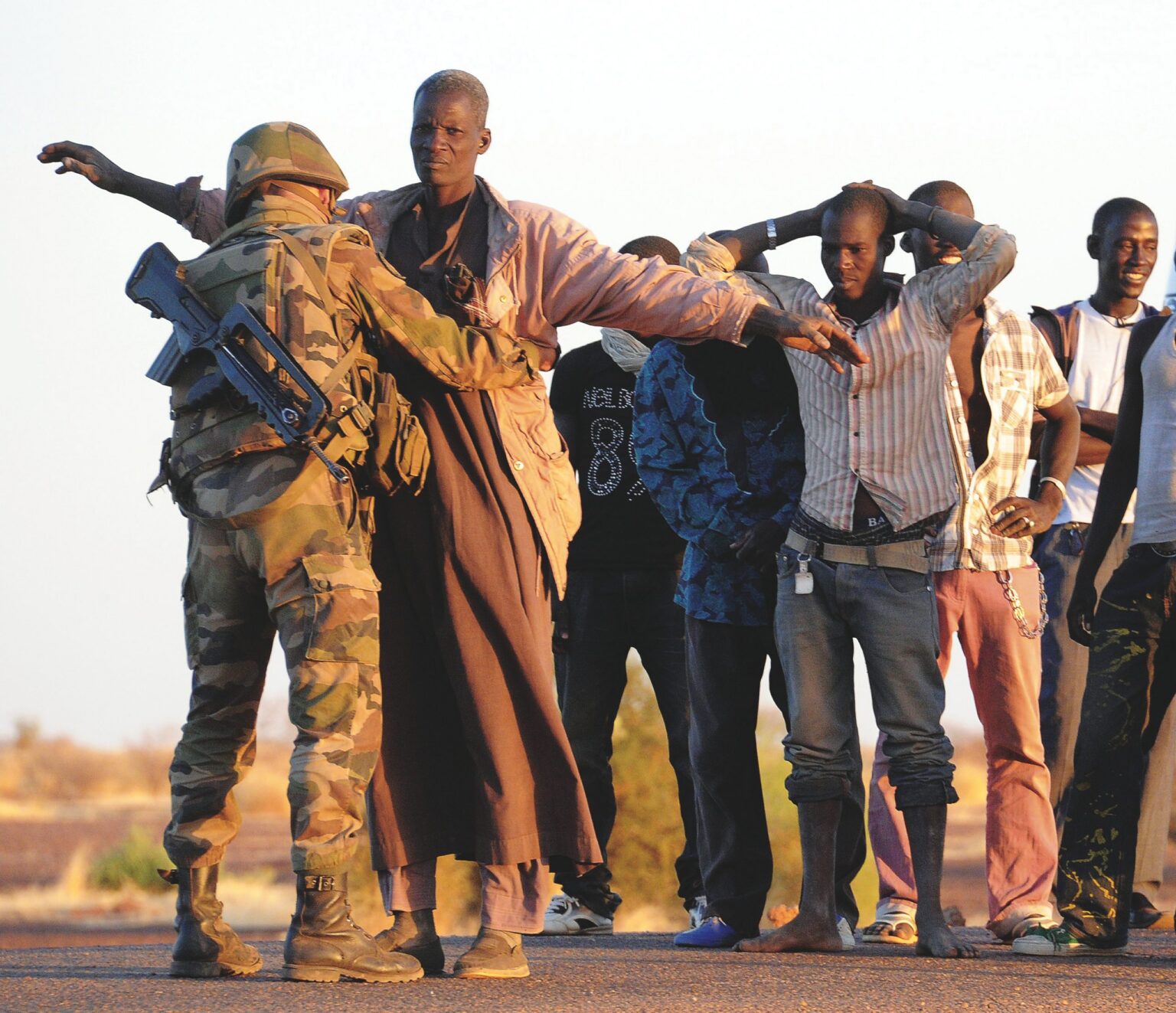
With the French intervention in Mali, aided by American and British logistics support, and now Ecowas forces hurried into the fray to beef up the intervention, is West Africa allowing itself to be recolonised?, asks Cameron Duodu in this first of his two-part analysis.
Imagine this scenario: By some quirk of fate, the president of the United States is a hawkish figure of the Dick Cheney type. And he wants to “whup the arse” of some “rogue state” that “threatens the interests of the United States in the Middle East.” But he needs a majority of votes in the United Nations Security Council to authorise an invasion before he can send American warplanes to annihilate the “rogue state”.
The Security Council has lined up into its usual bloc – Britain and France are with the USA; Russia and China don’t want to imperil their trade relations with a United States that is filling their coffers with dollars through imports and so have indicated that they would abstain; the Afro-Asian bloc is divided down the middle, half for invasion, half against. Except for one small African state, whose vote will decide whether the US should invade under a UN figleaf or go full frontal. The US dispatches a delegation to go and see the head of state of the African state. He is offered money. But he refuses to accept it, for he is a religious nut who believes sincerely that a ruler must be “righteous” in order to be able to “enter the kingdom of God”.
Not only that – the head of state has a personal “pastor” who lives in a foreign country and sends him holy water by diplomatic courier once a week to “cleanse” himself from his daily contact with a “sinful world”. The pastor has recently told him that he has dreamt and seen the devil come to the head of state, in the form of a serpent, to offer him an apple which if he bites into will result in his immediate death.
Now, to the head of state, there was no difficulty whatsoever in deciphering the message contained in the pastor’s dream: unlike dreams about the results of international football matches in which his country was involved, this dream had very clear symbolisms: Snake = US delegation; + Apple = proffered US money; + Bite = taking the US money; ANSWER: = dying immediately.
No need to check back with the “pastor” to see whether this interpretation of his dream was correct. So the head of state sent the US delegation away empty-handed. “Potuscheney” – as the American leader is known to his staff – hits the roof when he is told that the head of state of such a small African country is preventing him from his favourite pastime – “KAS” – kicking the arse of someone.
“You told that bastard we’d look after him and his family for the rest of his life?” “We did, Mr President.” “And the arsehole refused American money?” “Yes, he did, Mr President.” “OK, get me the Joint Special Operations Command (JOSOC) fellers!”
JOSOC is described as “a network of highly-trained, completely unaccountable US assassins”, armed with ever-expanding “kill lists”. It was JOSOC that ran the operation behind the Navy Seal team that killed Osama bin Laden.
Five days after this conversation, the head of state of the small African state is driving towards a village where he is to open a newly-constructed primary school. He is in a happy mood, for travelling with him is an apostle from his pastor’s church, who will be left behind to convert the teachers to the pastor’s denomination. “I say get the teachers. Then they will get the children. And once we get the children, the church will never be driven out of them!”, the pastor had instructed.
Unbeknown to the president and his convoy, 8,500 feet above them flies a small pilotless aircraft, known as a “drone” of the Predator class. It is controlled from a “container” [cubicle] at the Creech Air Force Base in Nevada, near Las Vegas. Although he is 7,000 miles away, the drone’s controller can see the head of state’s convoy clearly on his screen (the drone is equipped with ultra-sensitive cameras which can even see in the dark, through infra-red sensors).
The controller can see the vehicle in which the head of state is riding, by matching his features, as beamed back by the drone’s cameras, to the biometric picture in his passport. The controller uses his joystick to place the head of state in the cross-hairs of the drone’s lazer gun. He presses the trigger. From 8,500 feet above, a narrow beam of very powerful light shoots down and penetrates the car. The driver of the car is literally blinded, loses control of it, and it careens off the road, hitting a tree and ricocheting back into the road, upside down.
One of the cars in the convoy smashes into the car of the head of state, and in turn flies high over it and lands eighty feet away. Various outriders in the convoys ram their motorcycles into the upturned cars and into each other – almost as if the scene had been specially choreographed for a James Bond movie.
Altogether, 25 people die and 40 are injured. The dead include the head of state, whose normally loquacious pastor had been unable to forewarn him not to make the journey – despite having collected a huge contract for a member of his flock from the head of state, only the week before.
That same night, an American delegation visits the newly-installed head of state of the small African state. The delegation brings him a “small gift” – the secret number of a bank account in Bermuda. He is told that it is in the interest of the United States that he stays alive. He interprets this to mean that he will be protected from “accidents” like the one that had claimed the life of his predecessor.
When he receives a personal telephone call from Potuscheney that night, asking him whether the US had his assurance that his delegation at the UN would vote with the US, the new head of state answers without hesitation: “I was always with you, Mr President. Always. No country that promotes terrorism can expect an iota of sympathy from my administration. Not one iota!”
Awash with drones
Up to a few years ago, such a scenario as the one painted above could have been laughed out of court. But the US “already operates” aircraft, used for “surveillance and bombing targets”, in Burkina Faso. The secret became public only because the US signed an agreement with Niger in early February 2013, to station drones in that country! Following the invasion of Mali by France in January 2013, it is certain that Mali’s skies will by now also be awash with drones.
In fact, the arrival of the drones in West African skies puts a completely new construct on the coup d’etat that took place in Mali on 21 March 2012. It was Captain Amadou Sanogo’s overthrow of the government of President Amadou Toumani Toure that triggered a new, more robust Tuareg uprising in northern Mali.
The Tuareg rebellion, as such, was nothing new. A nomadic and fiercely independent-minded ethnic group, the Tuaregs have been fighting not only against the government of Mali but other governments in the Sahel region, from Algeria, Mauritania, Niger, and Burkina Faso to as far away as northern Nigeria and Chad, since independence was granted to the new countries of what used to be called French West Africa, in 1960.
What was new in March-April 2012 was that the Tuaregs were joined by Islamist militants, mostly out-gunned ex-Muammar al-Gathafi fighters from Libya. These included religious fanatics who hijacked the rebellion almost completely and imposed strict “Sharia” or Islamic law wherever they could in northern Mali. Also in the mix were members of Al Qaeda in the Maghreb (AQIM) whose tentacles extend as far as Nigeria (through Boko Haram).
The “hijackers” did the Tuaregs no favours by demonising the image of the northern rebellion through severe punishments imposed on people who were alleged to have committed certain offences, such as stealing and adultery. Amputation of limbs and public flogging were some of the punishments. The militants further tarnished the image of the rebellion by banning Malian music (despite the popularity of internationally renowned musicians as Ali Farka Toure and Salif Keita).
Worst of all, the militants desecrated some shrines and mausoleums considered “holy” by the inhabitants of northern Mali. They also threatened to destroy the ancient manuscripts that some families in Timbuktu had inherited from their ancestors and which they had managed to preserve – despite the inhospitable conditions in the Sahara Desert – for some 10 centuries or so.
The actions of the armed religious fanatics horrified the northern Mali population so much that when the French felt obliged to intervene to drive them out, the French were welcomed by the populace.
The mountebank administration in the Mali capital, Bamako, which pretends to be run by a civilian “president”, Dioncounda Traore, but is, in reality, under the command of Captain Amadou Sangono was particularly joyous that the French had intervened. Its joy was greatly increased when Britain signalled the complete internationalisation of the Malian conflict
by assisting the French with transport aircraft.
The reason for the Western intervention was that although Sanogo had blamed the ousted president for not having been able to defeat the Tuareg rebellion in the north, Captain Sanogo could not challenge the Tuaregs either. In fact, after he had taken over, the Tuaregs threatened to go to Bamako, the capital, and set up a government there.
It was to prevent this that the French hastily assembled a large force of troop and war-planes and went to engage the Tuaregs and their allies in northern Mali. Needless to say, the Tuaregs ran from the French bombs and are now scattered in a terrain that holds no secrets from them – the nooks and crannies and the oases that hide amidst the sands of the Sahara Desert.
Operation creep?
The Economic Community of West African States (Ecowas) has succumbed to pressure from the Western powers and has sent troops from Nigeria and Ghana as well as some of Mali’s immediate neighbours, to go and take up positions in northern Mali, with the objective of eventually replacing the French. In agreeing to send soldiers to Mali to replace the French troops, the Ecowas states have snookered themselves. First of all, they are going to experience budgetary difficulties, for it is not at all certain that the French, the Americans and the British (who ferried the Ghanaian contingent to Mali) will continue to offer the “logistic support” the Ecowas governments have been clamouring for, and which, if the governments are to be believed, led to their delaying their intervention in Mali for so long. True, the Ecowas foray into Mali occurred with the full authority of a UN Security Council resolution. But the Security Council, as far as is known, has not voted any funds for the Mali operation.
Apart from Nigeria, no West African government can finance a foreign military expedition for any length of time, without creating havoc in its domestic budgetary processes. Yet, unless the Ecowas force is transformed into a UN peacekeeping contingent, it is difficult to see how the UN could finance the Ecowas troops.
The conundrum hides beneath another minefield: what if the Ecowas Mali caper turns into what is known in military parlance as an “Operation Creep”? This is a type of military operation that begins in a small way but which stays on indefinitely as new tasks are placed on the table.
For example, after public safety has been restored to the troubled country, “Operation Creep” starts off by accepting the task of disbanding the mutinous elements in the armed forces; then retraining the remainder; then helping to place a civilian administration in power that can control the armed forces; then making sure that the insurgents who were displaced at the onset of the operation cannot return to threaten the central government anew.
Each of these steps is booby-trapped with social and political imponderables, many of which will be “unexpected” and therefore difficult to confront.For, how does a group of foreign military missions deal with the internal affairs of a member state of their regional organisation without infringing its sovereignty? Even if the country’s government does not mind, what about its people? Suppose the people detect that the central government is corrupt, or inefficient and so want to get rid of it, would the forces of intervention defy the people and prop up the unpopular government in perpetuity?
Or should the regional organisation instigate a coup d’etat and give the country a “better” government? Who decides which government would be “better” for the people of another country?
Usually when “Operation Creep” is set in motion, such questions are never raised, let alone answered. The occupational force crosses its fingers and hopes that good sense will prevail and that things will “work out” in such a way that it will not be necessary to stay in the invaded country for years and years and years.
A quintessential example of “Operation Creep” is the “UN Interim Force In Lebanon (UNIFIL) which has been trying to keep the peace between Israel and its Arab neighbours since 23 March 1978! No one knows when UNIFIL can leave Lebanon. Just as no one ever dreamt that the UN intervention there would last for a good thirty-four years – and counting!
Indeed, what should be worrying Ecowas member states is this: they should
be asking themselves – “we were able to restore peace to Liberia and leave after seven years; we were able to leave Sierra Leone too, after nearly three years; and our relatively shorter involvement in Côte d’Ivoire ended after we had helped that country to settle down. But can we withdraw from Mali just as easily – especially as the French seem anxious to leave the Malians to their own resources as early as they can do so without losing face?”
The answer is not certain. The reason is that Mali is a huge country – it covers an area of 1,240,000 sq kms. It is the eighth largest country in Africa. And it shares borders with some of the largest countries on the continent – ie, Algeria and Niger, Burkina Faso, Guinea, Senegal and Mauritania.
What this means is that the insurgents whose attacks on the Malian army caused the March 2012 coup, have a huge territory in which to play hide-and-seek with the forces arrayed against them. The Tuareg element of the insurgent group, in particular, know the otherwise inhospitable Sahara Desert – which stretches over vast parts of the territory – like the palms of their hands. The porous borders are an advantage to them, as they carry out hit-and-run attacks. For how long can the Ecowas troops endure such attacks?
Enter the United States of America. Already, it has been assisting the French to obtain information about the movements of the Malian insurgents by sending surveillance aircraft – based in Burkina Faso, Niger, and probably Algeria – to reconnoitre their hideouts in the desert. The French will almost certainly share such intelligence with the Ecowas forces, and when the French eventually leave, it is expected that the Americans will continue to offer the service to the Ecowas forces.
Thus, gradually, the Ecowas troops will be seduced into accepting intelligence provided by American drones as a matter of course. And Ecowas armed forces chiefs will find it hard not to advise their governments to accept any offers made by the US to station drones on the territory of their countries. After all, Burkina Faso, Niger and Mali would already be in the US “drone loop”.
What would it matter if Ghana said “no”? And if Niger had signed up, what would Nigeria gain by opposing the use of its airspace for drone activity? There are already drone bases in Ethiopia, in Djibouti, and in the Seychelles. If an African country does not want them on its territory, too bad. Its territory would be overflown by drones anyhow and there would be nothing it could do about it. So why not co-operate? And perhaps get some US “budget support” in return?
What Nigeria and Ghana would have forgotten – if they were to be offered such a honey-trap – is that the drones do not only provide intelligence, but also do actually kill individuals targeted by the US. The list of who should be killed can include American citizens (at least two, a father and son – are known to have been killed by drones in Yemen). Foreigners who are killed are classified as Al Qaeda members who intend to inflict actual harm on the USA. The catch is that the “death list” is drawn up by American intelligence officers. And, apparently, the President of the USA has the final say on it! How can a targeted individual protest his innocence, since he won’t even know he was on the list, and even if he knew, would have no opportunity to tell his would-be murderers that he is in fact “hostile” to Al Qaeda, or has no intention of harming American interests? Are the US intelligence agencies so error-free that they should be given the power of life and death over the citizens of other countries?
Mistakes are made, of course, because the drones are controlled by pilots in America but are stationed in or near the target countries. Thus, a target in Somalia would be killed by a drone based in Djibouti or Ethiopia and piloted in Nevada, USA.
One American writer, Naomi Klein, is of the opinion that a US president could drive the country into “fascism” through being given all that power. She wrote in the UK Guardian that drones had “already been sent to kill at least one US citizen – one who had been indicted for no crime, but was condemned for propagandising for al-Qaeda. Anwar al-Awlaki, on the ‘kill list’ since 2010, was killed by a CIA-controlled drone attack in September 2011; his teenage son, Abdulrahman al-Awlaki – also a US citizen – was killed by a US drone two weeks later.” Klein continued: “This arrangement – where death squads roam under the sole control of the [US] executive – is one definition of dictatorship. It now has the potential to threaten critics of the US anywhere in the world…
“A Yemeni journalist based in Sana’a… went to al-Majala in Yemen where a missile strike had killed a group that the US had called ‘Al Qaeda’. What he discovered… were the remnants of Tomahawk cruise missiles and cluster bombs, some of them bearing the label ‘Made in the USA’. Fourteen women and 21 children were killed. Whether anyone actually active in Al Qaeda was killed remains hotly contested.”
This is the story of one drone pilot, as recorded by the German magazine, Der Spiegel: “A soldier sets out to graduate at the top of his class. He succeeds, and he becomes a drone pilot working with a special unit of the United States Air Force in New Mexico. He kills dozens of people…
“[In] one incident… a Predator drone was circling in a figure-eight pattern in the sky above Afghanistan, more than… 6,250 miles away… When he received the order to fire, he pressed a button with his left hand and marked the roof with a laser. The pilot sitting next to him pressed the trigger on a joystick, causing the drone to launch a Hellfire missile…
“Suddenly a child walked around the corner… [The pilot] saw a flash on the screen: the explosion. Parts of the building collapsed. The child had disappeared. [The pilot] had a sick feeling in his stomach.
“Did we just kill a kid?,” he asked the man sitting next to him.
“Yeah, I guess that was a kid,” the [man] replied.
“Was that a kid?,” they wrote into a chat window on the monitor… Someone they didn’t know answered, someone sitting in a military command centre somewhere in the world who had observed their attack: “No. That was a dog,” the person wrote. They reviewed the scene on video. A dog on two legs?”
(To be continued)








