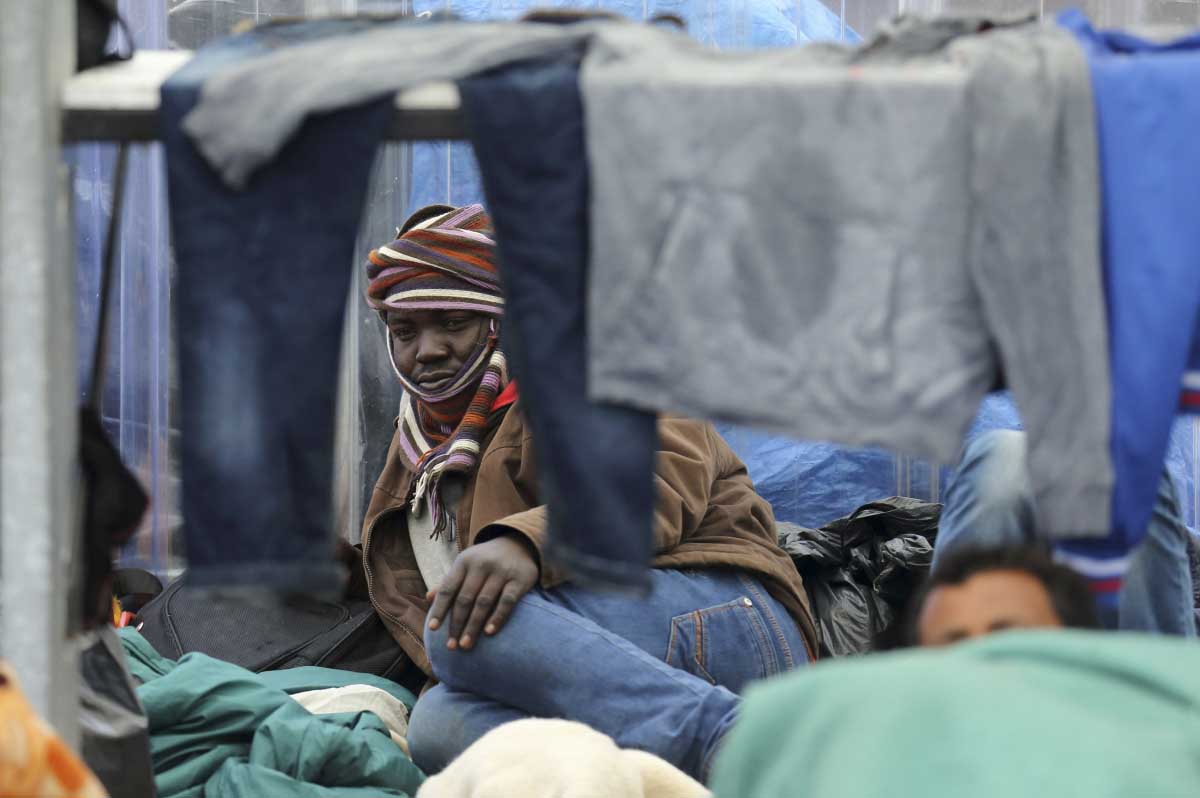
Crossing into Europe is not the only ordeal that African migrants face. Once in Europe, they have to negotiate camps before they reach their final desired destination. One infamous camp is in Calais, a port town in Northern France. New African sent George Ola-Davies to spend 48 hours with the stranded migrants there. His report makes for sober reading.
As night falls, torches, candles, oil- and solar-powered lamps and burning embers illuminate the otherwise sleepy mini-forest in Calais, a port town in Northern France. And as the sun gives way to darkness a beehive of activities can be observed from the main road. Most of the illegal immigrants here are trying to snake into their small tents, which have become their temporary homes as they seek to get away into their perceived Eldorado. Others get hold of their backpacks, ready to have a go at getting out of Calais into the United Kingdom. And then there are those who are so despondent they just don’t know what to do or what lies ahead. Theirs is an unknown future, their despair as inscrutable as it is insurmountable.
I have come to Calais to see how it is to be an immigrant desperately trying to get into the United Kingdom, which as of this month has tightened even further its already stringent immigration laws . The refugees and immigrants I have come to mingle with on this 48-hour assignment come from faraway places like Eritrea, Ethiopia, Sudan, Chad, Somalia and Bangladesh, and there are a few from Eastern Europe. Their current abode is derogatorily referred to as La Jungle or “the jungle”.
All the people I have met during my short stay here have one goal – to cross over into Britain. They have endured treacherous journeys, and some have lost friends and family on the way, but this last hurdle of crossing into Britain, is, they say, their most adventurous step.
Their camp was once a tranquil park where the people of Calais took walks or bike rides with their families or friends. But for a few years now, the park has been strewn with makeshift tents of all shapes and colours. The tents’ residents are here for many reasons: some are fleeing conflict or persecution, others are searching for better economic opportunities; all have sought a better life with the conviction needed to travel long distances at great risk.
Conditions in La Jungle are desperate; you would not wish them on your worst enemy. With no water, toilets or any other sanitary amenities to begin with, the camp would appear to be no place for the weak-hearted – yet it is “home” to around 1500 people.
There are only two makeshift bathrooms for the entire camp. The forest behind the tents serves as an open toilet. Some Sudanese refugees have dug pit latrines, access to which they closely guard. Many of the immigrants I spoke to admitted they had not had a bath for up to a week. The unsanitary conditions contribute to a putrid smell, which carries as far as a mile. In the absence of any dustbins, rubbish is strewn all over, and the filth, coupled with the absence of toilets and any form of drainage, compounds the sanitary situation and makes for a health hazard of enormous proportions. The situation is worse when it rains.
The immigrants fetch water from a standing pipe a kilometre away using plastic containers of all sorts. They are loaded in trolleys that were carted away from nearby discount supermarkets – Lidl and ALDI.
Come nightfall, the adventure really begins. As some creep into their tents, others line up in the streets, ready to stow away in trucks bound for Britain on ferries across the English Channel.
Speaking on to his cell phone as I approach him, 26-year-old Mustapha gives me a gesture to wait a moment. After a few minutes, he gets off his phone and tells me that he was speaking to his friends in England. “They are waiting for me,” he says with a beam.
Mustapha is from Eritrea. He tells me he has been on the road for eight years, trying to find a better life away from his country. He narrates how at the age of 18, he was a medical student in Asmara but (for reasons he does not wish to disclose) was arrested and put in jail in 2006 in the town of Massawa. While in prison it was part of his duty to fetch firewood for cooking. This chore gave him the opportunity to escape to Sudan with some fellow prisoners. But that freedom was short-lived. They were captured by the Sudanese authorities and sent back to prison in Massawa and given tighter and tougher security. “We faced enormous difficulties during this period. We were beaten every day but again, some of us managed to escape.”
Mustapha reveals that this time around, with the help of smugglers in Sudan, he and a group of other Eritreans managed to cross the Libyan Desert and go on to a seaport where they joined other African migrants on a tempestuous boat trip to Italy.
“I did not want to stay in Eritrea for many reasons, but my main reason is political.” He does not finish telling me his story but confides that he and a group of his friends have plans to try to get into Britain tonight. He bids me farewell and disappears into the dark with his other compatriots and their backpacks. I wave him a feeble goodbye. I head back to my hotel to reflect on the plight of Calais’ migrant community, thinking about what can be done.
When I return to the camp the following morning, I find a downcast Mustapha still there. Speaking as he brushes his teeth, he tells me: “Last night I was not lucky. My time will come one day, and I will go to England.” He has been in this camp for three months now and despite a number of attempts to board the lorries heading for England he has been unsuccessful in his bid to reach what he calls “our promised land”.
Mustapha, like many of his fellow immigrants in Calais, carries no identity card or papers. He tells me: “As an Eritrean you can only obtain a nationality document of any sort (passport, identity card) at 18. I did not have the time to officially request any as I escaped before I was called upon to join the army. Once you are in the army in Eritrea, you never come out. It becomes a lifelong profession, and I did not want to be that. Right now, you can say I am stateless.”
When I ask him about his predicament in the camp, like many of the refugees in Calais, Mustapha is adamant: “I will go to England at all costs.”
I ask him: But why don’t you just stay here in France? Rather dismissively he says:
“I had part of my education in English. I cannot now start learning another language and besides, the people here are not nice. Things are better in England.”
Almost all the immigrants here in Calais believe their lives will transform on arrival in the United Kingdom. They believe they will immediately find work or go to school. Mustapha still dreams of being a medical doctor, and he believes the UK offers him that opportunity. His long-term goal is to return home fully qualified and practice as a doctor in Eritrea, but only if the political situation changes in his country.
Another Eritrean, Alhana Tesfaye, paints an even darker picture. He spent eight years in just one post in the army. When he asked for a promotion, he was thrown in jail. After a year, like Mustapha, he also managed to escape with the help of his family.
“My mother sold all her gold and other jewellery to help pay for my escape and after about a month, I telephoned home only to be told that soldiers, not police, had arrested my mother and sister and that they had been told they would rot in jail unless they revealed where I had escaped to.” Afraid he would be tracked down, Tesfaye ceased contact with friends and family and he has not been in touch since. What he regrets most is the fact that he has never seen his child who was born three months after he escaped. “I do not know if it is a boy or a girl. The child, if still alive, should now be six years old,” he says, his voice almost breaking.
But why, I ask him, did he risk so much to come to Europe, rather than seeking a new life in one of Africa’s booming economies, like Nigeria or Ghana?
With a chuckle, Mustapha replies with another question: “Do you know that we travelled with many people from Nigeria and Ghana to Italy? There were men, women and children with us in the Sahara desert and in our boats. Why are they leaving their own countries? Have you seen any Europeans taking these dangerous routes as we do? No, they do not.”
Another migrant, who gives her name just as Almaz, from Ethiopia, is two months pregnant. Together with three other women, she is preparing a pancake breakfast; once the mixture in the frying pan is cooked, they serve the men sitting close by first, before serving themselves. They all eat the pancakes accompanied by nothing but cold water. “This is our full breakfast,” says Almaz sheepishly.
Almaz got pregnant in the camp and has not yet seen a gynaecologist. When I ask her why she has not requested to see a gynaecologist, she replies tersely: “I don’t want to stay here. Never!” Turning to the father of her unborn child whom she met in the camp, she asks him if they should see a doctor. He just waves a dismissive hand. In any case, Almaz is confident that in just a matter of days, they will both be on their way into England. I ask her why she is so optimistic? Rubbing her stomach, she says with a smile: “I will have priority because of this.”
The so-called Sudanese area lies at the far end of an open field, which used to be a playground. The Sudanese who inhabit that patch have constructed a makeshift mosque. On my second morning in the camp, two men from the Sudanese camp who give their names as Djilmanjai and Ibrahim join me for a chat after their morning prayers.
Ibrahim hails from Nyala in the Darfur region of Sudan. He was a member of the Justice and Equality Movement rebel group which launched a failed attack on the Sudanese city of Omdurman in May 2008, in which many of his colleagues were either killed or arrested. He managed to escape. “I cannot go back there. I will be killed like my comrades,” says Ibrahim, who despite his poor, broken English, wants to cross the Channel to start a new life. He says he prays every day for safe passage because “I know that I have already gone through the most difficult part of my journey.”
He says he could afford to stay in France if he were provided with a house, but he does not want to do so. “I want to go and work in England,” he told me unequivocally.
The temperature in the camp that morning is a chilly 7° Celsius. I join a group of men, including Djilmanjai and Ibrahim, around an open wood fire, which is both providing heat for their bodies as well as being used by the men to boil water for tea. Some are using the
fire to dry some clothes they have just washed without laundry detergent.
As I liberally chat and walk around with the different groups in the camp, I can’t help but feel that there are tangible tensions between the various nationalities in La Jungle. For instance, Mustapha, who only the day before was so forthcoming and approachable, even pleading with others to open up to me, today refuses to cross what looks like an unmarked barrier between the Eritreans and Ethiopians on the one side, and the Sudanese, Chadians and Somalis, on the other.
Djilmanjai, a pious Muslim from Abeche in Chad, tells me later: “They will not come here to pray because they drink a lot of alcohol.” He points to a heap of beer cans and hard liquor bottles that litter the other side of the camp.
These communal tensions, in such difficult conditions, have been known to boil over. Fighting has broken out before among the refugees. Three times in the last six months, French riot police have been deployed to the camp to prevent any violence.
The conditions in the camp, the tensions between communities and the anger and frustration of some of the stranded migrants have made things difficult for charities to operate. For example, in August, some residents threw back food given to them by charity workers because “it was tasteless and had no spices”. Some charities have reduced their operations in the camp, worsening conditions for some migrants.
Things are about to get more difficult for those in the camp as winter approaches. France, Britain and the European Union cannot sit idly by, observing the plight of these people. Calling on European nations to act does not reduce the agency of African governments, who must have the primary role in the safeguarding of their citizens.
None of the migrants I spoke to said they did not like their countries. What they are looking for is a better life. Governments everywhere should help them meet their aspirations so they do not have to face such difficult conditions and take such risks.