
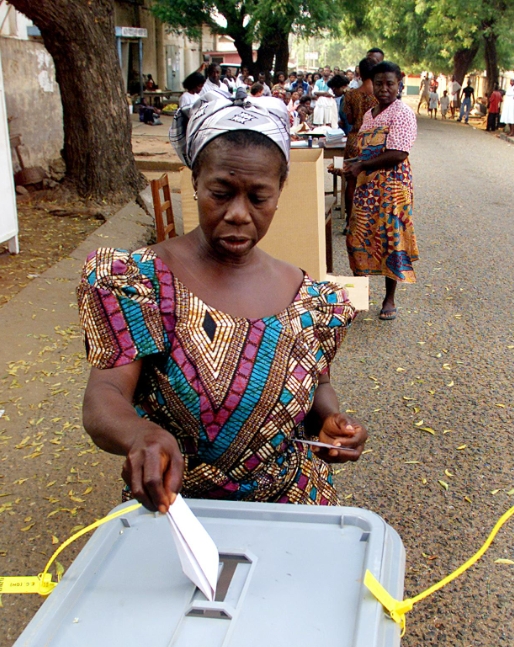
With the forthcoming elections in Ghana less than a month away, Cameron Duodu examines if “extremist rhetoric” and allegations of corruption are doing more harm than good to the country’s stable democratic process, which is often used as benchmark of democracy in Africa.
The word “crucial” has been so often used in connection with elections in Ghana in the recent past that it has become devalued of meaning. As every election looms in the country, soothsayers never cease to predict that if the result does not favour one side or the other, the country will stand in danger of being blown apart. When constitutional rule was first mooted in the early 1990s, it was assumed that the then Chairman of the PNDC (Provisional National Defence Council), Flight-Lieutenant Jerry Rawlings, would entrench himself in power with even more draconian laws, if his desire to translate himself from a military leader to a civilian president, was repudiated by the electorate. Then the opposition parties would become so fed up with the brutal military rule of Rawlings that they would resort to insurrectionary methods to try and oust him. Rawlings won the elections of 1992 and 1996, but there was no insurrection.
Nevertheless, the doomsayers did not relent in their efforts, and when Rawlings selected the late John Atta Mills to be the flag-bearer of his National Democratic Congress (NDC) for the 2000 elections, the voice of doom was heard again. Rawlings wanted to hide behind Mills and rule, despite the fact that he would have enjoyed a total of 19 years and three months at the helm of affairs in Ghana. Therefore, if Mills lost, it would be Rawlings who would lose face, and since he didn’t like losing face, he would find a military means of reversing the verdict of the electorate.
In the event, Mills lost – twice – and each time Rawlings feebly accepted the result of the election. Yet, each successive election has thrown out variations on the same theme. The result has been that Ghanaians, aware of the saying that ‘there’s no smoke without fire’ now routinely view elections with a great deal of apprehension. They are right to be suspicious: in the 2008 election, which Mills of the NDC won with a wafer-thin majority, there were rumours – confirmed by the outgoing President John Kufuor of the New Patriotic Party (NPP) in an interview with the London Financial Times, that some military personnel urged him not to accept the result of the Tain by-election that tilted the balance of the vote in favour of Mills against the NPP candidate, Nana Addo Dankwa Akufo Addo, after a runoff. Kufuor told the FT that if he had agreed to stay on, while election litigation began to take its course, “that would have been a coup.” Someone who worked closely with Kufuor has told me that Kufuor showed a great deal of statesmanship at that time, because the pressures put on him by his own party were enormous.
Despite having overcome such bitter disputes, however, the political scene in Ghana is still rampant with extremist rhetoric when election campaigns are mounted. In recent days, the most dangerous signposts for the December election have been erected by the National Organiser of the NDC. In a secretly taped address to NDC foot-soldiers, this party official revealed that he was working in cahoots with the Ministry of Finance and the security service to obtain training and security service identity cards for NDC party boys, who would be unleashed on constituencies to cause trouble and yet make it appear that those troubles were caused by the Opposition.
The tape has been played again and again on Ghana radio stations and it appears that, for the moment, the NDC plan has been scuttled. But what the tape reveals is that the NDC is desperate to use the advantage of incumbency to win the December election and retain power. Why? Because it has allowed itself to become exposed as the “lying party” and fears the electorate no longer has any trust in what it says. Only one example will suffice to substantiate the charge that the NDC lies as a matter of course. Most people knew that the late President Mills was not in good health and had been going to the United States to receive medical attention.
NDC: “The lying party”
On his return from his last visit to the US, poor President Mills was prevailed upon by his propagandists to carry out a ridiculous dance called “Azonto” on the tarmac of Kotoka airport, and in fact carry out a short attempt at jogging, to prove that he was not as sick as people claimed he was. Within days of carrying out this propaganda exercise, the poor man was dead. Even when he died, the “lying party” insisted that Mills had had a stroke, and it was left to ex-President Rawlings to tell the world, in an interview with the BBC recorded abroad, that Mills had died of a “cancer” that had moved from his throat to affect his eyes.
But the propaganda debacle may be the least important of the NDC’s troubles. Its other worry is over charges of alleged corruption that have been made, very strongly, against the party’s top people in government. No less a person than the party’s founder, Rawlings, has charged that the party is afraid to be defeated in the December election because of the massive “corruption” that has been rife within the NDC government. The party needs a “revolution,” Rawlings said. But was Rawlings, in saying this, merely trying to paint a new party formed by his spouse, Nana Konadu Agyemang Rawlings, as cleaner than the NDC and one that should therefore be voted for by NDC supporters, or was he seriously putting the NDC administration in the dock? In other words, was Rawlings playing party politics or carrying out a national obligation to expose corruption if he sees it anywhere?
What is incontrovertible is that the new party formed by Mrs Rawlings – the National Democratic Party (NDP) – has confused the broad mass of the NDC membership. At a delegates’ congress in Kumase in mid-October 2012, Mrs Rawlings was unanimously adopted as the flag-bearer of the new party. Who were these delegates? Were any of them at the Sunyani congress of the NDC in 2011 at which Mrs Rawlings was trounced by the late President Mills, garnering less than 4 per cent of the votes cast for the flag-bearer? Is the floating of the NDP merely a ploy by Mr and Mrs Rawlings to regain relevance within the NDC or do they really intend to use the party to actually oppose the NDC? There is no clear answer, for Rawlings, in particular, appears to be talking from two sides of his mouth at the same time.
On the one hand, he speaks well of the current NDC flag-bearer, Mr John Mahama, whom he describes as having brought “a new hope” into the NDC. But at the same time, he has unleashed a torrent of abuse on the very men who are helping Mahama to campaign effectively in order to win the election! According to Rawlings, these NDC stalwarts are devils and “dwarfs”, who are responsible for most of the alleged corruption in the NDC, and they must be cast out if the party is to regain the trust of the electorate. Evidence that the confusion within the NDC has filtered into the highest echelons is provided by a plaintive plea by Dr Tony Aidoo, one of the former advisers of Rawlings himself and now a so-called party elder, to President Mahama to name the individuals whom Rawlings had tagged as devil “dwarfs”. Otherwise, he, Dr Aidoo, might well be regarded as a member of the constellation of devil “dwarfs!”
It is not known whether other NDC “cadres” have made similar representations to President Mahama, but many are seething at the idea that just when the party needs to be reinvigorated to fight to achieve victory at the polls, Rawlings should be denouncing them to Mahama. Nor are they pleased that while Mahama may have appeased some of them in private, he has, so far, not offered any public defence of those manning his election campaign, against the accusations of Rawlings. The party’s financiers, who were no doubt in the sights of Rawlings when he made his spirited denunciation, need reassurance from Mahama, and quickly, too.
Yet when he did make a statement about the whole Rawlings issue, all that President Mahama said was that his campaign was going pretty well and he was unperturbed by the association of Rawlings with his wife’s party, the NDP. “I believe that our campaign is going well and that God is on our side and I believe that we are going to be victorious,” President Mahama said. He added that the NDC must respect the choices of the NDC founder (Rawlings) because Ghana’s 1992 Republican Constitution protects freedom of association: “We have as one of the cardinal principles in our constitution, freedom of association, and so people are free to belong to any party or associate themselves with any party they want. I don’t think that it’s a big deal. We must respect their human rights to associate with a new party if they want to.”
This statement will surely exasperate NDC cadres and make them lukewarm, if not apathetic, towards Mahama. Unless, of course, he has got them to disregard the Rawlings issue altogether. This may not be as strange as it sounds; indeed, the late President Mills had come to that self-same conclusion before he died – after years of enduring a tongue-lashing from his former boss.
However, the truce between Rawlings and Mahama, such as it is, may not outlast the election campaign. A new phenomenon has arisen whereby – in contrast to opposition to President Mahama’s soft-pedalling on the Rawlings issue – some NDC activists from Northern Ghana (where President Mahama hails from) appear to have spontaneously gleaned the fact that Rawlings doesn’t really want “their man” to win, and therefore, turned very aggressive towards him.
A good example of these verbal combatants is Alhaji Baturi Idrissu, managing editor of the Al-Hajj propaganda “newspaper”, who alleged on a radio station that he personally saved Rawlings from the consequences of an unspecified illegal act six years ago. If reckless individuals continue to target such barbs at Rawlings on behalf of Mahama and the NDC, then the last days of the election campaign could turn into a completely new ball game. For Rawlings usually gives as much as he takes, and the process of litigation in respect of defamation is so arduous in Ghana that propagandists can get away with murder, knowing that any potential punishment directed at them will be so irrelevant and insignificant in relation to the harm they might have done that they would simply not be bothered by it.
Of rumours and corruption
With the NDC in what appears to be self-destruct mode, it would be fair to assume that the NPP is having an easy ride. But that is not quite the case. There are persistent rumours that the “Ashanti faction” of the party, which has never managed to disguise its preference for Allan Kyerematen (“Allan Cash”) as the flag-bearer against the holder, Nana Akufo Addo, is not campaigning as enthusiastically for victory as it is capable of. Even ex-President Kufuor is tarred with the “Allan Cash” brush, though he has denied being biased. He has publicly professed that though he is still campaigning for Nana Addo.
Of course, those who circulate the rumours forget that the same rumours made the rounds in the 2008 election campaign, and yet Nana Addo did quite well in Ashanti, and that in the event, he was only beaten with a handful of votes by the late President Mills. So far, the NDC itself has not been able to fault Nana Addo very much, except to engage in nitpicking on sections of his manifesto, especially that which promises to make secondary education – or the senior high school system as it is now known – free of charge. The proposal is criticized on the grounds that it will be difficult to finance, and that it is a sign that Nana Addo wants to take the electorate for a ride by making wild promises that cannot be implemented.
He, on his part, maintains that his team has crunched the numbers and concluded that the free education system can not only be financed but is the only basis on which Ghana can enter the future with confidence that it will possess the skilled manpower necessary to achieve the accelerated development that the exploitation of the country’s petroleum resources has now made possible.
Socially, too, the education of all the potentially qualified entrants into the senior high school system is of paramount importance, as uneducated youths will swell the ranks of the unemployed and become the cannon fodder of politicians anxious to win power through violent methods and rabble-rousing. Where the NPP has failed to make maximum gains against the NDC is in the area of presenting an unassailable political discourse to the electorate. Obviously, it is easier for an opposition to attack a sitting government than the other way round. But even that advantage aside, the NDC has behaved in such a wantonly corrupt manner in several instances that it could be knocked down with a feather. Yet, the NPP has not managed to take full advantage of the situation.
The most notorious of these lapses is the practice of some NDC ministers secretly conniving with litigants against the state to settle incredibly weak cases out of court. Once such settlements were reached, they were presented to the courts where the litigation was mounted, and entered by the judges as agreed settlements. Thus, the settlements became transformed into “judgement debts” which the state was legally bound to honour.
The cases are of such notoriety that they tainted the late President Mills’ reputation badly, and the current president, Mr Mahama, has found it necessary to appoint a sole commissioner to look into all judgement debts against the state, in general. Although this modus operandi by the president has not short-circuited public denunciation of the judgment debts, the NPP has been mealy-mouthed about it. Not only that: a major plank of civil service praxis, inherited from the British colonialists, is never to appoint a commission unless one knows how it will report. In other words, Mahama may be seeking to circumvent the true import of the judgment debt imbroglio, in the same way that his Attorney-General’s office, has been pussyfooting over whom – and how – to prosecute those who appear to have conspired to benefit from judgement debts illegally. Indeed, it is an NDC former Attorney-General, Mr Martin Amidu, who has been spearheading the attacks on the judgement debt syndrome within the NDC administration, and not the opposition! What an opportunity the NPP has lost – and in an election year, too.
Another issue on which the NPP has not led debate in a clear and forthright manner is the proposal by the Electoral Commissioner, Dr Kwadwo Afari-Gyan, to create 45 new constituencies in which voting will take place in the December election. The electoral commissioner is empowered to create these constituencies if he so wishes, but for him to do so without regard to its effect on the other aspects of the political process, especially the looming election, is negligent, to say the least. What his intransigent action means is that the political parties will have to devote time, and resources, which they should be usefully deploying in carrying out their campaigns, to organise primaries to select candidates, and then ensure that the candidates are effectively presented to the electorate in the constituencies – all within the period of about ONE month!
Even the legislation governing the creation of the constituencies has been so hastily drawn up by the Electoral Commission that the legislative instrument concerned has failed twice to be accepted by parliament. Its eventual adoption was a most contentious issue over which the full house of parliament disagreed with its own committee on legislation – a largely unprecedented development in the parliamentary history of Ghana. All these high-handed actions have created the impression, logically enough, that the Electoral Commission may be attempting to carry out “gerrymandering” .
Yet apart from some strong objections raised by the former Minister of Finance, Mr Yaw Osafo Marfo, the NPP campaign has not mounted any strong opposition against the proposal to create 45 new constituencies. Indeed, ambitious NPP politicians are already battling to be adopted to fight for the seats. And who can blame them if their party does not oppose the idea?
In other words, both sides of the Ghanaian political divide have many short-comings which make it difficult for the electorate to convince itself that one side is unambiguously superior to the other – in terms of message, organisation and general public appeal. Yet, it is such intangible aspects of politics that victory or defeat is predicated upon in a democracy. Maybe the democratic process is still young in Ghana, though it has been going for two decades now, and is often used as a reference point for attempts at creating democracy in other African countries. Maybe too much is expected of, and from Ghana. That may be so, but it was from Ghana that the saying – made by Dr Emmanuel Kwegyir Aggrey – surfaced, namely: “Nothing but the best is good enough for the African.”








