
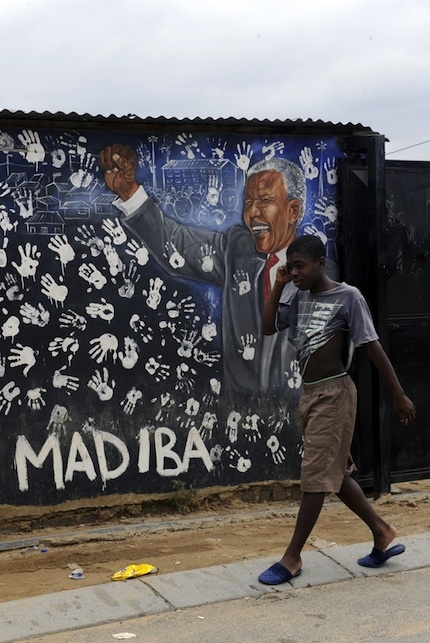
South African historian and political scientist, Dr Motsoko Pheko, who is also the former President of the Pan Africanist Congress of Azania (PAC), remembers a compatriot in the liberation struggle whom he describes as “a man who has lived his life for others, sometimes at the expense of his own people, in the quest to harmonise humanity.” But he proffers: “My disappointment is that I think the people with whom Mandela negotiated freedom in South Africa did not respond as they should have done. They wanted to have their cake and eat it.”
After my imprisonment for my anti-apartheid activities, I spent some years at the United Nations in New York and at the UN Commission on Human Rights in Geneva as an accredited Representative of the victims of apartheid and colonialism in South Africa. One of my many duties was to call for the release of all political prisoners in South Africa and expose the barbarism of apartheid colonialism. Some of these prisoners were Nelson Mandela, Robert Mangaliso Sobukwe, Zephania Mothopeng, Walter Sisulu, Nyati Pokela, Govan Mbeki and Jafta Masemola.
When I spoke in parliament on President Nelson Mandela’s 90th birthday, I said, “It is an extraordinary birthday of a man who has lived his life for others, sometimes at the expense of his own people, in the quest to harmonise humanity.”
The day President Nelson Mandela departed from this planet on 5 December, I was commemorating the birthday of another political stalwart and anti-apartheid hero, founding president of the PAC, Professor Mangaliso Robert Sobukwe, for whom the apartheid colonialist regime had a special draconian law called the Sobukwe Clause. This law enabled the regime to imprison him on Robben Island without even a mock court trial. The Sobukwe Clause, which fell under the General Law Amendment Act (no. 37 of 1963) was passed to allow the Minister of Justice to liberally use his discretion to renew Sobukwe’s imprisonment annually. This went on for three years and Sobukwe was the only one imprisoned under this clause. In 1969 he was put under house arrest in his home in Galeshewe, Kimberley, until his death. On the passing of President Mandela, therefore, memories of how far South Africa has come flashed back and forth.
Indeed, some of the qualities I admired about President Mandela were his humour, tolerance and perseverance in struggle. I believe diligence as well. He was a hard-working person. My disappointment is that I think the people with whom he negotiated freedom in South Africa did not respond as they should have done. They wanted to have their cake and eat it. They took the magnanimity of the colonially land-robbed South Africans for political imbecility.
Through the Native Land Act 1913, the British colonial government allocated the then five million Africans only 7 per cent of their land and gave its European colonial settlers numbering 387,349 people – 93 per cent of the African country. This law is now disguised as “abolished” in Section 25(7) of the “New South African” constitution. The Native Trust Land Act 1936 added a mere 6 per cent of land to make it 13 per cent for Africans.
The freedom fighters of this country, especially those who belonged to the military wings of the Pan Africanist Congress (the Azanian People’s Liberation Army) and to the African National Congress (Umkhonto Wesizwe) were imprisoned after being paraded before the “Truth and Reconciliation Commission” (TRC) with the perpetrators of apartheid. Many, like Kenny Motsamai, are still in jail. This is despite the International Convention on the Suppression and Punishment of the Crime of Apartheid, through which the United Nations declared apartheid a crime against humanity. This now passes as a “miracle” and “rainbow nation”.
The consequences of the wrong political response to the statesmanship of President Mandela by the representatives of the apartheid colonialist regime are that in South Africa today, there are “two nations”. One is the extremely rich and white settler minority. Another one is extremely poor, at 79.2 per cent, the African majority.
Mandela’s greatest contribution is that he tried his best to secure a prosperous and happy future for everyone in South Africa, but greed on the part of the forces of apartheid, backed by the West, meant that the golden opportunity that President Mandela gave them was not used. They did not respond to the South African political situation on equally magnanimous terms and in the spirit of justice. The victims of apartheid gave far more to “reconciliation” than the perpetrators of colonialism and apartheid did. Many questions have been raised.
Why did Mandela have to share the Nobel Peace Prize with an apartheid leader, F. W. de Klerk? Was it reconciliation to associate Nelson Mandela with Rhodes University, a creation of that British imperialist agent, Cecil Rhodes? Mandela-Rhodes University is an appeasement of Western imperialism and a condoning of the crime of apartheid colonialism. It is the undermining of African intelligence in the extreme.The passing on of Nelson Mandela represents a serious challenge for South Africa. Its people must rise to the occasion and ensure that there is equitable redistribution of land and its resources according to the population. The Marikana massacre of African workers has already sent a signal that something urgent must be done to hasten the economic and social emancipation of the African majority in South Africa for the good of everyone.
No African people should be made to live like slaves in their own country, under any circumstances. The poverty, the filthy inhuman shacks in which millions still live in South Africa must go. This in a country that is four times the size of Britain and Northern Ireland combined and so rich in natural resources.
Indeed, liberation without repossession of land and its resources by the dispossessed is a gigantic colonial fraud. The effects of the 1884-1885 Berlin Conference must be banished from the shores of Africa.
Perhaps, now that the greedy ones missed the “Mandela magic”, the words of James Russell Lowell are apposite, when he wrote in his poem The Present Crisis, “Truth [is] forever on the scaffold, Wrong forever on the throne, – / yet that scaffold sways the future and, behind the dim unknown, / stands God within the shadow of keeping watch above His people.”
Madiba, you did your share. You have shown the light. Let all the people of the world who cherish human freedom regardless of race, nationality and class, walk in this light from Africa.
Farewell Madiba! Greet Sobukwe, Sisulu, Lembede and all the African heroes of Africa’s total liberation. Remember Kwame Nkrumah, Patrice Lumumba, Marcus Garvey and Malcolm X.








