If you are not ill, don’t drink medicine prepared for someone who is ill, for even your mother might upbraid you for being too “huuhuu” (too forward) when you start to throw up. It happened to me.
A friend who lives in Texas has the same musical tastes as myself. He loves Dexter Gordon and a few of my own jazz heroes. Yet he calls himself “Obosomfuor”, which means fetish priest. It is indeed brave for an “educated” person to give himself such a name, for unless your mind is very advanced, you will fall in line with group-think and consider “fetish priests” as backward people who dress themselves in frightening garb and use horrifying means to brainwash and prey on the gullible people in our society.
Group-think? Yes, it affects most of us who call ourselves “educated” people. Most of us went to mission schools or schools based on missionary education. So we think it is clever to make fun of “fetish priests”, while accepting the practices of other religions as sacrosanct. We concentrate on the superficial elements in our indigenous religions – especially where these religions rely on things alleged to contain magical powers – without giving a thought to other more important elements in those religions that flash before our eyes but which we do not, or prefer not, to see.
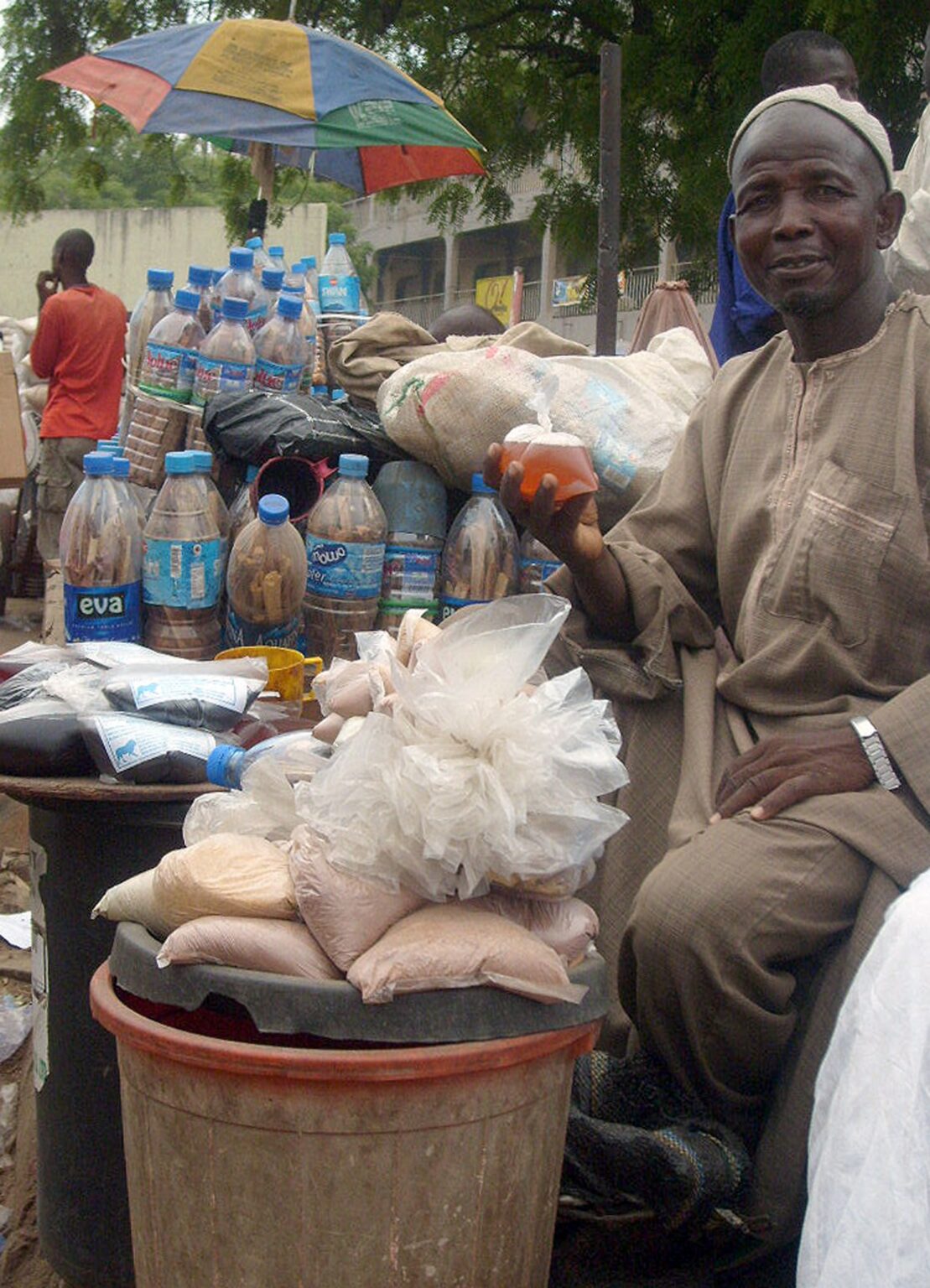
For instance, most of the “fetish priests” we despise use magic only to augment a solid knowledge of the particular properties of pharmacologically-rich plants, which they use to cure diseases. My own father was not a priest, but he taught us what plants were good for curing the diseases that troubled us in childhood. We got conjunctivitis during the Harmattan season each year. No sweat – a bunch of leaves was put into a clean cloth and squeezed. The liquid from the leaves was then dropped into each eye in turn. By the next morning, our eyes were completely healed.
He also taught us how to cure sores and stomach-ache with the bark of trees as well as herbs and boiled leaves. His best achievement, however, was to “vaccinate” us against all kinds of diseases. He did this by mixing a heap of secret stuff (including gun-powder!) into a dry paste (mmotor), which was then inserted into our skin, after he had made a cut in it. Blood came, but it wasn’t so painful, for we knew he wouldn’t like to hurt us. Anyway, he rubbed the place with loving fingers, and that was enough to drive all pain away. I still bear a small scar on my cheek that reminds me of my father’s “vaccination” experiment.
Whether it was a scientifically effective practice or not, I survived all my childhood illnesses and am still here to tell you about it. Indeed, later, when I went to school, government health officials used to come and vaccinate us against smallpox and other diseases. With all their training, they left scars on my body about ten times as large as those left by my father’s cut. It tells you something, doesn’t it?
The best lesson I learnt from my father, however, was taught to me by accident. One day, a brother of his who was a professional herbalist who practised in Takoradi came to stay with us. His arrival meant we had nice chicken to eat almost every day, for whoever came to consult him brought a chicken, not only as a fee but to be used in foretelling whether treatment for the individual would be successful or not. If the chicken died, after its throat had been slit, with its stomach pointing upwards, it was a good sign. But if it expired facing downwards, it meant my uncle would have to work harder at curing the sick person.
To us, who only ate chicken at “important festivals” like Ohum, Odwira and Christmas, this sudden proliferation of chicken in our meals was extremely welcome. Now, whilst he was with us, an older brother of mine, Kwame, was taken ill. I accompanied the herbalist into the deep bush, and watched in fascination as he collected tree barks, herbs and roots which he put in a bucket that I carried. A glint of heavenly pleasure lit up his face whenever he recognised a particular plant he had been searching for. Sometimes, he even gave a yell of sheer delight. To me, the plants were all “bush”. But to him, they were a great source of life-giving medicines.
When we got back, he cooked them into a strong-smelling potion and then gave it to Kwame to drink. Kwame took just one sip of the medicine and immediately spat it out! Nothing anyone could say would make him drink any more of it. I was so annoyed at Kwame’s lack of appreciation for the enormous effort Papa Fori had put into trying to make him well that I offered to drink the medicine rather than let it go to waste! You see, I thought that if I, who was not sick, offered to drink the medicine, it would shame Kwame and make him drink it!
But ha – Kwame was made of sterner stuff. My psychological effort was wasted on him. He didn’t relent. I now had to put my throat (as it were) where my mouth was. If I didn’t drink the medicine, I would be taken for a brat who vainly boasted about things he could not do! My father would know I was full of hot air. And my uncle from Takoradi would change his opinion of me. I could not contemplate the shame I would suffer. So, I took hold of the cup of medicine. And I downed it in one gulp: gbunah! The drink pierced my throat as if I had swallowed one thousand well-sharpened needles. And as it went down, it hit my innards as if a bomb had been exploded inside me. I spewed it all out without ceremony. And I kept spewing. And spewing. I felt faint. I could feel consciousness fleeing from me. But the spasms I felt when I spewed didn’t stop being painful. To my astonishment, my father, instead of commending me for my bravery, was rather scornful about it. “If you are not ill, why drink medicine prepared for someone who is ill?” he asked. My mother was even more direct: “Ne huuhuu!”, she said, upbraiding me for being “too forward”.
Not even the herbalist offered me any comfort. I got the distinct impression from him that I had made him unpopular with my parents, because he had not stopped me from drinking the medicine that was not meant for me. Surely, he ought to have known it would make me sick instead, since I wasn’t ill? I was unable to enjoy the chicken soup that was offered me when I got better. For it wasn’t only a physical illness that had taken hold of me. It was a sickness of the spirit, brought about by the realisation that I was just a vain young fool who would do stupid things if I thought they would bring me praise.
Now, back to my friend in Texas. The other day, out of the blue, he sent me, over the internet, a record of the brass band from my home-town – the Asiakwa Brass Band. He also attached a photograph on the record sleeve showing the bandsmen. Unfortunately, the photo is so fuzzy that I can only recognise two of them, Yaw Kwaakye (trumpeter) and one other guy whose face I know but whose name escapes me.
The photo and the music sent me back many years through time. For I saw the birth of the brass band. It came into being in the late 1940s when many of the Asiakwa men who had fought in the Second World War had returned home and there was very little for them to do to entertain themselves. It was okay sitting at the palm wine bar to recount stories of the war. But it became boring, after all the stories from Burma or East Africa had been told.
Then someone got the idea that they should contribute money and form a brass band. They did, and managed to buy six or so instruments and a drum. They next “imported” a man who had once played in the “Gold Coast Police Band”. My father’s shop was right opposite where they practised – the Gyaasehen’s house.
The first song he taught them was – wait for it – God Save The King. As soon as they were able to master it, he took them on a route march, playing the song. They were a magnificent sight marching along, with their instructor ahead of them twirling his conductor’s baton, and occasionally rendering a piercing note of his own, on his cornet.
They later improvised a fantastic hi-life song which didn’t have a name! It was good, however, and we named it for them as “wam-paa-la-laa”. You couldn’t hear it without being moved to dance. It could last an hour, non-stop. This song made the band very popular in the area, but I was amazed to find them officiating, one day in 1974, when I went to Odumase-Krobo to attend the funeral of the artist and sculptor, Vincent Akwete Kofi. The last time I heard them play was, sadly, at my own mother’s funeral, some 15 years ago.
And now, Obosomfuor has sent me their music. I wish the Arts Council of Ghana could support brass bands of that type to survive. Many are simply rotting in a lot of villages and towns.