Many might consider it too early to put the terrible end of Muammar Al Gathafi into meaningful context, including what it means for Africa. But that isn’t what I think, not by a long chalk!
I have been invited by Baffour Ankomah, editor of New African magazine, to write for its Lest We Forget column. An almost new writer for the New African! This sounds fun.
Many, many years ago I did write an article or two for this publication, one of them on “new” Africans going about their cosmopolitan business, slim attaché cases at the ready, called “No Problem in Uganda”. The editor then was Alan Rake.
Lest We Forget is such a nostalgic sounding title which is one reason I took up Baffour’s invitation as if there was no tomorrow. We in the “new” nations tend to forget too quickly, or not to be aware, of the umbilical cord connecting yesteryear to what happens today. As one who has been around for less than a year short of three-quarters of a century, it perhaps comes naturally to look back with a fitful degree of contentment on a varied life lived.
I also have a long-held ambition: that in whatever I do, I should, in however small a way, help to foster the realisation that Africans and those of African descent (what used to be called People of Colour, as if others were without!) are full members of the Human Race. As is well-known, not everyone on earth agrees!
Somalia
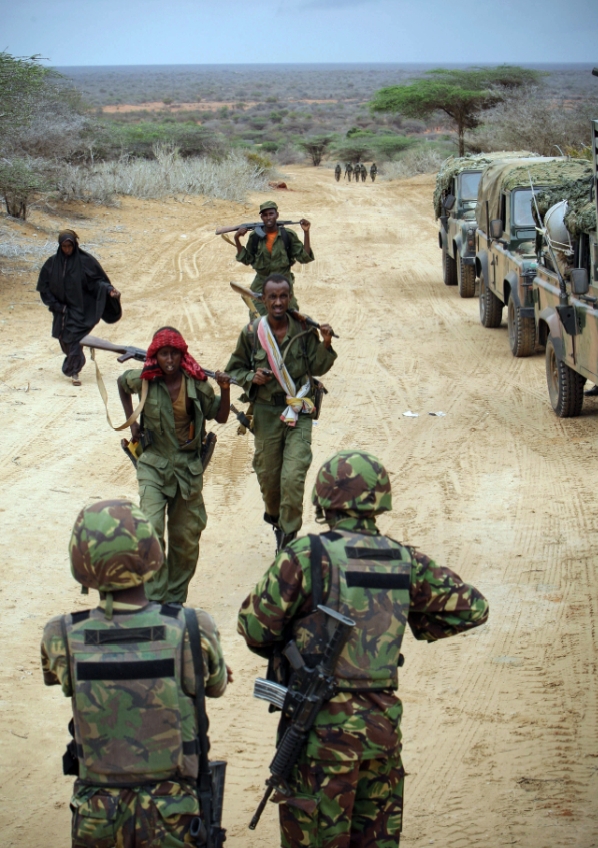
In the middle of August 2012 four helicopters of the Uganda People’s Defence Forces (UPDF) set off for the Somali warzone where first Uganda (in 2007) then Burundi (2008) and afterwards Kenya (2010) had gone to answer the African Union’s call to try keeping the peace through AMISOM (African Union Mission to Somalia). Many other African countries promised to do the same, but to date haven’t shown up. Kenya only turned up, late in the day, to forestall further attacks by Al-Shabaab on Kenyan soil.
One of the four helicopters made it safely to its destination. The other three did not, crashing into Mount Kenya, one of them burning out, even the other two rendered unrecoverable. Altogether seven airmen died. Such have proved to be some of the more extreme hazards of African nations going to the aid of others. What exactly happened is the subject of a Commission of Inquiry set up in Uganda, and headed by President Yoweri Museveni’s younger brother, Gen Salim Saleh (his nom de guerre) who for long stretches of time was de facto leader on the ground of Uganda’s so-called Bush War (1980-86).
The AU had resolved in early 2007 to send African troops to “keep the peace in Somalia”, an interesting concept, but including the understanding that “if attacked you can fight back aggressively”. Most African nations were receptive to the idea of helping Somalia, but in the event only Uganda and Burundi sent troops, later being joined by Kenya which went to Somalia with much greater military material than the other two, including planes, determined to wipe out Al-Shabaab once and for all, probably a difficult goal.
Uganda’s President Yoweri Kaguta Museveni had expressed great regret that, in 1994, he was not in a position to go to Rwanda’s aid during the terrible genocide, in which around 800,000 perished, with no help from the outside world. He swore this would never happen again and Somalia offered a strong opportunity for keeping this promise. Many Ugandans, apprehensive about their country’s involvement, had their fears confirmed when in 2010 seventy were killed in Kampala while watching the FIFA World Cup on television by bombs planted by Al-Shabaab.
The setting up of AMISOM, first mooted by the AU in January 2007 and soon mandated by the UN Security Council, was a new enterprise for East Africa, although in West Africa there had been at least two such bodies: ECOWAS (Economic Community of West African States, 1981) and ECOMOG (Economic Community of West African States Monitoring Group, 1990).
Any setting up of AMISOM had come under attack by the Union of Islamic Courts, then ruling Somalia, which warned against peacekeepers, calling them hostile forces. It was in the same spirit of assisting each other that some African nations allowed the training of ANC combatants against apartheid-ridden South Africa in their own countries, a huge support for the ANC.
Right from the early 60s Nkrumah and other African leaders and populations had cherished the unification of Africa. Some, like Al Gathafi of Libya, went as far as advocating a United States of Africa (probably in his mind with himself as president!).
But a more practical idea was to go for a number of regional groupings, each of these dealing with the others, ultimately uniting the whole African continent.
As far as Uganda is concerned, being in Somalia has brought about two advantageous fallouts to itself, of which Museveni might not have been oblivious! One is that Uganda today is the hub of regional peacekeeping. The other is that its forces are now thoroughly adept at urban peace control.
In 1985, when from London I visited the Bush War, I came across a keen young commander, Ivan Koreta. Today Lt Gen Koreta, deputy chief of the UPDF, is very sure about these gains. “Our president deserves all the praise for the swiftness with which we went to the aid of our Somali brothers and sisters. And of course a peaceful Somalia is also good for our own security since weaponry from there won’t end up in Uganda,” the genial, heavily moustached soldier told me.
Libya
Many might consider it too early to put the terrible end of Muammar Al Gathafi into meaningful context, including what it means for Africa. But that is not what I think, not by a long chalk! True it only happened a year ago, on 20 October.
But sober reflection on the Libyan leader’s death, both on what happened and as a metaphor, will serve to warn our continent that what happened to Gathafi (incidentally the single most crucial individual in the making of Libya into a unit, from 40-odd years earlier) can happen to any of our leaders. The stark message boils down to: Africa beware!
Of course, arguably the seeds of our own destruction lie in our own stars. And it is also true that Gathafi’s character was capable of putting off even those who admired his achievements, above all: his outstanding part in making Libya a cohesive nation from disparate tribes, each roaming in its own territory. Anyone who doubts the validity of this, only needs to watch Libya as, God forbid, it disintegrates back into its disparate parts. Does Gathafi’s ghost wear a rueful look of “I told you so”? Or does it break into weeping, at seeing the death of a vision?
You do not have to be a total Gathafi admirer to stand aghast at the reduction of a nation into its myriad parts, and with those who brought it about (smaller in vision than the man destroyed) walking the streets of their mostly foreign cities as if nothing much had happened. The nursery rhyme comes unbidden to mind: “Humpty Dumpty sat on a wall/ Humpty Dumpty had a great fall/ All the king’s horses and all the king’s men/ Couldn’t put Humpty together again.”
Of course the irony about “the king’s horses and the king’s men” isn’t lost: that Gathafi was up to the mischief of glorifying kings in other countries but his own, and had nearly half a century before removed King Idris off the Libyan throne. (What goes round comes round!)
The mindless (I am not sure “mind” is the right word!) bombing of parts of Libya, like a naughty child, or a madman, smashing all around him without a second thought, will never be forgotten by all who saw it from the comfort of their own homes. Who, pray, gave the bombers the right? “Might is right?” (Is it true that one of them, the most vociferous indeed, had been lent nearly $50m for his re-election by the man he killed? Was this his way of liquidating the debt?).
The cruelest part, T S Eliot’s April, is that the “winners” of the war, “plunderers” is a better word, are now the ones to decide when and if funds should be availed to mend the broken bits. And from where do these funds emanate? From oil gushing out of Libyan soil, dummy! The AU, rather late in the day admittedly, cried out for a different solution. It was met with a resounding silence from the skies above! If Africa, if the Africans, care to make sure that they are full members of the human race, they have willy-nilly to make sure that they are united in a common cause.
Otherwise they will continue to be picked off one by one, and swallowed whole, the swallowers not even belching, seemingly so small the meal!
Before Somalia finally imploded like a snake swallowing its own tail, it took the courage of one or two Africans to go to its aid. President Museveni of Uganda was a principal one in the case. He can certainly be questioned on some issues, but assuredly not on this one. But Somalia is where we came in.