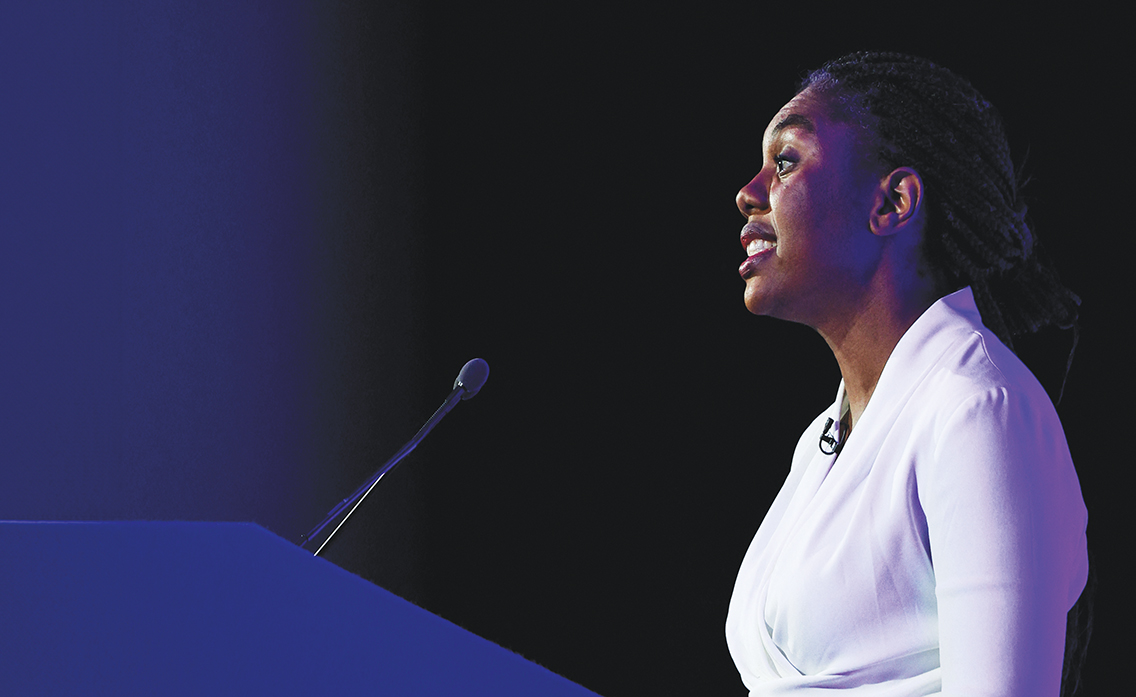
What a start to a year that has to be different! Whatever happens, 2025 will be an African year. An African, Kemi Badenoch, sits on the same benches in Parliament as those from which Benjamin Disraeli and Sir Winston Churchill oversaw the affairs of the British Empire in its grandeur, and where Harold Macmillan mused on the speech he would deliver on the “wind of change blowing through the continent of Africa”. That is the bench of the leader of the Conservative Party.
It is the same bench to which Enoch Powell, who preached about the “rivers of blood” which would flow as a consequence of extended “black immigration”, also aspired. Do you feel, as Shakespeare once observed, “the time is out of joint”? Not if you observe also that the mother of one of Badenoch’s closest challengers for the post, James Cleverley, comes from Sierra Leone.
Olukemi (Kemi) Olufunto Adegoke, who later married Hamish Badenoch, was born on 2 January 1980 to Nigerian parents in Wimbledon, south-west London. However, she spent much of her childhood in the US and Nigeria. Having returned to the UK aged 16 years, Kemi achieved a computer programming degree at the University of Sussex. She made her early career in banking – working for a time with the “posh people’s bank” Coutts. Her spell as digital director of the right-wing magazine The Spectator showed the way her life and political views were developing and drew her to the attention of people who would be helpful to her in her subsequent career in the Conservative Party, which she joined at 25.
Badenoch made her name initially as a member of the London Assembly and as an early supporter of Brexit when such views were less popular in political quarters than they became later. In 2017, the year after the Brexit referendum, she became MP for North West Essex, a county associated with robust Conservatism.
Kemi handled several offices of state competently and, respected rather than liked, steered a steady course through the tumultuous and sometimes chaotic years of the Boris Johnson, Liz Truss and Rishi Sunak premierships. Consequently, she was well-placed to come through to win when her rivals faltered.
Kemi’s confrontational aspect has not been seen as the drawback one would have expected. It is said that if she were alone in a room she would start an argument with herself. Perhaps that may not be such a bad thing for somebody who has been likened – and may liken herself – to Mrs Thatcher, whose persona still casts a potent spell over the Conservative Party she led to three Parliamentary election victories.
Badenoch, however, will have to seek far for opponents of the calibre of the Argentinian generals (in the Falkland Islands conflict of 1982) or the fractious miners against whom her predecessor directed the national confrontation to her own advantage.
The new Conservative leader may well be judged by the quality of the opponents she chooses to fight as much as anything her party may plan, propose and perform. Either way I cannot see her allowing Nigel Farage, the publicity-hungry demagogue who now leads the Reform UK party, to boss the future of the right-wing in UK politics.
Reparations move centre-stage
The concept of demanding that reparations should be made for slavery, and all that involves, has been around for some time. Yet, this year it is centre-stage. The accession of King Charles III has been a step in this direction. In spite of him being heir to great wealth created in a good part through slavery, the king’s more liberal attitude, such as he understands it, appears to be genuine enough.
He may not do much positively – tradition and the unwritten constitution would not allow it – but he could facilitate the endeavours of those who can. The fact that Charles III is said to be prepared to let Australia become a republic, if that country chooses to do so, seems to show an earnestness of intent. He will be guided by his Ministers and a record number of African and Caribbean parliamentarians were elected last July. They will all have the King’s ear and could push the agenda forward rapidly.
David Lammy, as Foreign Secretary, holds one of the highest offices of state. Like several prominent Caribbean people in national life, he comes from a Guyanese background whose forebears were enslaved. Although, since becoming a member of the government, he seems to be back-sliding on his former firm advocacy of the payment of reparations, Lammy cannot shake off his reputation as being a tribune of the people.
For a start, I don’t think his North London constituency would let him. He is the successor of Bernie Grant, one of the first three Black MPs to be elected to Parliament, and a vigorous campaigner for community rights. That community now has a voice as the highest table in the land – and he should use it.
Reparations, on the other hand, could be the very battleground on which Badenoch will make her stand against the likes of Lammy and other progressives. She is probably the country’s best-known ‘culture warrior’. Whether by accident or design, she seems to have come out on the opposite side of almost every cultural issue which the majority of Africans, West Indians and liberals hold dear.
Just as the boxing establishment once yearned for a ‘White hope’ to dethrone controversial Black world heavyweight champion Jack Johnson, circa 1908–15, so, it seems, the Conservative political establishment looks to Badenoch as the ‘Black hope’ to put general Black aspirations ‘in their place’. That is the place they occupied under the ancien regime. Interesting times lie ahead – expect no-holds-barred punch-ups in the UK Parliament.
UK needs Commonwealth more than ever
The selection of Shirley Ayorkor Botchwey as the new Commonwealth Secretary-General has sneaked under the news radar, except to the minority who take the international news seriously.
Yet it is an event which could shake up more than just the diplomatic status quo. One of her predecessors, Sir Shridath ‘Sonny’ Ramphal, who passed away only a few months ago, showed what could be done in that position. It is a far bigger and more significant playing-field now.
Whatever mess the UK has got itself into over Brexit, this is the age of international ‘blocks’ – just look how European countries have flocked to join NATO in the presumed predatory shadow of the Russian Bear. There is said to be safety in numbers – and there is wisdom as well.
The UK wants to be a big puncher on the international stage, as new leader Keir Starmer has said often, and I am afraid it will do something stupid to try to prove it. However, the British cannot act successfully alone: they need to have friends and allies, and those options are running out quickly.
The EU won’t trust them for a long time yet, and the acclaimed special relationship with the US is no longer significant in even one dimension, and Trump is likely to demand his pound of flesh, further weakening the UK’s bargaining power. Rushing to the NATO beat will get the country into a lot of trouble.
The UK needs the Commonwealth, and needs it at the same time as the links through the Commonwealth Games seem to have become irretrievably strained. That is another reason why the reparations for slavery may come to the foreground, whether wanted or not.
The new Secretary-General is Ghanaian, and Ghanaians are forcing the pace in many aspects of our national life. I’m impressed by their vigour and sense of direction.
In spite of the now recognised Windrush pioneering spirit, the West Indian constituency has had much of its self-confidence dented, for which there are very good reasons. Just look at UK Black History Month celebrations. West Indians look back on the history they have endured and overcome, whereas, although proud of their own tradition, Africans are intent on making their own history here and now.
That is an energy and vision which the entire nation needs to demonstrate. London has shown much of that vibrancy but much of the hinterland appears to be “another country”. Dean Acheson, one-time US Secretary of State, said in 1962: “Great Britain has lost an empire but not yet found a role.” Perhaps it will find the latter when it has started to deal with the consequences from the former.
The future looks to be exciting, it always does, but the future turns quickly into the present with its challenges, and to the past with accompanying disillusion and regret. It seems that in the short-term, all hopes are bound to fail or they have to be compromised to achieve a modicum of acceptance.
It doesn’t have to be that way. Please, take the longer view. Things were very different in recent yesteryear. Even 12 months ago, let alone three or four years, could anybody have foreseen a Black woman – an African, at that – as the Leader of His Majesty’s Loyal Opposition; that the reparations for slavery would get a hearing at such a high level; and the heads of nations in five continents deferring to an African as Secretary-General of the Commonwealth? The year, the future, is what we make it.
Choose, think and act well.