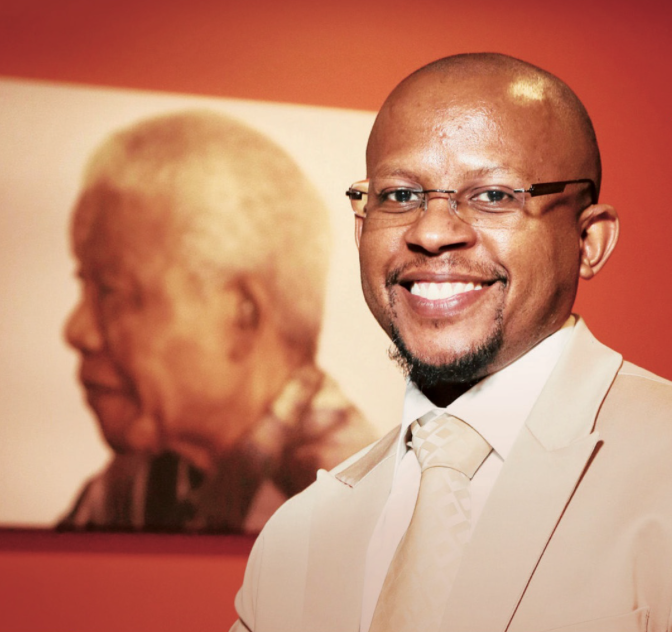
Pusch Commey interviews Sello Hatang, CEO of the Nelson Mandela Foundation
In a nutshell, what is the work of the Nelson Mandela Foundation and its role since Madiba’s death?
It is a post-presidential office initiative. It was founded by Mandela himself in 1999 after he had left public office. Our mandate from the great man was to help change the world and the lives of the vulnerable in any which way we could. He was then looking at building schools, clinics, preventing and curing HIV/Aids, etc. Then in 2007 the mandate was changed; and again in 2009.
At the moment we are looking at three things: Mandela Day, declared by the UN as a day for humanitarian work; critical dialogues on every intractable issue, predominantly in South Africa but also around the world – especially post-conflict issues; and the memory work: private papers bequeathed to the foundation to share Mandela’s legacy with the rest of the world.
What are some of the themes and highlights of the centenary celebrations?
There are three themes: ‘Find the Madiba in you’, meaning, let us just be good people; build a value-based society; and ‘Be the legacy’. If we were to follow these, we would be half-way to being victorious as a whole. And this would help shape how our children would see the next century, while we focus on fighting poverty and inequality.
There are many other initiatives. For example, eradicating pit latrines as well as supporting early childhood development centres. These should become part of the ‘unpoisoning’ of the future. Children who are not in a stimulating environment have a poisoned future.
We are also involved in something as basic as providing sanitary towels for girl-children. It is a question of dignity.
There is the ‘climbing Kilimanjaro’ motivational project. Then there is the pertinent issue of eradicating systemic racism. We should not simply look at the symptoms, but the causes as well.
It is something we have to work against, and part of our mandate at the Foundation. We have to make sure our country is forever united, otherwise we are on the road to nowhere.
What about justice in South Africa especially social justice?
It is the core of most of the work we do at the Nelson Mandela Foundation. As long as most children are in a dead end, a crushing environment where 25% of children go to bed hungry, there can never be justice.
What is your view on the racial faultlines of economic and social injustice, that Madiba was so concerned about?
When retired US Ambassador Thomas Pickering visited us, we took him to the slums of Alexandria. He was aghast when he saw the levels of poverty there. He could not sleep easy. Meanwhile the next-door neighbour Sandton is the citadel of opulence. We noted that as long as this is not resolved, we will not have peace.
When you think of economic growth, and there is growth, that growth does not extend to black people. How that wealth benefits black people too is the issue of the day.
We hosted the statistician general to explain why we were unsettled by the state of the country. For example, relatively few blacks go to university according to the statistics, but even then, most of them fall by the wayside because of economic challenges. That is disconcerting.
So what then is your opinion of the economic vision of Mandela that people are complaining about?
We can’t still be moaning about what could have been. Is it a reflection of lack of vision and imagination? It does not help to be arguing for a better past. How we see the way forward is the most important issue of the day. We should be debating a better economic future, not a better economic past. What about the cancer of economic inequality and the land question, which has become a sore point in the evaluation of Madiba’s legacy? It is the duty of all of us to respond to that call of justice. It is not charity to do so. This calls for sacrifice from each and every one, especially the beneficiaries of injustice. The land issue is just one of a myriad issues. Madiba could not do it alone, and he understood that. Neither did he have the luxury of time. What we know is that he set the stage for redress, and took a back seat. Equality was his guiding vision. So should it be with all of us.
What is the state of reconciliation in South Africa? What can Mandela’s general vision do for the future?
One of his memorable sayings was about the importance of words. What he learnt during 27 years in prison was that words can build or destroy. He spoke about the importance of listening; and compassion. To always fight for the vulnerable. He lived it.
The state of reconciliation is suffering quite a bit. We should be doing more to have a more cohesive country.
What has been your personal experience of racism in South Africa?
Long ago, I may have been about 10 years old, I was walking with my broth brother when two white kids yelled the ‘K’ word at us. It is the equivalent of the ‘N’ word. My brother just said ‘keep walking’. And I did. I just became invisible.
It was later that my brother explained to me what that meant. It leaves a wound that lives, but the important thing is not to be paralysed by it; to overcome. Then you begin to think that it should never happen to any other child. That is what our Atlantic programme is about. Systemic racism is a terrible disease. It does not care about age, and it can manifest itself anywhere.
Recently, there has been a buzz about making history compulsory in schools. In the context of Nelson
Mandela’s legacy, what are your thoughts?
It is very important. The lack of knowledge of history is part of the problem in South Africa; so we engage in slogans and chase ghosts. An example of what a country can become when we are a-historical is the debate around Nelson Mandela’s economic legacy. We lack context. We have had some kids come here to speak negatively about Madiba. And when you ask them for cogent reasons and a comparative view, they have no intelligent response. Had they studied history, they would have been able to engage in a better debate.
Is the issue of history part of your programme?
Yes, we have a programme for Fellows to deal with history and the problem of racism, called Atlantic Fellows for Racial Equity. Within a historical context, we have a programme for schools and how to handle racism, etc. You have been CEO for quite a while. What would you say is your most memorable moment? I have been in the post about five years. Etched in my memory is when a student of the University of Johannesburg, Palesa Madiba, went missing. Her family could not find her. Then I got a call for assistance.
We marshalled the resources of the foundation, the public and Mama Winnie Madikizela-Mandela to rally the country to help find her. It was a most poignant moment trying to help a family in distress. The power of the name I represent came into play and it worked.
Hosting people like Barack Obamah here at the Foundation, has also made for very special moments.
What was your biggest takeaway from that encounter?
His humility, just like Madiba. He was comfortable in his own skin. He made you feel at home and made you really feel comfortable. He was still the President of the US then, in 2013, but did not walk around with airs. This is what we can learn from the greats – retaining a sense of self that does not look down on others. Both Madiba and Obama exhibit these fine qualities. NA