
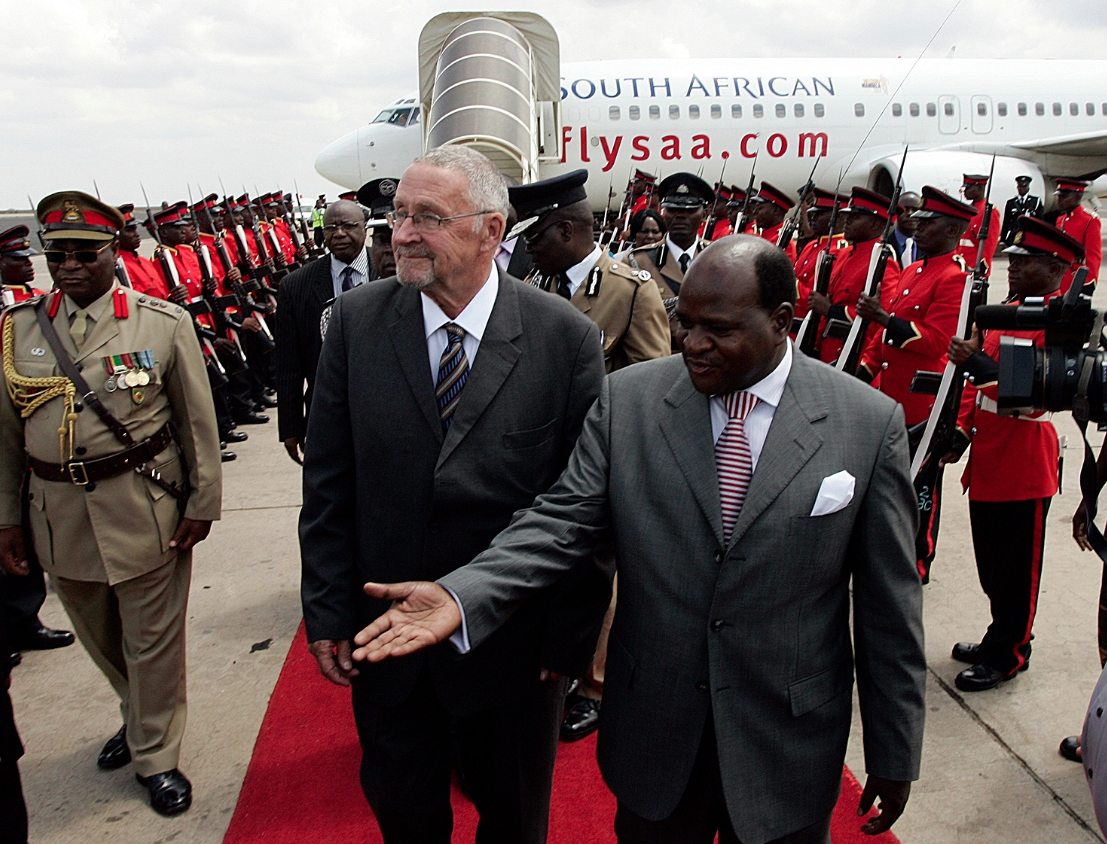
After his election victory in September 2011, President Michael Sata appointed Dr Guy Scott as his vice-president. Here, he talks about some of the issues and challenges the new administration has faced. Darren Moore interviewed him in Lusaka.
Q: It has been one year since the Patriotic Front took power in Zambia. What are some of the limitations and surprises that you have encountered since being in office?
A: I think the main limitation is that you come in as an outsider and you are an entirely new feature on the political landscape. For example, in Britain when there’s a general election, no matter how unlikely it may be that the opposition will take over from the government, everybody is briefed, everybody gets the same information and the civil servants are almost as much at the disposal of the opposition as they are at the disposal of the governing party, so there are minimum hiccups that you cross or encounter.
We had a very different situation. No one could have been really prepared. The system in Zambia works in such a way that no one is prepared for a change in government, it just came as a complete surprise. Then you had the problem of sorting out a lot of people in key positions, the permanent secretaries for example are there for reasons of nepotism, so you have issues of trust with the civil service even after you have taken over.
It’s almost a psychological phenomenon because we are kind of half way between a US and a British political system; it’s not always entirely clear whether you can change the top five levels of your government, as is the practice in the US, or whether the same professional civil servants at all levels carry on working with a new government. In practice, it’s a mixture as some of the permanent secretaries and directors must be changed quite quickly and replaced by “loyalists” while others are expected to adjust to the new leadership. Of course this uncertainty has very unsatisfactory consequences in many ways as some people think they may be dismissed quite soon so they need to make whatever money they can immediately, so it can create an unfortunate burst of corruption during this time.
Then, of course, there is the corruption that is not part of or caused by the election, but is part of the previous government and you have to start to root that out, and that is very difficult. It could be blamed partly on the constitution that is not clear but also on the previous administration which was in power for 20 years and believed that it was going to rule forever.
Q: In talking about the transitional process, do you think that you have reached a level that you are actually happy now within the process?
A: No I don’t think we are happy yet, but I think we have improved things a lot, and we are working much better with the current leadership.
Q: Arguably in the last election, your main power base emanated from the throngs of jobless young people who have been largely surplus to Zambia’s economic growth. What have been the current administration’s job creation strategies over the last year?
A: I think the votes of the young unemployed do not account for our majority. I mean they are a significant proportion of our support, but you would also be surprised at how many old, employed people there are in Zambia who simply wanted a change and said this country is not being properly governed, standards are too low, hospital hygiene is unsatisfactory, and schools have no books. So I believe we actually took a pretty good even demographic profile among the voters.
Q: Still pushing on the fact that President Sata ran on a platform of job creation, what is the strategy for creating more non-traditional jobs in Zambia?
A: I think you want to create low-cost jobs, that is really what you are after, and obviously for example, a cement factory doesn’t go anywhere near to creating enough employment. I think it costs something like half-a-million dollars a job, and that would take half of all China’s reserves just to fully employ Zambia.
So you’re looking for low capital-cost jobs and mining is not really one of them. However, servicing the mining industry does present opportunities, for example growing eucalyptus timber for pit props and so forth, and doing maintenance on peripherals such as pumps can also be quite labour intensive.
So we have started a project with the Zambian Association of Manufactures and the Zambian Chamber of Mines to get the local content back into the mining industry. So we are taking measures to increase local content in this capacity. In the areas of agriculture, we would like to boost the labour-intensive crops like cotton where we have a considerable comparative advantage and in fact are already distributing free seed, in parallel with what we do for maize and the provision of fertiliser. There are other cash crops such as coffee, tobacco and the like that can provide jobs.
Q: One of the promises of the Patriotic Front’s manifesto was to create a more participatory democracy through the creation of a new constitution within 90 days. How is that taking shape?
A: It’s on target. There is a committee that will take all the enquiries of the constitutional review commissions and go through the raw recommendation of the witnesses, and try and form a judgment from that as to what Zambians want rather than set up another commission, so that’s about to come out with a draft constitution which should reflect the will of Zambians. It should be out by the start of 2013 and then it will be setting in place an adoption process, but there should in principle be a referendum which will put the question about what they want.
Q: Without accusing the Zambian electorate of being naïve, would you say the average citizen has enough grassroots knowledge of the constitutional issues to engage in this process?
A: They actually have a lot of knowledge; there are a lot of non-government organisations doing public education in this area, some of them mischievously so, but others more altruistically I believe. The Catholic Church in particular, but not exclusively, has been involved in every constitutional crisis or change in Zambia since the mid 1950s, and they were a major pressure on the colonial government to get its act together, so you reach the question of fundamental citizen rights.
There is a school of thought that says that this should be justiciable, i.e. if you write in your constitution that everyone should have the right to three meals a day and can specify what that means, then you can actually take the government to court if these three meals a day are not met. Governments of course question how on earth you can enforce such pledges.
Then there are the legal issues of running mates for example, and things that would change the political dynamic, like having an elected running mate. Myself, I’m not a legal running mate, I’m just appointed and can be fired tomorrow, and clearly that prevents you from, for example, forming a coalition where, say, the Patriotic Front and the United Party for National Development (UPND) will come together, which was actually the deal we thought we were going to run with. But Hakainde Hichilema of the UPND wouldn’t accept the job of vice-president because he would have no security, whereas if the constitution says he has to be the running mate and get his own mandate, then he could have stuck to his guns like Joyce Banda in Malawi.
So these are some of the practical political considerations for the constitution.
Q: Not long after your appointment, you asserted that Zambia was now moving from a post-colonial to a cosmopolitan condition, as you were appointed to one of the highest offices of the land, even though you are of European descent. What has been your personal experience and role of representing Zambia on the national and international stage?
A: For a lot of people, it’s good news, race is not an issue here … it’s really not an issue here. People keep coming here and trying to do vox-pops on me and they can’t get any controversy going… that’s domestically.
Internationally, well, I think the Queen of England did a double take after I was introduced to her and shook her hand. She, maybe, thought she had misheard, I think. And I think even Prince Philip was so taken aback he couldn’t produce one of his classic quotes.
Q: But again would you also say that your appointment demonstrates a level of political maturity in post-colonial sub-Saharan Africa?
A: Once we had won, everybody who said we would never win had to change their minds. Yes, you have got all these funny twists and turns such as West Africans who don’t really understand Southern Africans that well. It is what it is… and shows how stupid and inaccurate race is as an indicator of anything. What are you hoping to assess by somebody’s colour? The only thing you will assess is their reflectivity, there is nothing behind it, and I think Zambians just realise that.








