
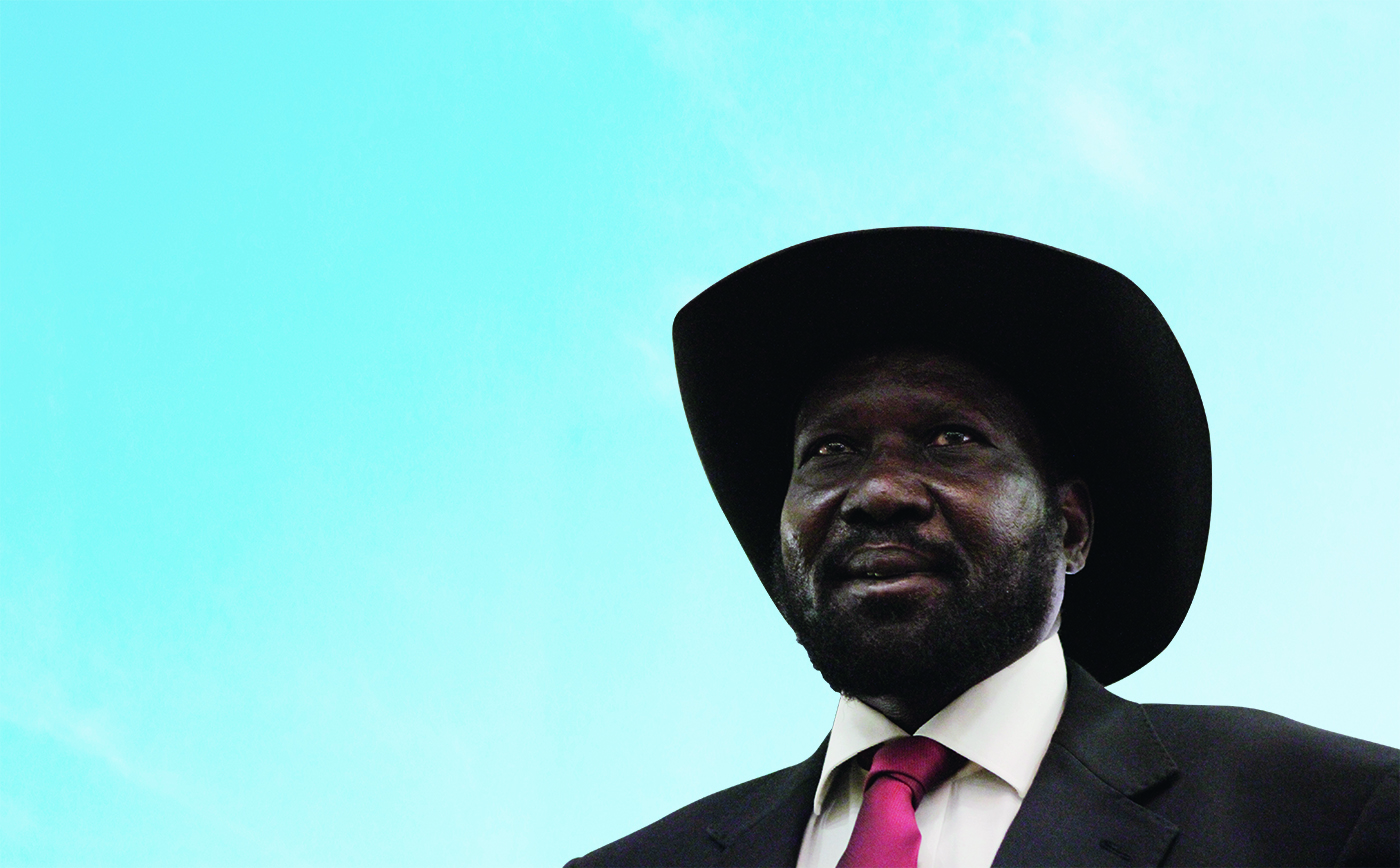
South Sudan’s president, Salva Kiir Mayardit desperately wants to return his country to peace, but he says the Americans are using the peace talks currently going on in Addis Ababa to put pressure on the East African regional grouping, IGAD, which is moderating the peace negotiations, to get him out of power. In a wide-ranging interview, the leader of Africa’s youngest country warned that if the mediators, including the Americans, do not want grudges and conflict to deepen in South Sudan, they should leave the current elected Parliament and the Executive untouched.
So when we gained our independence in July 2011, everybody expected something good for himself or herself. But it was difficult to deliver. So you cannot enjoy being in a position where you cannot deliver. You cannot really be happy as a head of state when people are living in bad conditions.
And, mind you, we have not really been free of war. There have been malicious attempts to destabilise us by the people we broke away from. They have been sending forces from time to time to cause havoc down here.
And we still have the problem of Abyei, which is unresolved up to now. And people are still dying. Unfortunately we have not demarcated our borders with our six neighbours and that is a timebomb because people are encroaching from here and there and you never know what will happen next. Plus our own local politics which has now resulted in another war.
The situation has been compounded even more by the fact that oil was discovered in Abyei. So Khartoum is now saying that the area where there is oil should be carved out from Abyei and given to them, and then they will allow the rest of Abyei to secede and join the South.
Yes, we did not inherit anything. In fact, before 2005 you would not have been able to go to Nimule. Going to Nimule at that time would have taken you the whole day. And if you happen to reach it, you would be very exhausted because of the bad state of the road.
So there were no roads when we came in. There were no hospitals, no schools, no pipe-borne water, no electricity, no functioning institutions, nothing. These buildings we are in now were not in this shape. We had to renovate them all.
In fact, our people found it difficult to accept this arrangement, but our late leader Dr John Garang said it had to be, if we had to be free. We were buying our independence. And that is how we did it during the interim period from 2005 to 2011. Yet in 2012 there were still clashes between North and South and we had to do more negotiations. This is why you are asking if we conceded too much to Khartoum. No we did not. We don’t think we conceded too much.
Khartoum knows that we don’t have an alternative pipeline to transport our oil. There is no other route than passing through Sudan. That made them intransigent. They would always rush in to shut down our oil production by blocking the pipeline.
I always tell my former president, Omar Bashir, that shutting down the oil is bad for both of us. “You get nothing if we don’t produce the oil, and you will suffer like us,” I tell him. He says “No, no, no. Your people are doing this and that, so we will shut down the pipeline.” But in the end they don’t, because we all know the consequences.
So they kept South Sudan as part of East Africa, and this is why they issued the “Closed District Ordinance”; that is, starting from the Nuba Mountains down, if you came from the North you had to have a passport to come to the South. And anybody going from the South to the North equally needed a passport. So we were ruled as two separate entities.
Now when the British left after independence, Khartoum did not really have time to change the status quo in South Sudan. Instead, the provocative actions that they were doing caused the mutiny of August 1955 by Southern troops who were in the national army. That is how the war of 1955 started. So Sudan gained independence in January 1956 with a burden of war already on its shoulders.
Unfortunately, the rulers in Khartoum did not think about subduing the South by means of development or peace, but by using military force to crush the rebellion. In the process, they forgot about development in the South. They did not build any roads, schools or hospitals. And the few that were there were occupied by the military as barracks.
So yes, it was a deliberate plan by Khartoum, and also partly by the British, to keep the South undeveloped. The British did it by using delaying tactics so that they could hold on to Sudan longer, but the Northerners convinced Southerners to help them kick out the white man, and after that, as they put it, “we will resolve our problems at home as brothers”. But this did not happen after independence.
So even after the signing of the CPA, those people who had been armed by the Khartoum government remained with their arms in their huts. Nobody disarmed them. And this became a source of insecurity in South Sudan. There were random killings in and around Juba by unknown people. And these are the people used by the old system to give the government in Juba no rest, so that we would be distracted from the path of development.
So I would not say we ignored the internal problems in South Sudan, but there were so many that sometimes they can overwhelm you. And we also needed to maintain external relationships with friendly countries. So we are doing a balancing act.
Now in 1991, Riek Machar, the same Riek Machar [his vice president who rebelled in December 2013, leading to the current crisis] rebelled against Dr John Garang who was then the leader of the Sudan People’s Liberation Movement and Army (SPLM/A).
Riek was in Nasir in Upper Nile State, which is very far away in the east on the Ethiopian border. He announced a coup from there and claimed to have taken over the SPLM/A. Dr Garang was in Torit, we were all there with him. We were supposed to hold a conference of the leadership of the Movement. Riek refused to come and decided to announce his own coup – a theoretical coup because you cannot overthrow somebody you have not arrested.
Now from Nasir, Riek started slaughtering all the Dinka officers who were under his command. He killed them and left the Nuer alone [Riek is a Nuer]. Later, he joined forces with Khartoum and was given arms to fight us. This was in 1991.
In 1992, Riek fought side by side with Khartoum forces against us, and as a result they were able to take all the towns and areas that we had under our control. We were around Juba at the time, and our forces used to stay at Jebel Kujur, the mountain on the outskirts of the town. But Riek Machar came from behind and stabbed us. This is how we could not take Juba in 1991.
Riek went on fighting against us until 1997 when we had regained our strength and were recapturing towns. He then went and surrendered finally to the Khartoum government and was made the assistant president of Sudan, not the vice president, but the assistant president. An assistant is something senior to an advisor but less than a vice president. That was the position given to him, and he was made chairman of the Southern states.
But later he saw that things were not good for him and he defected back to us. He had been a traitor to our cause and had done much harm to us. But we received and welcomed him, and he was even restored to his position in the SPLM and SPLA according to his seniority level by the time he left. He became No. 3. And when Dr Garang died and I became the leader of the Movement and the First Vice President of Sudan, based in Khartoum, Riek became No. 2 in the Movement. That is how he became the vice president of South Sudan after independence in 2011.
And for the sake of peace and harmony, all the militias that he created, I brought them in so that they would not disturb the peace of South Sudan. I integrated them all – some into the army, some into the police and prisons, some into wildlife as wardens, and some into the fire brigade. The rest who had academic qualifications went into the civil service.
And when he failed to take over the government, he ran to the bush and went to mobilise his ethnic Nuer and called them the White Army. These are not regular soldiers but civilians who know how to use the gun. These are old people, youths, and very small boys whom he gave orders to destroy the Dinka areas.
So they did it in Bor which is Dr Garang’s hometown. They destroyed this town in 1991, and they did it again in 2013. The university that was named after Dr John Garang in Bor and called Dr John Garang Memorial University of Science and Technology was destroyed and renamed Ngundeng University. Ngudeng is a Nuer prophet of long ago, so they named the university after him.
They then raped women, whether young girls or old women, their grandmothers, they raped all of them and killed them. I have said it elsewhere and I want to repeat it here: The Arabs of the North whom we fought for 40 years did not do what Riek Machar and his supporters did in Bor, Malakal, Bentiu, and other places.
So the question people are asking is: If Riek wants to be the leader of South Sudan, why does he kill the Dinkas. Are they not part of the communities he aspires to lead? And why does he destroy government buildings? Where will he stay if he becomes the leader?
Why did he not wait if he is a democrat as he claims? Do democrats come to power by force of arms? That period is gone. He should have just waited for the elections. If I am a dictator, did I break any bank to take all the money for myself? Did I go to any institution to do whatever I wanted? Why did Riek Machar and his followers break all the banks? They looted the hospitals. They looted everything. They destroyed historical buildings – buildings that were left behind by the British, they destroyed them.
And there are many things that you can read into it. There are people who are looking for resources and they see South Sudan as a country full of resources, especially oil. With my government, they see that they cannot loot these resources. But if it is Riek Machar, they can play around with him and then take over.
So it is the situation of Iraq that they want to happen here. These are strong nations, they can come in, throw away the elected government, and then install one of their stooges. That is the first thing.
The second is that those who talk about democracy are saying that the SPLM, as a party, is too strong to be challenged by any other political party. We have 19 political parties in this country, including the SPLM. So they say the other 18 political parties, even if they are combined, cannot challenge the SPLM. Therefore the SPLM has to be destroyed. It has to be divided. Their aim is to crush the SPLM into factions, to create so many factions.
Now they are supporting Riek Machar and his group in the hope that those who went with him are not actually his supporters per se, and they will break away from Riek any time soon and form their own parties. So this is what they want: factions!
Concerning the dissolution of Parliament, which is part of the transitional government idea, they also think that over 90% of the parliamentarians are SPLM members and so nobody can pass any motion without the SPLM agreeing to support that motion. This is why they say Salva wants to establish a dictatorship in South Sudan. But I am not. I don’t go to Parliament usually, it is the SPLM that has the majority in Parliament and this majority came through an election. They were not appointed.
But I told the mediators in Addis Ababa that the dissolution of this Parliament, which was elected, is a red line to us. We will not accept it. It is not going to happen because this Parliament was elected by the people. And even if we reach an agreement here in Addis Ababa, it is the same Parliament that will endorse it. In fact, people do not accept the transitional government idea, but I thought if this is what will resolve the conflict, let it be.
Regarding the Executive, I told them that if you talk about the removal of the elected president, again it is a red line to us. So if you don’t want grudges and conflict to deepen in South Sudan, leave these two institutions untouched – Parliament and the Executive.
We are ready to appoint members of the political parties that they want to Parliament. We are also ready to expand the Executive so that we can accommodate other political parties although we already have representation of the political parties in the Executive. Even in Parliament, I appointed members of the other political parties to serve in the House. So this is where we are. We are not in agreement with the transitional government idea.
Then they come and ask me what role I think Riek Machar should play in the transitional government. I tell them that Riek Machar should not play any role in the transitional government because when he staged the
coup, he wanted to be No. 1. He was the vice president at the time. So what do you think he will accept? If you want to bring him back as vice president, he will not accept it. And he cannot be a minister.
So unless he says he wants to be a prime minister, which we don’t have in our constitution, that position doesn’t exist in our setting, then I don’t know what he can do. So we say Riek Machar should remain as an opposition leader for this interim period and then he can stand for elections. He can prepare himself to challenge any presidential candidate that will come up, whether it is me or anybody else.
But the Troika – the Americans and the European Union – want the election to be pushed back three years. The reasons behind that are very clear. They think that in three years’ time, they would be sufficiently prepared to have a candidate of their choice, and equip that candidate with whatever amounts of money he may need to win the election, so that they can have their man in Juba.
They said “No, don’t touch the already signed agreements, we [the Americans] will be given access later to the files so that we will know what has been done. But we have nothing to say on it just now. If there are new contracts to be awarded, yes we will sit down and sort them out, but not the existing agreements.” So we left the existing agreements alone. And the Americans went on to impose sanctions on President Bashir and pulled out their companies from South Sudan.
I appealed to them to bring back their companies when I became the First Vice President of Sudan. I said to them: “Those companies that were operating in the oil fields in South Sudan, let them come back.” They said: “No, if this is done Bashir will benefit from this money. So we are not coming back”. They wanted Bashir to fall. But Bashir cannot fall because he is with his people.
Now when South Sudan became independent in 2011, I called the Americans again. “Let your companies come back,” I told them, “so that if there are oil blocks that have not been awarded to any companies, I will give them to you – including Block 5B which was originally awarded to an American company that later pulled out. Up to now that block is still not awarded to anybody.”
So I called them but they said no. Riek Machar had told them that, “If you help me to become president, I will chase away the Chinese and the other Asian oil companies in South Sudan, and I will give everything to you.” And they believe him. So this is my crime. I haven’t offered them what Riek has offered.
Again in 1964, at a roundtable conference in Khartoum, Southerners called for a federation. So it has stuck in some people’s minds that they are the owners of federation, especially the people of Equatoria where we are now. They think they are the ones whose assumptions must hold sway.
Again Riek Machar, looking for support when he was the Vice President … there was a day I asked him to deputise for me at a conference where the Equatorians were talking about this federal system. I was supposed to go and close the conference on the last day, but when my schedule wouldn’t allow me, I delegated my Vice President, Riek Machar, to go and deputise for me.
Riek went and found that federalism was one of the top resolutions of the conference, so he jumped on the bandwagon and told them: “Look, [with] this federation I am with you and I will support you.” So the people understood this to mean it was Riek who could support them for a federal system and not the President. This is how the clamour for federalism grew.
But taking you back again, we have 10 states in South Sudan. When we were together with Sudan, these 10 states and the others in the North were called federal states, even though federalism did not appear in their official titles. But each state had, and still has, its own constitution, its own parliament, its own executive, and its own local government under it. It is therefore actually a federal system without the name.
And so if our people want to introduce federalism here in the South, it is a matter of looking into the ingredients, the substances, and what exactly can federalism bring to these 10 states which is not there already. These are the things that we should look at, what powers and what resources should the states have, and so on. But it is not something mechanical that you can just impose, it needs to be studied.
Q: There is also the accusation that your forces deliberately targeted a particular ethnic group during the December fighting. Is that true?
A: It’s not true. Look, if you go out there now and ask the soldiers that you saw coming in, standing around the office here, go and ask them where they come from, you will find Nuers there. If our soldiers were targeting the Nuer, as it has been claimed, why would they not kill these people? The deputy commander of the Presidential Guard is a Nuer, and he is still at his post. The accusation is not true. It is Riek Machar who is doing it. Because he has killed all the Dinkas around him, he hopes that I will do the same here so that we become equal criminals. But I have not done it.
So when he was the one chairing the Council of Ministers, and he was the one supervising all the institutions and the commissions, why did he not detect this corruption and prosecute the offenders? He was the one awarding contracts and it was through them that state funds were looted, including by Riek Machar himself.
You go around here and see all these tall buildings, ask whose buildings they are, and you will find that they belong to the same people who are now calling themselves opposition, including Riek Machar. Where did they get the money from to build those houses? Let them show you my house[s] if I have built any?
I am hopeful that we will stop the war, because I am very open. If only my brother would respond, we would stop the war tomorrow. I said it in Addis Ababa to one of the IGAD leaders, that I am the president of all South Sudan and as the father of the people who are dying, whether they are dying in support of Riek Machar or in support of me and the government, they are all my people and I don’t want them to continue dying. The only gift that we can give them is to stop the fighting and bring the people back to peace so that we can develop our country.
In Addis Ababa, Riek Machar started with accusations, heaping many accusations on me. The IGAD mediators kept telling him: “Riek, this is not the time. We want your commitment to peace, like what Salva has said. Are you committed to peace?” But he couldn’t give a straight answer.
He would say, “I want to say something first before I come to that point”. And then he would go around maybe for one hour and then stop. And they would tell him: “We want your commitment, are you committed to peace?” And still he would not give a straight answer. I am challenging him today to commit himself to peace. Our country needs peace. It needs development. And we can’t achieve this in war. War from 1955 is enough. n








